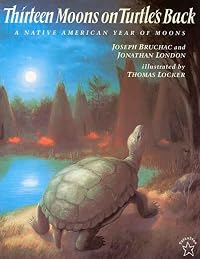
Thirteen Moons on Turtle's Back: A Native American Year of Moons
by Joseph Bruchac (Author), Jonathan London (Author)
On This Page
Description
Celebrates the seasons of the year through poems from the legends of such Native American tribes as the Cherokee, Cree, and Sioux.Tags
Recommendations





Member Reviews
As a fan of Joseph Bruchac, I could go on and on about how amazing I think he and his works are. This picture book is a hybrid genre of both poetry and prose, that tells stories from thirteen different Native American tribes about each of the thirteen moons. Each moon has its own story within a poem and a detailed illustration. These are all different myths which Bruchac and London pieced together so beautifully. These traditional stories are important for all people to read and appreciate. Children need to learn not everyone views how the seasons and months change the same. Native Americans view it quite differently than what is considered the "norm" by popular culture. This book teaches children to respect these differences.
I would show more persoanlly teach this to children of all ages. I actually remember studying this in high school when my class started our unit on poetry because these poems are so beautifully done. This book teaches an appreciation for Native American culture and authors, with Bruchac being one of the most well-known in the industry. It may be considered a "childrens book" but it is so much deeper than that. It offers a connection to a lifetime many of us never experienced. For those who have, it deepens their affection for the natural world and their repsective cultures and upbringings.
Genre: Folklore/Fairytale
Sub-Genre: Picture Book show less
I would show more persoanlly teach this to children of all ages. I actually remember studying this in high school when my class started our unit on poetry because these poems are so beautifully done. This book teaches an appreciation for Native American culture and authors, with Bruchac being one of the most well-known in the industry. It may be considered a "childrens book" but it is so much deeper than that. It offers a connection to a lifetime many of us never experienced. For those who have, it deepens their affection for the natural world and their repsective cultures and upbringings.
Genre: Folklore/Fairytale
Sub-Genre: Picture Book show less
In Thirteen Moons on Turtle's Back, a grandfather tells his grandson why Turtles have 13 circles (or moons) on their shells. I loved reading this book, as the author describes each moon in poem format.
First, I loved how the Folktale referred to Native American culture. Each moon pays tribute to either an animal, plant, or type of season that Native American Tribes nurtured and appreciated. For example, some of the moons include: "Strawberry Moon, Moon of Wild Rice, and Moose Calling Moon. This book's main message is that people should give thanks to the wonderful natural resources of the world.
Second, the author included a few Native American Words. For example, the author writes, "Kway, Sozap....you do well at watching." My only show more complaint is that there is no glossary at the end of the book (so the reader can look up what these phrases actually mean).
And third, I enjoyed the personification of the animals. For example, during the Baby Bear Moon, the author writes, "When we walk by on our snowshoes we will not bother a bear or her babies. Instead we think how those small baby bears are like our children We let them dream together." This stanza personified the Mama Bear as nurturing and loving. Giving animals human traits is part of a long tradition in Native American culture. Participating in this tradition gave this book an authentic feeling. show less
First, I loved how the Folktale referred to Native American culture. Each moon pays tribute to either an animal, plant, or type of season that Native American Tribes nurtured and appreciated. For example, some of the moons include: "Strawberry Moon, Moon of Wild Rice, and Moose Calling Moon. This book's main message is that people should give thanks to the wonderful natural resources of the world.
Second, the author included a few Native American Words. For example, the author writes, "Kway, Sozap....you do well at watching." My only show more complaint is that there is no glossary at the end of the book (so the reader can look up what these phrases actually mean).
And third, I enjoyed the personification of the animals. For example, during the Baby Bear Moon, the author writes, "When we walk by on our snowshoes we will not bother a bear or her babies. Instead we think how those small baby bears are like our children We let them dream together." This stanza personified the Mama Bear as nurturing and loving. Giving animals human traits is part of a long tradition in Native American culture. Participating in this tradition gave this book an authentic feeling. show less
This book is a beautiful way to share Native American legends about the thirteen cycles of the moon and the changing seasons based on the thirteen scales of the turtle's back. It incorporates poems from thirteen tribes' stories that instilled respect for nature, animals, and spirits.
The poems are each from a different tribe of Native Americans, and each poem centers around a different time of year and the seasons. It shows how the Indians think of seasons; it can be informational as to how to Indians tell seasons- from the moons in the sky. I really like this book because the illustrations are magnificent and the poems are very indicative of what time of year it is while also shining light on a particular tribe. The beginning of the book is a little boy talking to his grandfather about he turtle he is carving out of wood, and this sets up the grandfather to be the narrator of the story about the 13 moons on turtles back, which is equal to the number of squares on turtle's shell. This book can be informational, show more while also being quite enjoyable. The poetry is capturing, rhythmic and very descriptive. It makes the reader feel and sense the season that they are writing about, and makes the story very easy to get into. show less
“Thirteen Moons on Turtle’s Back” begins with a tale from Grandfather to a small boy about the many scales on Old Turtle’s back and how they represent the thirteen cycles of the moon in each year. Grandfather’s stories continue with thirteen different stories from thirteen different Native American tribal nations about how each moon represents the changing of nature and the seasons of the year. Each tale includes the wonder of nature and animals to explain events such as why the coyote sings in winter or why maple sugar only flows once a year. The tale of the “Moon of Falling Leaves” tells us why the pine and spruce remain green and the other trees shed their leaves in the autumn. “Moon When Wolves Run Together” is a show more tale where an old wolf tells his people that when it is time for the people to leave the earth they can follow the wolf’s footsteps which have filled the sky with stars. The last story, “Big Moon”, tells how the “People of the Dawn place one final moon” in the sky called Kit-chee Kee-sos, Big Moon. It is the last in the “circle of seasons, thirteen moons on Old Turtle’s back.”
These pourquoi tales demonstrate the Native American’s respect of nature and the amazing stories they told to explain the events of each season. Each tale is represented with a beautiful poem and illustrated on two pages in soft earth-tone hues. Below each poem is the number sequence of the moon represented and the Native American tribe from where the tale originates. Some of the stories are almost romantic while others teach the consequences of our actions such as laziness. I loved these tales and could read them again and again.
In the classroom the book could be used for many purposes. The beautiful tales the Native Americans told could be represented with this book in discussion of their culture and ways of life. The number of moons in a year and how the Native Americans used the moon cycles of 28 days for their calendar would be an extension in a lesson on learning how to read the calendar. Calendars with the cycles of the moon could be provided to the students to teach them the days of the week and the names of the months. The stories about the moon representing that phase could provide an interesting introduction for each calendar month. show less
These pourquoi tales demonstrate the Native American’s respect of nature and the amazing stories they told to explain the events of each season. Each tale is represented with a beautiful poem and illustrated on two pages in soft earth-tone hues. Below each poem is the number sequence of the moon represented and the Native American tribe from where the tale originates. Some of the stories are almost romantic while others teach the consequences of our actions such as laziness. I loved these tales and could read them again and again.
In the classroom the book could be used for many purposes. The beautiful tales the Native Americans told could be represented with this book in discussion of their culture and ways of life. The number of moons in a year and how the Native Americans used the moon cycles of 28 days for their calendar would be an extension in a lesson on learning how to read the calendar. Calendars with the cycles of the moon could be provided to the students to teach them the days of the week and the names of the months. The stories about the moon representing that phase could provide an interesting introduction for each calendar month. show less
Summary: The book opens with an Abenaki storyteller explaining to his grandson that just as there are always 13 scales on ``Old Turtle's back,'' there are 13 moons in a year, each of which has a name and a story and also explains why the Native Americans have 13 months in a year and not 12 months in a year as we do and why these 13 months are important to the Native American history and ancestry/ nations.
Personal Reaction: This book is a great introduction to the Native American concept of the seasons of the year and the close and personal relationship with all of Nature. Although the language and vocabulary a little difficult for young children this is a great read aloud book! The pictures are colorful and great attention keepers. show more
Classroom Extension Ideas: 1. I would make copies of all 13 poems in this book and have each student pick one and read over the poem and write what they think the poem is saying in their own words. 2. I would have the students draw a picture of what they are visualizing while I read a poem from the book to them. show less
Personal Reaction: This book is a great introduction to the Native American concept of the seasons of the year and the close and personal relationship with all of Nature. Although the language and vocabulary a little difficult for young children this is a great read aloud book! The pictures are colorful and great attention keepers. show more
Classroom Extension Ideas: 1. I would make copies of all 13 poems in this book and have each student pick one and read over the poem and write what they think the poem is saying in their own words. 2. I would have the students draw a picture of what they are visualizing while I read a poem from the book to them. show less
Reading Level: Intermediate
Genre: Hybrid (Poetry and Traditional Literature)
Summary: The thirteen scales on the back to the turtle’s back relate to a different moon that helped the Native American people keep track of the months/seasons.
Evaluation: This book teaches students about how Native Americans distinguished their months and seasons and shows them how different it is from the twelve month cycle. Each moon had its own distinct poem that described the moon and the time that it takes place. The poems are beautifully written and the illustrations highlight the poem and bring it to life.
Genre: Hybrid (Poetry and Traditional Literature)
Summary: The thirteen scales on the back to the turtle’s back relate to a different moon that helped the Native American people keep track of the months/seasons.
Evaluation: This book teaches students about how Native Americans distinguished their months and seasons and shows them how different it is from the twelve month cycle. Each moon had its own distinct poem that described the moon and the time that it takes place. The poems are beautifully written and the illustrations highlight the poem and bring it to life.
Members
- Recently Added By
Lists

Youth: Poetry
124 works; 1 member

The Story of the World: History for the Classical Child: Activity Book One
291 works; 3 members

GraceCollection TBR/To Buy List
106 works; 1 member
Author Information

Joseph Bruchac, author of more than seventy books for children and adults, is also an acclaimed storyteller and poet. He has received many prestigious literary awards, including the American Book Award, the PEN Syndicated Fiction Award, and the Lifetime Achievement Award from the Native Writers' Circle of The Americas

Jonathan London was born a "navy-brat" in Brooklyn, New York, and raised on Naval stations throughout the U.S. and Puerto Rico. He received a Masters Degree in Social Sciences but never formally studied literature or creative writing. He began to consider himself a writer about the time he graduated from college. After college he became a dancer show more in a modern dance company and worked at numerous low-paying jobs as a laborer or counselor. He wrote poems and short stories for adults, earning next to nothing despite being published in many literary magazines. For some 20 years before he penned his first children's book, London was writing poetry and short stories for adults. In the early 1970s, he was reading his poems in San Francisco jazz clubs, and those experiences found their way into his witty children's book Hip Cat, which has been featured on the PBS children's television show Reading Rainbow. After writing down the tale The Owl Who Became the Moon in 1989, London began to wonder if other people might want to read it. He picked up his kids' copy of Winnie-the-Pooh and saw that the book was published by Dutton, so he casually decided to send his story to them. Surprisingly enough, they wanted to publish him. Working with different illustrators, and occasionally with co-authors, London has produced literally dozens of books. Most have appeared under his name, but some have come out under a pseudonym, which still remains a secret.He has published over forty books and has earned recognitions from organizations like the National Science Teachers Association. (Bowker Author Biography) show less
All Editions
Awards and Honors
Awards
Notable Lists
Classifications
Statistics
- Members
- 1,149
- Popularity
- 21,946
- Reviews
- 17
- Rating
- (4.24)
- Languages
- English
- Media
- Paper
- ISBNs
- 12
- UPCs
- 1
- ASINs
- 6