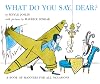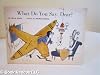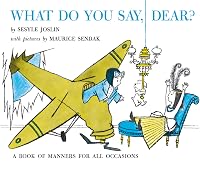
What Do You Say, Dear?
by Sesyle Joslin
On This Page
Description
Offers advice on how to cope correctly with a variety of common and uncommon social situations.Tags
Recommendations









Member Reviews
This book tries to teach manners (no idea if it's successful), and avoids being totally condescending and didactic by putting them all in the case of bizarre, childish make-believe scenarios. What do you say when you're walking backwards to town (because you like to do that) and bump into an alligator? What do you say when you're flying your plane and remember the Duchess asked you to drop in, so you do and break her roof?
It's silliness incarnate, and you have to love it!
There are three scenarios in particular that reviewers have commented on, so let's tackle those.
The first is the "decapitation". In this case you're asked what you say when you're out picking flowers in front of your castle, a dragon appears and breathes smoke at you, show more and then a knight saves you by chopping off its head. (You say thank you.)
There's no blood or anything gory shown, and as far as I'm concerned the princess being saved from the dragon by the knight is a common fairy tale set-up. I don't have a problem with this. There are more violent scenes in both classic and recent Disney animated films, nobody is claiming the dragon was talking and friendly and just violently attacked - I have no problem with this scene for this age group. Let's move on.
The next one is where you are a cowboy. Suddenly the bad guy shows up and holds a gun to your head and asks "Would you like me to shoot a hole in your head?" (You say "no thank you", which strikes me as perfectly sensible.)
This one is a bit trickier. I'll be honest and skip ahead a bit by saying I, personally have no problem with ANY of this book - but in this case I can really see why some people do. The scene is a bit explicit, and the Western is no longer a popular form of drama anyway so it's not like this situation is likely to have come up in your child's play.
However, as nobody actually gets hurt, I'd say most kids won't even notice to be upset. There's more violent scenes on cartoons in the morning.
And the last one that people have complained about is the one where you're a pirate and have captured a lady and tied her up. Every morning when you untie her to eat breakfast she says "Good morning, how are you?" and you are supposed to say the same.
As far as this goes... meh. Clearly nobody is being particularly ill-treated.
Now, overall, I don't mind any of these scenes because I know quite a few children. This sort of thing and more is exactly what they come up with when they're playing pretend. If you think children do not play-act violence you are very much mistaken. They do. They do it because it's exciting. They do it because it's fun to practice being really bad in a safe way that doesn't actually harm anyone, when in real life they work so hard to be GOOD. They do it because these things scare them and playing them makes them less scary. They do because the stories they are exposed to have violence there, explicit or implied, and they want to understand that. They do because you can't have a good story without a villain.
And children have been doing this for as long as there have been children to play pretend at all. I do not believe that this is in any way linked to actual violence when these children grow up.
Obviously if your child is bothered by this sort of pretend violence, don't read them this book. Or if you are. However, truthfully, I don't think it's that big a deal in this context. show less
It's silliness incarnate, and you have to love it!
There are three scenarios in particular that reviewers have commented on, so let's tackle those.
The first is the "decapitation". In this case you're asked what you say when you're out picking flowers in front of your castle, a dragon appears and breathes smoke at you, show more and then a knight saves you by chopping off its head. (You say thank you.)
There's no blood or anything gory shown, and as far as I'm concerned the princess being saved from the dragon by the knight is a common fairy tale set-up. I don't have a problem with this. There are more violent scenes in both classic and recent Disney animated films, nobody is claiming the dragon was talking and friendly and just violently attacked - I have no problem with this scene for this age group. Let's move on.
The next one is where you are a cowboy. Suddenly the bad guy shows up and holds a gun to your head and asks "Would you like me to shoot a hole in your head?" (You say "no thank you", which strikes me as perfectly sensible.)
This one is a bit trickier. I'll be honest and skip ahead a bit by saying I, personally have no problem with ANY of this book - but in this case I can really see why some people do. The scene is a bit explicit, and the Western is no longer a popular form of drama anyway so it's not like this situation is likely to have come up in your child's play.
However, as nobody actually gets hurt, I'd say most kids won't even notice to be upset. There's more violent scenes on cartoons in the morning.
And the last one that people have complained about is the one where you're a pirate and have captured a lady and tied her up. Every morning when you untie her to eat breakfast she says "Good morning, how are you?" and you are supposed to say the same.
As far as this goes... meh. Clearly nobody is being particularly ill-treated.
Now, overall, I don't mind any of these scenes because I know quite a few children. This sort of thing and more is exactly what they come up with when they're playing pretend. If you think children do not play-act violence you are very much mistaken. They do. They do it because it's exciting. They do it because it's fun to practice being really bad in a safe way that doesn't actually harm anyone, when in real life they work so hard to be GOOD. They do it because these things scare them and playing them makes them less scary. They do because the stories they are exposed to have violence there, explicit or implied, and they want to understand that. They do because you can't have a good story without a villain.
And children have been doing this for as long as there have been children to play pretend at all. I do not believe that this is in any way linked to actual violence when these children grow up.
Obviously if your child is bothered by this sort of pretend violence, don't read them this book. Or if you are. However, truthfully, I don't think it's that big a deal in this context. show less
What Do You Say, Dear? A Book of Manners for all Occasions, is a funny and lighthearted way to discuss the importance of being polite with children. I think this book is more appropriate in a home library than the classroom. The wonderful illustrations by Maurice Sendak demonstrate action scenes ranging from one bumping into a crocodile on a city street, being saved by a knight from a fierce dragon and piloting a plane into a duchess’s house for tea.
In each over the top situation, the author asks, “what do you say dear?” The simple but polite answers such as “thank you very much” are hilarious in light of these extreme situations. The absurdity of this book will make a read aloud full of laughter while reiterating the show more importance of manners to children. The pictures, however, are what make the book funny enough to sustain a topic that might otherwise seem heavy handed. show less
In each over the top situation, the author asks, “what do you say dear?” The simple but polite answers such as “thank you very much” are hilarious in light of these extreme situations. The absurdity of this book will make a read aloud full of laughter while reiterating the show more importance of manners to children. The pictures, however, are what make the book funny enough to sustain a topic that might otherwise seem heavy handed. show less
This best book of manners ever illustrates that, even in strange and awkward circumstances, one should always be polite. It even worked with my most recalcitrant of three year olds. The Sendak illustrations are a big part of the book's success.
In today's world we'd never get a children's book published that would ask questions like . . .
"You are a cowboy riding around the range. Suddenly Bad-Nose Bill comes up behind you with a gun. He says, 'Would you like me to shoot a hole in your head?' What do you say, dear?"
That's our loss. . .
In today's world we'd never get a children's book published that would ask questions like . . .
"You are a cowboy riding around the range. Suddenly Bad-Nose Bill comes up behind you with a gun. He says, 'Would you like me to shoot a hole in your head?' What do you say, dear?"
That's our loss. . .
This book teaches/reminds children about proper manners by introducing ridiculous situations and then prompting children for the correct words to speak. For instance:
You have gone downtown to do some shopping. You are walking backwards, because sometimes you like to, and you bump into a crocodile.
What do you say, dear?
Excuse me.
The repeated phrase "What do you say, dear?" (with the response on the following page) invites child readers/listeners to participate in the book and think up the correct answers for the increasingly absurd situations. A couple of the situations suggest violence (a gun appears in one, a kidnapped girl in another), which is my only issue keeping this from being a 5-star book.
The illustrations, in a muted palette show more of blue, gray, black and white, are notable for being the early work of famed author/illustrator Maurice Sendak. show less
You have gone downtown to do some shopping. You are walking backwards, because sometimes you like to, and you bump into a crocodile.
What do you say, dear?
Excuse me.
The repeated phrase "What do you say, dear?" (with the response on the following page) invites child readers/listeners to participate in the book and think up the correct answers for the increasingly absurd situations. A couple of the situations suggest violence (a gun appears in one, a kidnapped girl in another), which is my only issue keeping this from being a 5-star book.
The illustrations, in a muted palette show more of blue, gray, black and white, are notable for being the early work of famed author/illustrator Maurice Sendak. show less
This is yet another book of illustrations that won the Caldecott Honor.
Published in 1958, it is one of Sendak's earlier works.
Using silly situations to discuss the topic of manners, the author and the illustrator working together do not preach, rather they suggest appropriate behavior.
The words Thank you, please, beg your pardon, excuse me and may I please be excused were once a part of our everyday interaction.
Sadly, our social mores of this generation have stretched to rude curtness.
Published in 1958, it is one of Sendak's earlier works.
Using silly situations to discuss the topic of manners, the author and the illustrator working together do not preach, rather they suggest appropriate behavior.
The words Thank you, please, beg your pardon, excuse me and may I please be excused were once a part of our everyday interaction.
Sadly, our social mores of this generation have stretched to rude curtness.
Forgot all about this book until today, when Melissa reminded me of it. I hope it's still in print, because it's hilarious as well as educational.
When prompted by a discussion in the Children's Books group I remembered this from my childhood. Funny. Holds up well except for being just a bit sexist. Find it in your library before they cull it.
Members
- Recently Added By
Lists

Favorite Childhood Books
1,646 works; 514 members

Best children's picture books
377 works; 85 members

Caldecott Honor Books
296 works; 22 members

75 Books for Fall Literacy Block - Dr. Reed
67 works; 2 members

Geek Dad Read to Your Kids Additions List
66 works; 4 members

Books Read in 2015
3,299 works; 127 members

Early Picture Books
467 works; 9 members

Books We Loved As Children
603 works; 252 members
Author Information

33 Works 1,654 Members
All Editions
Awards and Honors
Common Knowledge
- Canonical title*
- Vad säger du då, mitt hjärta?
- Original publication date
- 1958
- Dedication
- This was for
Victoria, Alexandra, Julia, and Awich Hine Buff - First words
- You are downtown and there is a gentleman giving baby elephants to people.
- Last words
- (Click to show. Warning: May contain spoilers.)This is the end. Goodbye.
*Some information comes from Common Knowledge in other languages. Click "Edit" for more information.
Classifications
Statistics
- Members
- 929
- Popularity
- 28,700
- Reviews
- 14
- Rating
- (4.25)
- Languages
- English, French, German, Swedish
- Media
- Paper
- ISBNs
- 15
- ASINs
- 14