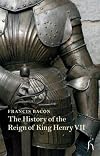
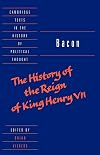
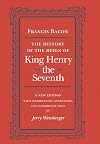
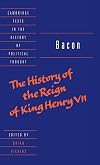
Bacon: The History of the Reign of King Henry VII and Selected Works (Cambridge Texts in the History of Political Thought)
by Francis Bacon
On This Page
Description
This is a major student edition of the text described as 'the first modern classic of English history'. Bacon's penetration into human motives, his life-long experience of politics and government, and his remarkable literary skills, render this History of the Reign of King Henry VII a major work of English literature and an important document in the history of political thought. The introduction places Bacon's History in the context of Renaissance historiography, revealing its debt to show more Tacitus, and shows Bacon's originality in re-ordering traditional material to make a coherent psychological analysis of the King's actions. In addition to the usual series features and supporting contextual material (including relevant Essays by Bacon), generous editorial footnotes explain the historical and political issues of the reign of Henry VII, and a substantial glossary clarifies Bacon's rich but sometimes unfamiliar vocabulary. show lessTags
Recommendations
























Member Reviews
Until the 1920's books and plays in Great Britain had to be submitted for the review of the Lord Chancellor before publication. Bacon had been Lord chancellor until the year before this book was written in 1622. Perhaps Frank was trying to get the job back? It's the official Tudor Party line on Richard III, and is a staple of Richardian Studies. Other than that it's a very modern Biography with some discussion of Henry VII with some warts admitted.
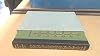
Bacon's History of Henry VII. Provenance: Joachim Freyher von Winghagerwe, Prague und Saxe... 1651
Ratings
Members
- Recently Added By
Author Information

368+ Works 8,279 Members
Francis Bacon was born on January 22, 1561 in London. After studying at Cambridge, Bacon began a legal career, ultimately becoming a barrister in 1582. Bacon continued his political ascent, and became a Member of Parliament in 1584. In 1600, he served as Queen Elizabeth's Learned Counsel in the trial of Robert Devereaux, the Earl of Essex. After show more numerous appointments under James I, Bacon admitted to bribery and fell from power. Much of Bacon's fame stems from the belief by some that he was the actual author of the plays of William Shakespeare. While many critics dismissed that belief, Bacon did write several important works, including a digest of laws, a history of Great Britain, and biographies of the Tudor monarchy, including Henry VII. Bacon was also interested in science and the natural world. His scientific theories are recorded in Novum Organum, published in 1620. Bacon's interest in science ultimately led to his death. After stuffing a fowl with snow to study the effect of cold on the decay of meat, he fell ill, and died of bronchitis on April 9, 1626. (Bowker Author Biography) show less
Series
Belongs to Publisher Series
Common Knowledge
- People/Characters
- Bacon, Francis, 1561-1626
Classifications
- Genres
- History, Nonfiction, Biography & Memoir, General Nonfiction
- DDC/MDS
- 942.05 — History & geography History of Europe England and Wales England 1485-1603, Tudors
- LCC
- DA330 .B12 — History of Europe, Asia, Africa and Oceania Great Britain History of Great Britain England History By period Modern, 1485- Tudors, 1485-1603
- BISAC
Statistics
- Members
- 135
- Popularity
- 242,810
- Reviews
- 2
- Rating
- (3.75)
- Languages
- English, Latin
- Media
- Paper, Ebook
- ISBNs
- 8
- ASINs
- 11