Dickens' Working Notes for His Novels
by Charles Dickens
On This Page
Description
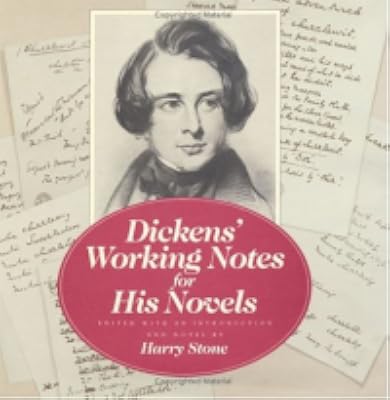
This volume collects for the first time all of Charles Dickens' extant plans and notes for his novels. Dickens wrote his novels in segments during the course of serial publication. Beginning with "Dombey and Son," the sixth novel, he wrote out plans for each segment as he went along, sketching future developments, querying himself about options, noting motifs, establishing recurrent images, working out chronologies, experimenting with names, and, in general, reminding himself of what he had show more done and what he should do next. Some notes survive from before "Dombey" and those for a few novels after that are incomplete or abbreviated, but for the most part the plan from "Dombey" on are full and complete. Each sheet of these notes is reproduced here in actual-size photographic facsimile and is transcribed on the facing page in typographic facsimile, a format that preserves Dickens' holographic nuances and at the same time allows for the instant decipherment of his often difficult hand. Included are his plans for "The Old Curiosity Shop, Martin Chuzzlewit, Dombey and Son, David Copperfield, Bleak House, Hard Times, Little Dorrit, Great Expectations, Our Mutual Friend, "and "Edwin Drood." The volume also contains thirty-three full-page illustrations and a full-color frontispiece. Harry Stone, an internationally recognized Dickens scholar, provides the reader with a full account of Dickens' methods of planning and working. In a comprehensive introduction and extensive notes, he uses Dickens' written plans to illuminate the thought and technique of the novels. He examines creative concerns, such as Dickens' process of naming and visualization, and technical matters, such as his use of various pen nibs, ink colors, and papers. By making fully available and comprehensible Dickens' own cache of in-process plans, possibilities, and alternatives for shaping his novels, "Dickens' Working Notes" offers unparalleled insights into the novelist's art and into the nature of the creative imagination." show lessTags
Member Reviews
Fascinating for a writer (and Dickens lover) to see what he worked from.
Members
- Recently Added By
Author Information

2,578+ Works 313,139 Members
Charles Dickens, perhaps the best British novelist of the Victorian era, was born in Portsmouth, Hampshire, England on February 7, 1812. His happy early childhood was interrupted when his father was sent to debtors' prison, and young Dickens had to go to work in a factory at age twelve. Later, he took jobs as an office boy and journalist before show more publishing essays and stories in the 1830s. His first novel, The Pickwick Papers, made him a famous and popular author at the age of twenty-five. Subsequent works were published serially in periodicals and cemented his reputation as a master of colorful characterization, and as a harsh critic of social evils and corrupt institutions. His many books include Oliver Twist, David Copperfield, Bleak House, Great Expectations, Little Dorrit, A Christmas Carol, and A Tale of Two Cities. Dickens married Catherine Hogarth in 1836, and the couple had nine children before separating in 1858 when he began a long affair with Ellen Ternan, a young actress. Despite the scandal, Dickens remained a public figure, appearing often to read his fiction. He died in 1870, leaving his final novel, The Mystery of Edwin Drood, unfinished. (Bowker Author Biography) show less
Classifications
Statistics
- Members
- 17
- Popularity
- 1,446,290
- Reviews
- 1
- Rating
- (5.00)
- Languages
- English
- Media
- Paper
- ISBNs
- 1