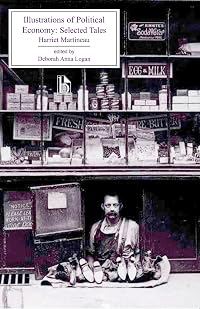
Illustrations of political economy : selected tales
by Harriet Martineau
On This Page
Description
Published in 1832, Illustrations of Political Economyestablished Harriet Martineau as both a successful and controversial author and a pioneer of nineteenth-century "social problem" writing. This widely read series of didactic stories popularized political economy, making it accessible to audiences by vividly dramatizing issues such as overpopulation and labour strikes. Illustrations of Political Economymarks a pivotal moment in which literature and politics came together, laying the show more foundation for the realism and social commentary of later Victorian novels. This Broadview edition contains a critical introduction and a rich selection of historical documents, including contemporary reviews of Illustrationsand writings on population growth, factory conditions, and working-class life. show lessTags
Recommendations
























Members
- Recently Added By
Lists

In Our Time books
4,934 works; 2 members
Author Information

112+ Works 825 Members
Martineau, from a devout and strict Unitarian family in Norwich, was born without the sense either of taste or of smell and, by the age of 12, showed signs of severe deafness. Throughout the early years of her life, she battled poverty and illness. At her mother's insistence, Martineau was educated, at first at home by her brothers and then for a show more short time at school. Because her loss of hearing became worse, she was sent home. Within a space of about three years during the late 1820's, Martineau's favorite brother, Thomas, died; her father lost his fortune and died; and her fiance became insane and died. By 1829, the last of the family money was gone, and she was reduced to helping support her mother and sisters with her needlework. At about this time, she began to review for the Unitarian periodical The Monthly Repository and in 1831 won all three prizes in the magazine's contest for the best essays on the conversion of Catholics, Jews, and Muslims. During 1832-33,she published the tales "Illustrations of Political Economy" and its sequel, "Poor Laws and Paupers," in monthly parts. Despite their pointed didacticism, the works were a tremendous success. Other works of fiction followed. In 1839, she published her first novel, "Deerbrook," and, three years later, her fictionalized biography of Toussaint L'Ouverture, "The Hour and the Man," appeared. Despite her forays into fiction, however, Martineau is better known today for her historical, political, and philosophical writings. Early in her career, she was influenced by the classical economies of David Ricardo and Thomas Malthus. She was friends with Edwin Chadwick and James Kay-Shuttleworth, and acquainted with John Stuart Mill. A strong, often radical proponent of utilitarian reform, early in her career she wrote a number of instructive texts that advocated the same curriculum for men and women. By the mid 1840's, Martineau had completely thrown off her Unitarianism and in 1851, published her antitheological "Laws of Man's Social Nature." Some good work has been done on Martineau's life and writings, especially on the political aspects of her public life. Books on Martineau as a literary artist are scarcer; Deirdre David's "Intellectual Women and Victorian Patriarchy" (1987) contains an excellent discussion of Martineau, and Valerie Sanders's "Reason over Passion" (1986) discusses Martineau as a novelist. One of the most insightful books on Martineau, and one of the most readable, is her own Autobiography (1877). (Bowker Author Biography) show less
Awards and Honors
Notable Lists
Classifications
Statistics
- Members
- 9
- Popularity
- 2,308,943
- Languages
- English
- Media
- Paper
- ISBNs
- 5