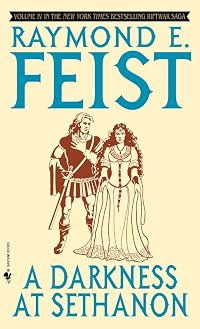
A Darkness at Sethanon
by Raymond E. Feist
The Riftwar Cycle: Publication (Series Blocks) (3), The Riftwar Cycle: Publication (Series Name) (The Riftwar Saga, 3), The Riftwar Cycle, Alternative Reading Order (03 (Riftwar Saga 03)), The Riftwar Saga (3), The Riftwar Cycle: Chronological (07 (Riftwar Saga 03))
On This Page
Description
Fantasy. Fiction. Thriller. HTML:An evil wind blows through Midkemia. Dark legions have risen up to crush the Kingdom of the Isles and enslave it to dire magics. The final battle between Order and Chaos is abotu to begin in the ruins of the city called Sethanon.Now Pug, the master magician sometimes known as Milamber, must undertake an awesome and perilous quest to the dawn of time to grapple with an ancient and terrible Enemy for the fate of a thousand worlds.
Tags
Recommendations



Member Reviews
A solid book to finish off the Riftwar Saga.
Loose ends from the previous books, especially Silverthorn were tied off, and most of the characters received continued development, which was good to see. The set piece battle of Armengar was the highlight for me (as it appears to be for many others), and the reveal of the Enemy was thematically satisfying and made for a good twist. There were definitely moments where it felt like Feist was really coming into his own, and who doesn't love some dragons?
Unfortunately some of my issues from the earlier books continue to affect my judgement of this one. The magic system is still completely obscure, and is further complicated by the different kinds of magics that different characters can wield, show more none of which are properly elucidated. The addition of a time manipulation sequence, though well written, seemed to extend this fantasy element to a whole new level of surreal. And speaking of time, arbitrary amounts of days and weeks continue to abound in this book, though admittedly they are nowhere near the level of Magician.
I've also noticed Feist's penchant for starting chapters or sections with one liners. Often they do work to create the tone or atmosphere that he's after, but they also lose their effectiveness with overuse. Sadly, now that I've seen it, I cannot unsee.
This concluding book has given me enough incentive to give the other Riftwar novels a chance, which I was honestly expecting not to feel after Magician. However, I'll probably be going to something else first. show less
Loose ends from the previous books, especially Silverthorn were tied off, and most of the characters received continued development, which was good to see. The set piece battle of Armengar was the highlight for me (as it appears to be for many others), and the reveal of the Enemy was thematically satisfying and made for a good twist. There were definitely moments where it felt like Feist was really coming into his own, and who doesn't love some dragons?
Unfortunately some of my issues from the earlier books continue to affect my judgement of this one. The magic system is still completely obscure, and is further complicated by the different kinds of magics that different characters can wield, show more none of which are properly elucidated. The addition of a time manipulation sequence, though well written, seemed to extend this fantasy element to a whole new level of surreal. And speaking of time, arbitrary amounts of days and weeks continue to abound in this book, though admittedly they are nowhere near the level of Magician.
I've also noticed Feist's penchant for starting chapters or sections with one liners. Often they do work to create the tone or atmosphere that he's after, but they also lose their effectiveness with overuse. Sadly, now that I've seen it, I cannot unsee.
This concluding book has given me enough incentive to give the other Riftwar novels a chance, which I was honestly expecting not to feel after Magician. However, I'll probably be going to something else first. show less
The Riftwar saga is the introduciton to Feist's worlds of imagination, but until this book really is laboring under its heritage as his homebrew DND world.
In this book, Feist finally throws the doors to his cosmology wide open as an author, and it is a banger. I find Prince Arutha and Jimmy the Hand less than inspiring, but Pug and Macros the Black and the final answer to what Tomas is was worth the wait. As was the answer to the Chaos Wars and the Great Enemy. Well worth the series to get to this ending.
In this book, Feist finally throws the doors to his cosmology wide open as an author, and it is a banger. I find Prince Arutha and Jimmy the Hand less than inspiring, but Pug and Macros the Black and the final answer to what Tomas is was worth the wait. As was the answer to the Chaos Wars and the Great Enemy. Well worth the series to get to this ending.
I have not read the Riftwar Saga books under ideal conditions. I read the different books years apart, and this book I read at bedtime, often while drowsy. I have only a loose grasp of the lore, magic, and gods of this universe, but what little I can penetrate I have to say I am not impressed. The basic problem with Feist is that his characters trip over themselves to make clear they are "good guys" or "bad guys" (and let's be clear here: it's all guys; the female character we spend the most time with is a dragon that two male heroes use to ride through the cosmos). Yes there is a villain-turned-hero here, but even he falls prey to Feist's simplistic characterizations. On top of this issue, there is the problem of narrative pacing; this show more novel is all lead up to a climatic battle that takes place in one chapter; there is little tension and the stakes and challenges the character face are not that clear. show less
A Darkness at Sethanon is the final book in the Riftwar Saga, the first subseries in Raymond E. Feist’s Riftwar Cycle.
Like the previous books, this was a good story that held my interest all the way through. I didn’t enjoy it quite as well as the previous books, though. It seemed like there was less of the fun banter that I’ve enjoyed so much in previous books, although there were still some great moments. Also, although this book wrapped the story up pretty well, I had some complaints about how that was done. I still enjoyed this book a lot, but I think there are some things that I’ve just become pickier about now that I have more epic fantasy under my belt.
I’ll elaborate on my above comments a bit behind the spoiler tags:
I show more felt like the Pug and Tomas storyline was a bit over the top, and those were the only parts where my interest wavered. Fortunately, they were only a small portion of the book. It just seemed like we were piling one “big thing” after another. Yes, it’s definitely high time we got an oracle involved. Oh, and what good fantasy story doesn’t involve a visit to the Halls of the Dead? Ah, yes, a nice long hallway with portals to tons of different worlds would be a cool thing to add. And I’m skipping a few. Each place they went to was supposedly more amazingly difficult to get to than the last. Tomas and Pug also seemed to possess/gain overly-strong powers, with Tomas’ in particular seeming to come out of nowhere with some nebulous explanation that the existence of the Valheru gave him more powers that he no longer had at the end of the book when they had been defeated. Oh, and the amulet Arutha wore that protected him from being located by Murmandamus? Yes, it’s totally logical that this amulet would be used to convert his sword into something that could deflect magical energy and harm magical/supernatural beings.
I was much more invested in the more down-to-earth parts – the almost-assassination of Arutha, faking his death, seeking out Murmandamus, the huge battle at Armengar, the race for Sethanon, etc. That made it doubly frustrating to me that most of those actions didn’t really amount to much, or else they helped the enemy in the end. For example, the battle at Armengar where they managed to kill so many of the invaders only served to strengthen Murmandamus since he fed off the deaths of both friend and foe. Arutha’s battle with Murmandamus didn’t really accomplish anything, and even Pug’s and Kulgan’s attempt to keep the rifts closed and Tomas’ fight with the Valheru only staved off the destruction. The real “hero” was the lifestone, or possibly the gods, that somehow destroyed the Valheru in some inexplicable way. We don’t even know if Tomas’ sword in the lifestone affected anything or if it was just a coincidence. I just wanted to see my heroes’ actions and suffering amount to more after spending all that time reading about it.
Despite some of my sarcasm, I really did enjoy most of the story, and I love the characters, but I also have to admit that there are some issues. The things I do love make up for it though, and I’m sure the nostalgia factor is playing a role. show less
Like the previous books, this was a good story that held my interest all the way through. I didn’t enjoy it quite as well as the previous books, though. It seemed like there was less of the fun banter that I’ve enjoyed so much in previous books, although there were still some great moments. Also, although this book wrapped the story up pretty well, I had some complaints about how that was done. I still enjoyed this book a lot, but I think there are some things that I’ve just become pickier about now that I have more epic fantasy under my belt.
I’ll elaborate on my above comments a bit behind the spoiler tags:
I was much more invested in the more down-to-earth parts – the almost-assassination of Arutha, faking his death, seeking out Murmandamus, the huge battle at Armengar, the race for Sethanon, etc. That made it doubly frustrating to me that most of those actions didn’t really amount to much, or else they helped the enemy in the end. For example, the battle at Armengar where they managed to kill so many of the invaders only served to strengthen Murmandamus since he fed off the deaths of both friend and foe. Arutha’s battle with Murmandamus didn’t really accomplish anything, and even Pug’s and Kulgan’s attempt to keep the rifts closed and Tomas’ fight with the Valheru only staved off the destruction. The real “hero” was the lifestone, or possibly the gods, that somehow destroyed the Valheru in some inexplicable way. We don’t even know if Tomas’ sword in the lifestone affected anything or if it was just a coincidence. I just wanted to see my heroes’ actions and suffering amount to more after spending all that time reading about it.
Despite some of my sarcasm, I really did enjoy most of the story, and I love the characters, but I also have to admit that there are some issues. The things I do love make up for it though, and I’m sure the nostalgia factor is playing a role.
Well, at least the series came to an epic conclusion. Pacing continued to be uneven, so reading speed varied. Likable characters were only weakly redeemed, but one villain had a good redemption arc. There's just not that much tension because you know there's going to be happy ending. Not planning on reading more by Feist.
Enjoyed it. Its still not great writing, and it’s more something I’d recommend as a lighter read to someone who is already a fan of fantasy and has read the classics. For those people, it’s an enjoyable conclusion to what, apparently, is the first of many series in this universe.
The biggest issue with the series is that the writing is limited by the fact that the author likes his characters too much. Everyone is saved from certain doom (except undeveloped characters - they basically always die or disappear within half a book of being introduced), every relationship works out just the way it “should,” every old enemy turns out to be either totally evil (and is vanquished) or just misunderstood (and becomes a great friend), and show more the main characters always have enough money and titles to reward everyone for their help at the end of the book.
That said, it takes some confidence to write a fantasy book that features characters watching the big bang happen, so kudos for that. show less
The biggest issue with the series is that the writing is limited by the fact that the author likes his characters too much. Everyone is saved from certain doom (except undeveloped characters - they basically always die or disappear within half a book of being introduced), every relationship works out just the way it “should,” every old enemy turns out to be either totally evil (and is vanquished) or just misunderstood (and becomes a great friend), and show more the main characters always have enough money and titles to reward everyone for their help at the end of the book.
That said, it takes some confidence to write a fantasy book that features characters watching the big bang happen, so kudos for that. show less
I'm so glad I squeezed it in for the end of the year. :) Reading A Darkness at Sethanon again after so many years and having loved the series BOTH times, I feel kind of sad having finished it. I could keep going forever.
Fortunately, I might be able to. Feist has kept writing since I finished these the first time. :) :)
We see a lot more of the dragons, Pug, and Thomas in this one. But let's not forget about Jimmy the Hand! Martin Longbow! Getting to know past enemies and butting heads with new is just as good now as then!
I think I forgot about all the twisty timey-wimey multiversal adventures! Riding a dragon, going to the halls of the dead, defeating the eater of worlds... but above all, it's seeing all the changes in ALL the show more characters. So much happens, so much intrigue, so much mind-blowing BIGNESS. It's something I'm used to in SF but generally, don't see all that much of in Fantasy... but it's perfectly suited to it. :)
All told, I'm very, very happy to be getting back into Feist. Now I can catch up with ALL the books I've been missing. *rubs hands together hungrily* show less
Fortunately, I might be able to. Feist has kept writing since I finished these the first time. :) :)
We see a lot more of the dragons, Pug, and Thomas in this one. But let's not forget about Jimmy the Hand! Martin Longbow! Getting to know past enemies and butting heads with new is just as good now as then!
I think I forgot about all the twisty timey-wimey multiversal adventures! Riding a dragon, going to the halls of the dead, defeating the eater of worlds... but above all, it's seeing all the changes in ALL the show more characters. So much happens, so much intrigue, so much mind-blowing BIGNESS. It's something I'm used to in SF but generally, don't see all that much of in Fantasy... but it's perfectly suited to it. :)
All told, I'm very, very happy to be getting back into Feist. Now I can catch up with ALL the books I've been missing. *rubs hands together hungrily* show less
Members
- Recently Added By
Lists

Best Fantasy Novels
821 works; 361 members

NPRs your picks: top 100 Sci-Fi/Fantasy books
297 works; 80 members
Favourite High Fantasy Books
113 works; 23 members
Author Information

157+ Works 96,702 Members
Fantasy writer Raymond E. Feist was born in Southern California. He received a B.A. in Communication Arts with honors from the University of California at San Diego in 1977. His first novel, Magician, published in 1982 is the first book of The Riftwar Saga. His other series include The Serpentwar Saga, The Empire Trilogy, The Riftwar Legacy, show more Krondor's Sons, Legends of the Riftwar, Conclave of Shadows, Darkwar Saga, Chaoswar Saga, Demonwar Saga, and The Firemane Saga. Feist's work appears regularly on the bestseller lists of The New York Times and The Times of London. He has also worked with Sierra Studios and PyroTechnix to produce a role-playing game. (Bowker Author Biography) show less
Some Editions
Series

The Riftwar Cycle: Publication (Series Blocks)
30 works (3)

The Riftwar Cycle: Publication (Series Name)
31 works (The Riftwar Saga, 3)

The Riftwar Cycle, Alternative Reading Order
33 works (03 (Riftwar Saga 03))

The Riftwar Saga
3 works (3)

The Riftwar Cycle: Chronological
32 works (07 (Riftwar Saga 03))
Belongs to Publisher Series
Narrativa [Nord] (44)
TEAdue [TEA] (1503)
Work Relationships
Is contained in
Contains
Has as a student's study guide
Common Knowledge
- Canonical title
- A Darkness at Sethanon
- Original title
- A Darkness at Sethanon
- Original publication date
- 1986-03
- People/Characters
- Murmandamus; Pug; Tomas / Ashen-Shugar; Arutha conDoin; Guy du Bas-Tyra; Macros the Black (show all 7); Jimmy the Hand
- Important places
- Midkemia; Krondor, Kingdom of the Isles, Midkemia; Sethanon
- Epigraph*
- Ziet! De Dood heeft zich een troon gebouwd. In een vreemde stad - Poe - De stad in de Zee
- Dedication
- This book is dedicated to my mother, Barbara A. Feist, who never doubted for a moment
- First words
- The wind came from nowhere.
- Last words
- (Click to show. Warning: May contain spoilers.)Amos fell back heavily on the bunk. "Ah, Arutha, you still take all the fun out of life."
- Original language*
- Englisch
*Some information comes from Common Knowledge in other languages. Click "Edit" for more information.
Classifications
Statistics
- Members
- 6,268
- Popularity
- 1,978
- Reviews
- 52
- Rating
- (3.89)
- Languages
- 13 — Czech, Dutch, English, French, German, Greek, Hungarian, Italian, Portuguese, Russian, Serbian, Spanish, Turkish
- Media
- Paper, Audiobook, Ebook
- ISBNs
- 49
- ASINs
- 37