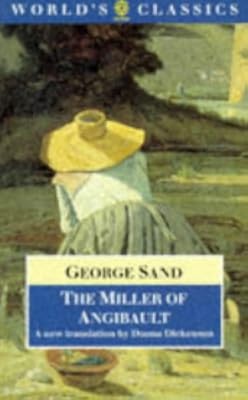
The Miller of Angibault (Oxford World's Classics)
by George Sand
On This Page
Description
The Miller of Angibault (1845) is George Sand's `arch-socialist' novel, according to the writer herself. Rejected by its original publisher as too violent an attack on property, it actually satirizes the utopian ideals of Paris reformers who try to put their naive plans into action among the country folk of Sand's native Berry. The Miller of Angibault reflects both the ebullient political movements of its period and the despairing conviction that the Revolution of 1789 had changed nothing. show more This is a new translation which fully captures Sand's self-effacing humour and gentle lyricism. show lessTags
Recommendations






































Member Reviews
Not a particularly enthralling read: recently widowed Marcelle de Blanchemont, along with her young son, goes to live in her country estate - and finds herself much less well off than expected. She is befriended by a good natured miller, and also meets the unpleasant, grasping Bricolin family - farmers who won't let their daughter marry the miller.
Marcelle too has a love interest- Henri Lemor, who she hopes to marry once her period of mourning is up. But unlike the miller, held back by being too poor, Marcelle's lover is reluctant to marry her because of her wealth:
'I adore this woman, this angel, but I could never be the husband of a wealthy woman...And then I would have certain scruples in condemning to poverty a woman for whom I feel show more an infinite tenderness...This child, this woman, they do not belong to our race...They are the dethroned masters of the earth, and they would demand of their former slaves the treatment and affectations to which they are accustomed.'
There's a very neat ending, with the help of a madwoman and a local tramp. Marcelle and the miller are a little too calm and virtuous to fully engage one's sympathies. show less
Marcelle too has a love interest- Henri Lemor, who she hopes to marry once her period of mourning is up. But unlike the miller, held back by being too poor, Marcelle's lover is reluctant to marry her because of her wealth:
'I adore this woman, this angel, but I could never be the husband of a wealthy woman...And then I would have certain scruples in condemning to poverty a woman for whom I feel show more an infinite tenderness...This child, this woman, they do not belong to our race...They are the dethroned masters of the earth, and they would demand of their former slaves the treatment and affectations to which they are accustomed.'
There's a very neat ending, with the help of a madwoman and a local tramp. Marcelle and the miller are a little too calm and virtuous to fully engage one's sympathies. show less
Ratings
Members
- Recently Added By
Lists

French Fiction of the 18th and 19th Centuries in English Translation
169 works; 3 members
Author Information

457+ Works 6,471 Members
George Sand began life as Aurore Dupin, the daughter of a count and a dressmaker. Educated both on her aristocratic grandmother's estate and in a Parisian convent, at 18 she married Casimer Dudevant, a provincial gentleman whose rough temperament was the opposite of her own, and from whom she obtained a separation several years later. At 31 she show more moved to Paris, where she changed her name and plunged into the bohemian world of French romanticism. Frequently dressed in men's clothing, she participated actively in literary debates, cultural events, and even the revolution of 1848. Sand was friend and correspondent with many of the major artists and writers of her age, including Balzac, Flaubert, and Liszt. Her love affairs with the poet Musset and the composer Chopin were the stuff of legend, chronicled in her own Story of My Life. Sand's immensely popular novels ranged from sentimental stories of wronged women, to utopian socialist fictions, such as her masterpiece in Consuelo, 1842, to explorations of pastoral themes written when she retired, late in life, to her estate in Berry. Though frequently dismissed as overblown or too sentimental, Sand's fiction has recently undergone a revaluation, emerging as an influential body of women's writing. As both a writer and an intellectual personality, Sand is a central figure in nineteenth-century French cultural life. George Sand died in 1876 (Bowker Author Biography) show less
Some Editions
Common Knowledge
- Original title
- Le Meunier d'Angibault
- Original publication date
- 1845
- People/Characters
- Marcelle de Blanchemont; Henri Lemor; Rose Bricolin; Grand-Louis
- Important places
- Angibault (Berry)
- Dedication
- To Solange
My child, let us search together. - First words
- The bell of St Thomas Aquinas church was just sounding one o'clock in the morning, as a slight, swift black shape slipped along the looming wall of one of those fine gardens that are still found in Paris on the left bank of t... (show all)he Seine, and which are worth so much in the middle of a capital city.
- Last words
- (Click to show. Warning: May contain spoilers.)'Why are you dancing like that, Alochon?' asked Edouard.
'Because, child', laughed the miller, lifting him up, 'when I cast my nets, in the brightest part of the water I caught a little angel who'll bring me happiness; and in the muddiest bit, an old devil of an uncle, whom perhaps I can ransom from purgatory!'
Classifications
Statistics
- Members
- 59
- Popularity
- 508,856
- Reviews
- 1
- Rating
- (3.08)
- Languages
- English, Estonian, French, German
- Media
- Paper, Ebook
- ISBNs
- 14
- ASINs
- 1