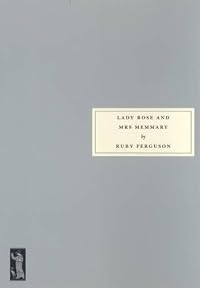
Lady Rose and Mrs Memmary
by Ruby Ferguson
On This Page
Description
The Countess of Lochlule marries Sir Hector, owner of the estate next to 'Keepsfield', the palatial Scottish mansion where she lives. But one day she meets someone on a park bench in Edinburgh. This novel is about dreams and the hard world of money and position and their relations to one another.Tags
Recommendations










Member Reviews
A dual timeline book, partly set in the "present" (the 1930s) and partly in the late 19th century, which recounts the life of a Scottish noblewoman and the great estate she inherits. It's a quick read and there are some descriptive passages which are a nice pastiche of the kinds of Victorian sentimental romances that Lady Rose and Mrs Memmary is echoing. But it's a little like drinking a cup of tea that's had a spoonful too much of sugar added to it.
25 Dec 2010 - from Jen
A charming book, in which we spend a day in the company of Mrs Memmary, along with some casual visitors, at Keepsfield, a great Scottish house, hearing the story of Lady Rose, who grew up here and was given the house by Queen Victoria as an only daughter who wouldn't otherwise have inherited it. I grasped the central conceit early on, but it didn't spoil my enjoyment of the book. It was moving, affecting, and steeped in the characters' love of Scotland and its history; a fairytale story, set apart from, but irrevocably linked into, real life (just as Charles Kingsley's stories are - he is introduced cleverly into the narrative), with all its customs and tragedies. Some of the enthusiasms of the main character and show more the beautifully-drawn children do recall Ferguson as a favourite pony writer; otherwise you wouldn't know this was by her. A lovely read. show less
A charming book, in which we spend a day in the company of Mrs Memmary, along with some casual visitors, at Keepsfield, a great Scottish house, hearing the story of Lady Rose, who grew up here and was given the house by Queen Victoria as an only daughter who wouldn't otherwise have inherited it. I grasped the central conceit early on, but it didn't spoil my enjoyment of the book. It was moving, affecting, and steeped in the characters' love of Scotland and its history; a fairytale story, set apart from, but irrevocably linked into, real life (just as Charles Kingsley's stories are - he is introduced cleverly into the narrative), with all its customs and tragedies. Some of the enthusiasms of the main character and show more the beautifully-drawn children do recall Ferguson as a favourite pony writer; otherwise you wouldn't know this was by her. A lovely read. show less
Lady Rose and Mrs Memmary is a tribute to 19th-century Scotland. First published in 1937, it was reissued in 2004 as Persephone Books #53, with the usual classic endpaper. It's a simple story, a comfort read, told by the elderly Mrs Memmary, caretaker of the once magnificent, now crumbling, Keepsfield estate owned by the Countess of Lochlule. The setup involves a group of tourists who stumble upon Keepsfield, now available to let as a holiday home. One of the women falls into conversation with Mrs Memmary, encouraging her to talk about the estate and the family that once lived there. Mrs Memmary is somewhat reticent, but tells her about the day Rose, the current Countess, turned six. The woman asks more questions, which leads Mrs show more Memmary to relate more chapters in Rose's life. The reader can imagine Mrs Memmary and the woman spending a couple of hours over a cup of tea, while the rest of the tourists explore the estate.
Lady Rose grew up in a very privileged environment, never wanting for material possessions but also, as was typical of wealthy society at the time, distant from her parents. She sees Scotland as superior to England and, really, anyplace else, as does everyone around her:
"So I shall take your hand, child, and turn you to the sea -- like this -- and I shall say to you, read, and fill your mind with the wonderful history of Scotland; look, and fill your eyes with the glorious beauty of Scotland; dream, and fill your soul with the poetry and romance of Scotland; and let the love of your country be always in your heart, Lady Rose." (p. 51)
Rose attended an English boarding school and, at eighteen, made her debut and became engaged to a Scottish nobleman. She fulfilled her duty as an heiress and wife, but here her story departs from the expected norm, and Rose turns out to be a surprisingly strong character. She acts rather impulsively on her convictions, resulting in irrevocable change that, as these things do, has profound positive and negative consequences that make for interesting plot twists. You will have to read to learn more.
Lady Rose and Mrs Memmary is aptly described by Persephone Books as "a fairy tale for grown-ups," with the simple prose I would associate with other fairy tales. Each of Mrs Memmary's flashbacks are introduced in a way that reminded me of old movies. Can't you just imagine this bit on screen?
So old Time seized his book and began to turn back the pages, ten, twenty at a time -- more than seventy pages of yellow leaves. Through them all the great white house gleamed whiter, and soon the Greek girl at the fountain was laughing as the waters of a bygone day gushed over her reaching fingers. (p.21)
This book didn't exactly bowl me over, but it was an interesting representative of a literary period and a pleasant diversion. show less
Lady Rose grew up in a very privileged environment, never wanting for material possessions but also, as was typical of wealthy society at the time, distant from her parents. She sees Scotland as superior to England and, really, anyplace else, as does everyone around her:
"So I shall take your hand, child, and turn you to the sea -- like this -- and I shall say to you, read, and fill your mind with the wonderful history of Scotland; look, and fill your eyes with the glorious beauty of Scotland; dream, and fill your soul with the poetry and romance of Scotland; and let the love of your country be always in your heart, Lady Rose." (p. 51)
Rose attended an English boarding school and, at eighteen, made her debut and became engaged to a Scottish nobleman. She fulfilled her duty as an heiress and wife, but here her story departs from the expected norm, and Rose turns out to be a surprisingly strong character. She acts rather impulsively on her convictions, resulting in irrevocable change that, as these things do, has profound positive and negative consequences that make for interesting plot twists. You will have to read to learn more.
Lady Rose and Mrs Memmary is aptly described by Persephone Books as "a fairy tale for grown-ups," with the simple prose I would associate with other fairy tales. Each of Mrs Memmary's flashbacks are introduced in a way that reminded me of old movies. Can't you just imagine this bit on screen?
So old Time seized his book and began to turn back the pages, ten, twenty at a time -- more than seventy pages of yellow leaves. Through them all the great white house gleamed whiter, and soon the Greek girl at the fountain was laughing as the waters of a bygone day gushed over her reaching fingers. (p.21)
This book didn't exactly bowl me over, but it was an interesting representative of a literary period and a pleasant diversion. show less
Three daytrippers in 1930s Scotland stop off at a stately home and are shown around by the housekeeper. She relates the story of the owner, Lady Rose- now an old lady, but brought up here.
From an idyllic childhood to growing up...doing the "season" and finding a husband...Lady Rose's magical early years give way to a tense marriage , children...and finally expulsion from "society".
Quite a magical and charming read- I remember seeing it was the Queen Mother's favourite book, and one could picture young Rose as something like Elizabeth Bowes-Lyon..
From an idyllic childhood to growing up...doing the "season" and finding a husband...Lady Rose's magical early years give way to a tense marriage , children...and finally expulsion from "society".
Quite a magical and charming read- I remember seeing it was the Queen Mother's favourite book, and one could picture young Rose as something like Elizabeth Bowes-Lyon..
One day, three tourists are given a tour of Keepsfield, a rambling, palatial estate in Scotland, and the home of the absent Lady Rose, Countess of Lochlule. The tour is given by the housekeeper, Mrs. Memmary, who tells the story of Lady Rose in snippets, from her childhood to early adulthood. This is a very sweet romance and a tale of how one woman manages to find happiness—first doing what is expected of her and then finding happiness in the most unexpected place. There’s even a fun little twist at the end of this short novel, which is both sweet and heartbreaking at the same time.
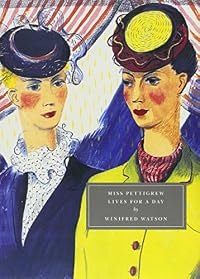
I generally love the books that Persephone have reprinted (there have bee one or two exceptions), and this is one of them, very similar to, as the show more Persephone website suggests, Miss Pettigrew Lives for a Day. At times this book has a very Cinderella-esque feel to it; there’s even a fairy godmother in the guise of an elderly aunt (and, to some extent, a spinster friend of Lady Rose’s, who is absolutely miserable despite having the freedom to do whatever she wants). While she’s married to Sir Hector, Lady Rose describes herself as happy; but is she really? In a sense, this novel is about the search for happiness, and the lengths that some people will go to in order to achieve it. It helps that Lady Rose—and the present-day Helen Dacre—are both romantics; it’s through Helen that we get to see the story as it’s meant to be. show less
I generally love the books that Persephone have reprinted (there have bee one or two exceptions), and this is one of them, very similar to, as the show more Persephone website suggests, Miss Pettigrew Lives for a Day. At times this book has a very Cinderella-esque feel to it; there’s even a fairy godmother in the guise of an elderly aunt (and, to some extent, a spinster friend of Lady Rose’s, who is absolutely miserable despite having the freedom to do whatever she wants). While she’s married to Sir Hector, Lady Rose describes herself as happy; but is she really? In a sense, this novel is about the search for happiness, and the lengths that some people will go to in order to achieve it. It helps that Lady Rose—and the present-day Helen Dacre—are both romantics; it’s through Helen that we get to see the story as it’s meant to be. show less
This was perfect reading for a quiet Sunday afternoon. Persephone 53 is a charming grown up fairy tale. Lady Rose is a romantic, and she carries that romantism all her life, and it is this which shapes her destiny. This simple little novel also highlights quite tragically how inflexible and unforgiving was Victorian high society. This is also a novel about Scotland, Lady Rose is a proud and patriotoc Scot - and the novel allows us a teasing glimpse of some of the beauties of Scotland before the modern world came along and trampled all over them.
It's a quick read and perfect if you're in the mood for something sentimental and sweet. The author does a great job of drawing one into this Scottish fairytale. A sweetnatured caretaker describes to three tourists, who are visiting the beautiful estate of Keepsfield, the life of the countess who owns it. She tells stories from the countess' early life to young adulthood. Very good!
Members
- Recently Added By
Lists

Books Read in 2019
4,052 works; 108 members

Persephone
148 works; 3 members
Author Information

36+ Works 1,334 Members
Some Editions
Series
Belongs to Publisher Series
Persephone (53)
Common Knowledge
- Canonical title
- Lady Rose and Mrs Memmary
- Original publication date
- 1937
- People/Characters
- Helen Dacre; Mr Dacre; Mr Van Elsen; Lady Rose Grahame-Rooth-Targenet
- Important places
- Edinburgh, Scotland, UK; London, England, UK
- First words
- "May we go up and see the house?"
- Last words
- (Click to show. Warning: May contain spoilers.)But Lady Rose had gone so far away that even her childhood's name could not call her back to earth again.
Classifications
Statistics
- Members
- 237
- Popularity
- 136,826
- Reviews
- 9
- Rating
- (3.86)
- Languages
- English
- Media
- Paper, Ebook
- ISBNs
- 2
- ASINs
- 6