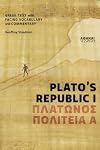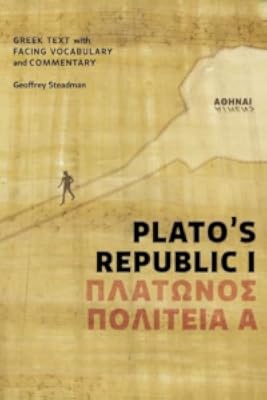
The Republic, Book 1 of 10 [Greek text]
by Plato
67 Members (3.50)
On This Page
Description
Plato's Republic is a central text in the Western philosophical tradition and also a specimen of its author's exceptional literary and dramatic skill. The first book introduces, and conspicuously fails to answer, the question: What is justice? It also introduces the sophist Thrasymachus, who is quite certain that he knows what justice is, namely that it is nothing other than what the dominant power in the state considers to be in its own interest. The contentious confrontation between show more Thrasymachus and Socrates sets the stage for Plato's controversial construction of an ideal state in which the true nature of justice will be revealed. The Commentary draws attention to the way Plato anticipates developments in later books, thus serving as an introduction to Republic as a whole. Particular attention is paid to Plato's language and style, so that students of Greek literature as well as philosophy are well served. show lessTags
Recommendations




Member Reviews
Members
- Recently Added By
Author Information

Plato was born c. 427 B.C. in Athens, Greece, to an aristocratic family very much involved in political government. Pericles, famous ruler of Athens during its golden age, was Plato's stepfather. Plato was well educated and studied under Socrates, with whom he developed a close friendship. When Socrates was publically executed in 399 B.C., Plato show more finally distanced himself from a career in Athenian politics, instead becoming one of the greatest philosophers of Western civilization. Plato extended Socrates's inquiries to his students, one of the most famous being Aristotle. Plato's The Republic is an enduring work, discussing justice, the importance of education, and the qualities needed for rulers to succeed. Plato felt governors must be philosophers so they may govern wisely and effectively. Plato founded the Academy, an educational institution dedicated to pursuing philosophic truth. The Academy lasted well into the 6th century A.D., and is the model for all western universities. Its formation is along the lines Plato laid out in The Republic. Many of Plato's essays and writings survive to this day. Plato died in 347 B.C. at the age of 80. (Bowker Author Biography) show less
Some Editions
Series
Belongs to Publisher Series
Common Knowledge
- Canonical title
- The Republic, Book 1 of 10 [Greek text]
Classifications
- Genres
- Philosophy, Nonfiction, Politics and Government
- DDC/MDS
- 321.07 — Society, government, & culture Political science Systems of governments and states Political Systems Ideal state; Utopias
- LCC
- PA4279 — Language and Literature Greek language and literature. Latin language and literature Greek literature Individual authors Plato
- BISAC
Statistics
- Members
- 67
- Popularity
- 464,773
- Rating
- (3.50)
- Languages
- English, Greek (Ancient)
- Media
- Paper
- ISBNs
- 3
- ASINs
- 2