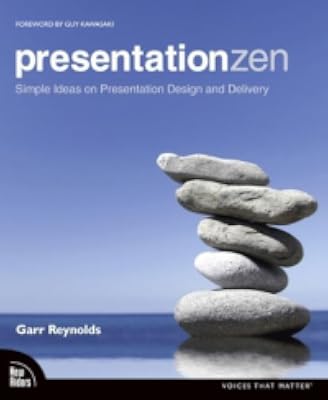
Presentation Zen: Simple Ideas on Presentation Design and Delivery
by Garr Reynolds
On This Page
Description
Provides lessons to help users design and deliver creative presentations using Microsoft PowerPoint.Tags
Recommendations




Member Reviews
PowerPoint has always enabled people who are basically thick and dull to look clever.
Of course it’s boring - would you hold up cue cards to an audience and then READ THE SAME CUE CARDS - no? So why does a digital projector and PowerPoint make it a good idea?
But PowerPoint is worse than that - with PowerPoint you can put a buzzword next to a graph - next to a picture and with a swish fade effect and for some bizarre reason that makes the buzzword important.
People say - 'don't read the words on the slide'
Well, why HAVE the bloody slide then?
Does the slide say something MORE IMPORTANT than what you are saying? If it does well.. why aren't you just saying it?
In fact if what you are saying can be said just as well on a slide show, why show more bother turning up at all? Just press play and go home.
We HAVE a system of text and images that conveys information – it’s called the internet. It way better than PowerPoint and I don't need anyone talking over it while I look at it.
Death to PowerPoint.
Death to seminars.
Death to people who wear those clip microphones.
Bring back good speakers who can keep you interested and answer questions as they go along.
Powerpoint no more makes someone a presenter than having a typewriter makes them a novelist. But many people fail to notice that. I have sat through far too many dull presentations in my time, and succeeded in staying awake during some only by gnawing on my own wrist. show less
Of course it’s boring - would you hold up cue cards to an audience and then READ THE SAME CUE CARDS - no? So why does a digital projector and PowerPoint make it a good idea?
But PowerPoint is worse than that - with PowerPoint you can put a buzzword next to a graph - next to a picture and with a swish fade effect and for some bizarre reason that makes the buzzword important.
People say - 'don't read the words on the slide'
Well, why HAVE the bloody slide then?
Does the slide say something MORE IMPORTANT than what you are saying? If it does well.. why aren't you just saying it?
In fact if what you are saying can be said just as well on a slide show, why show more bother turning up at all? Just press play and go home.
We HAVE a system of text and images that conveys information – it’s called the internet. It way better than PowerPoint and I don't need anyone talking over it while I look at it.
Death to PowerPoint.
Death to seminars.
Death to people who wear those clip microphones.
Bring back good speakers who can keep you interested and answer questions as they go along.
Powerpoint no more makes someone a presenter than having a typewriter makes them a novelist. But many people fail to notice that. I have sat through far too many dull presentations in my time, and succeeded in staying awake during some only by gnawing on my own wrist. show less
In a world committed to effective training-teaching-learning, publication of Garr Reynolds' beautifully produced and engagingly written book "Presentation Zen: Simple Ideas on Presentation Design and Delivery" three years ago would have resulted in the disappearance of "death by PowerPoint." The world seems to have other ideas. We still suffer through poorly designed PowerPoint presentations, where far too much text is crammed onto slides that are then read to painfully bored and tuned-out learners. Which is a shame since so much of what Reynolds suggests and displays throughout his book and on his ongoing Presentation Zen website makes so much sense and is so easy to incorporate into our work. "PowerPoint is not a method," he show more reminds us early in the book; "it is a tool that can be used effectively with appropriate design methods or ineffectively with inappropriate methods" (p. 12). Clarity and simplicity are the overarching themes he encourages us to explore and incorporate into our work. And if we needed proof that Reynolds cares as deeply about his audiences as we should care about ours, we find it explicitly in his admonition that "If your content is worth talking about, then bring energy and passion to your delivery. Every situation is different, but there is never an excuse for being dull" (p. 211). So let's hope his work continues to reach an ever-widening--and receptive--audience, and that dull presentations will eventually become little more than a dimly remembered nightmare. show less
Great information, but also a bit puffy. A book about clear presentation design that's less concise than it preaches should be problematic, but I disagree in the case of Presentation Zen because I think it allows a more thorough immersion for the readers who want it.
The real travesty is the sheer number of astonishingly terrible presentations forced upon captive audiences every day (I'm looking at you Corporate World). Anything to combat that is a win by my standards.
The real travesty is the sheer number of astonishingly terrible presentations forced upon captive audiences every day (I'm looking at you Corporate World). Anything to combat that is a win by my standards.
This was a good, solid, straightforward discussion about improving presentations. The author generally adopts the "less is more" aesthetic, and he provides plenty of useful, visual examples to support his claims.
There were a number of useful recommendations in the book. For instance, he suggests using a detailed, written document to support the live presentation. That way, the audience will have access to all of the details, and can focus on what you're saying. I also liked his push to "go analog" before you "go digital". That is, work offline (on paper, whiteboard, post-its, etc.) with the ideas and core message for your talk before you start putting bullet points on slide templates in PowerPoint. In fact, he eschews bullet points show more altogether, and I think he's won me over.
If anything was lacking, it was helpful responses for managing your bosses, peers, or possibly audience members who are expecting (or even demanding) "Death by PowerPoint" - that is, dense slides with many bullet points and lots of data per slide. In the book, the author notes that highly visual slides are the exception, and their very nature can be perceived as simplistic or "not doing your homework". The goal is to do the hard thinking in preparation to make the slides clear, coherent, and easy-to-understand. That is a very worthwhile goal.
The book has inspired me to really work on developing my presentations and presentation skills. show less
There were a number of useful recommendations in the book. For instance, he suggests using a detailed, written document to support the live presentation. That way, the audience will have access to all of the details, and can focus on what you're saying. I also liked his push to "go analog" before you "go digital". That is, work offline (on paper, whiteboard, post-its, etc.) with the ideas and core message for your talk before you start putting bullet points on slide templates in PowerPoint. In fact, he eschews bullet points show more altogether, and I think he's won me over.
If anything was lacking, it was helpful responses for managing your bosses, peers, or possibly audience members who are expecting (or even demanding) "Death by PowerPoint" - that is, dense slides with many bullet points and lots of data per slide. In the book, the author notes that highly visual slides are the exception, and their very nature can be perceived as simplistic or "not doing your homework". The goal is to do the hard thinking in preparation to make the slides clear, coherent, and easy-to-understand. That is a very worthwhile goal.
The book has inspired me to really work on developing my presentations and presentation skills. show less
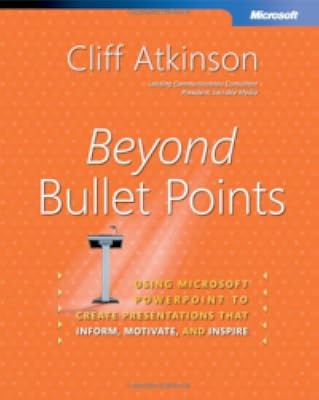
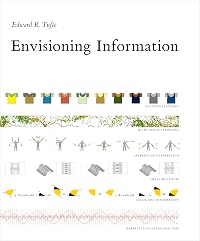
Garr Reynolds has turned the lessons of his wonderful blog presentation zen into a brochure-like book with good presentation design tips. A good, concise book for the Powerpoint-challenged who do not want or lack the time to distill the essence of Tufte's works. Reynolds's book is much better than Cliff Atkinson's Beyond Bullet Points. I only wish someone would tackle the real topics of presentations. With a little effort, it is easy to make a case against global warming, world hunger and obesity. It is much harder to do an engaging presentation about the next steps of a SAP project or a monthly sales report. It is thus no wonder that Reynolds does not quote neither Minto nor Zelazny who are helpful in those aspects.
Tracing ideas not show more to the current management bestsellers but back to their origins might reduce my impression of Mr Reynolds as an airport bookstore reader. Combining the works cited into a bibliography and a little bit less backscratching would have been helpful. At times, the repeat appearance of a select few becomes almost comic: The sect of Powerpoint addicts or the buddies of Garr Reynolds. Recommended. show less
Tracing ideas not show more to the current management bestsellers but back to their origins might reduce my impression of Mr Reynolds as an airport bookstore reader. Combining the works cited into a bibliography and a little bit less backscratching would have been helpful. At times, the repeat appearance of a select few becomes almost comic: The sect of Powerpoint addicts or the buddies of Garr Reynolds. Recommended. show less
I actually teach presentation skills to undergraduates, and this book forms the basis of my philosophy when explaining how students should not make slides consisting of 6 or 7 bullet points that they then read off word for word. Anyone who has ever heard a yawn or seen drooping eyelids while they are giving a presentation should read this, and learn from it (and no, it doesn't mean using every fancy PowerPoint feature in the book - this is not a book about PowerPoint or Keynote - it's a book about presentations).
I speed-read this today in my lunchbreak so can by no means be said to do it justice. Plus as I read, it sparked multiple ideas on how to re-think and re-imagine my presentations so that took up even more time than the reading. Great book - makes you really think about what you want to put across to people as well as the best way to accomplish that. Lovely illustrations too.
Members
- Recently Added By
Lists

Teacher Leadership
10 works; 1 member
Author Information

11 Works 2,056 Members
Garr Reynolds is the Author of the author of the best-selling books Presentation Zen and Presentation Zen Design, and a leading authority on presentation design and delivery. A sought-after speaker and consultant, his clients include many in the Fortune 500; A Writer, designer, musician, and long-time student of the Zen arts, he is currently show more Associate Professor Management at Kansai Gaidai University in Japan and Director of Design Matters Japan Garr's popular blog on presentation design and delivery is at www.presentationzen.com. show less
Awards and Honors
Series
Belongs to Publisher Series
Common Knowledge
- Canonical title
- Presentation Zen: Simple Ideas on Presentation Design and Delivery
- Original publication date
- 2008
- Blurbers
- Godin, Seth
Classifications
- Genres
- Business, Art & Design, Nonfiction, General Nonfiction, Technology
- DDC/MDS
- 005.58 — Computer science, information & general works Computer science, knowledge & systems Artificial Intelligence/Virtual Reality General purpose application programs Presentation Software
- LCC
- HF5718.22 .R49 — Social sciences Commerce Commerce Business
- BISAC
Statistics
- Members
- 1,600
- Popularity
- 14,170
- Reviews
- 18
- Rating
- (4.04)
- Languages
- 10 — Czech, Dutch, English, Finnish, French, German, Hungarian, Italian, Japanese, Spanish
- Media
- Paper, Ebook
- ISBNs
- 27
- UPCs
- 1
- ASINs
- 6