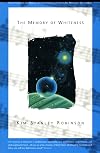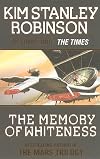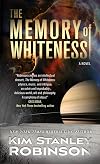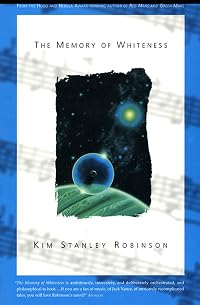
The Memory of Whiteness
by Kim Stanley Robinson
On This Page
Description
An early novel from Science Fiction legend Kim Stanley Robinson, The Memory of Whiteness is now available for the first time in decades.In 3229 A.D., human civilization is scattered among the planets, moons, and asteroids of the solar system. Billions of lives depend on the technology derived from the breakthroughs of the greatest physicist of the age, Arthur Holywelkin. But in the last years of his life, Holywelkin devoted himself to building a strange, beautiful, and complex musical show more instrument that he called The Orchestra.
Johannes Wright has earned the honor of becoming the Ninth Master of Holywelkin's Orchestra. Follow him on his Grand Tour of the Solar System, as he journeys down the gravity well toward the sun, impelled by a destiny he can scarcely understand, and is pursued by mysterious foes who will tell him anything except the reason for their enmity.
At the Publisher's request, this title is being sold without Digital Rights Management Software (DRM) applied.
. show less
Tags
Recommendations




















Member Reviews
With the entire solar system as a stage, Robinson's grand Space Opera is a heady mix of technological wonders (harnessed singularities turn asteroids into lush oases) and philosophical musings which attempt to draw links between music, quantum arcana, and human consciousness (sometimes a melody is not just a melody!) But it all gets muddled down by conspiracy paranoia and pseudo-religious tangents involving robed cultists and a mad playwright while the novel's central gimmick, a towering structure of musical instruments controlled by a single player, had me picturing something straight out of Dr. Seuss' Whoville. Robinson has a beautiful way with words however, if only he hadn't used so many.
This is probably the weirdest of KSR's books that I have read - it starts off with a musician going blind and ends with some fantastically trippy scenes which I'm not sure have profound thoughts connected to them (unlike some other books). Very good for those that may not read sci-fi, or want to blend physics and music - and one of the best pure stories (rather than worlds which happen to have a story going on) that KSR has written.
i liked this one quite a lot. quite different from Robinson's usual story. it's a far future sf, vividly set on a space opera stage. makes me think of stuff like Keith Roberts' Pavane, that kind of story, though it's easy enough to see Jack Vance in it too. the worlds are interesting, but the big deal is the main conceit: a galactic culture based on music, the nature of the interface between the audience and the work, and the nature and influence of artistic principles in engendering change. art, then, is always in the best sense revolutionary. starts with an Einstein quote: "It is the theory which decides what we can observe." and the whole thing, the physics of the whole culture, the diversity of models idea can generate, and the sort show more of synesthesia shorthand by which the idea moves out from the work, it's all a series of riffs on that one quote. nice. show less
The grand theme of this book is music. I cannot think of much SF I've read where this was the case, or even a big factor: The three Crystal Singer books by Anne McCaffrey and a short story by James Blish, the latter being good and the former being OK.
Robinson, on typically ambitious form, takes us on a tour of the solar system alongside the protagonist, a composer who develops a grand vision of how music and physics relate to each other at a fundamental level and creates music that gives people transcendant visions in response to hearing it. Now, music is sound and sound is a wave and waves have been studied by physicists for centuries and, of course, music can have a powerful and pretty direct effect on our emotional state, so there is show more some reality behind the ideas presented. I think that's all Robinson really wants to say; music is powerful and that power is mysterious in that, fundamentally, it's just a superposition of waves. He drops some hints that the Baroque composers are his personal inspiration. This is no surprise as there is supposed to be a correlation between high mathematical talent and liking the Baroque period in general and J.S. Bach particularly.
It's an interesting book, with a thriller plot-thread running through it to drive the narrative along but, surprisingly, the characters seem quite thin. This is odd because usually Robinson's great strength is characterisation, so much so that he can make it a fault by spending too much effort on it at the expense of slow pacing. No slow pace here. There is also very little in the way of ecological protection as a theme, which is again unusual for Robinson. His obsessions with Mars in general and Olympus Mons (the solar-system's biggest volcano) specifically are all present and correct, however.
The protagonist's visions of the nature of reality reminded me of a similar thing in [b:Galileo's Dream|6391377|Galileo's Dream|Kim Stanley Robinson|http://photo.goodreads.com/books/1303142224s/6391377.jpg|6579805], where it is done better. It would be tempting to say Robinson has improved as a writer in the intervening time but my experience is that his books have been a pretty random hit-or-miss collection with no obvious trend. This one sits firmly in the middle, neither the most perfect nor the most ambitious and not the weakest by some distance, either.
If you are a Robinson fan already, I can recommend this one; if you have never read any, I would recommend starting elsewhere, e.g. [b:Antarctica|41126|Antarctica|Kim Stanley Robinson|http://photo.goodreads.com/books/1320509406s/41126.jpg|3011567]. show less
Robinson, on typically ambitious form, takes us on a tour of the solar system alongside the protagonist, a composer who develops a grand vision of how music and physics relate to each other at a fundamental level and creates music that gives people transcendant visions in response to hearing it. Now, music is sound and sound is a wave and waves have been studied by physicists for centuries and, of course, music can have a powerful and pretty direct effect on our emotional state, so there is show more some reality behind the ideas presented. I think that's all Robinson really wants to say; music is powerful and that power is mysterious in that, fundamentally, it's just a superposition of waves. He drops some hints that the Baroque composers are his personal inspiration. This is no surprise as there is supposed to be a correlation between high mathematical talent and liking the Baroque period in general and J.S. Bach particularly.
It's an interesting book, with a thriller plot-thread running through it to drive the narrative along but, surprisingly, the characters seem quite thin. This is odd because usually Robinson's great strength is characterisation, so much so that he can make it a fault by spending too much effort on it at the expense of slow pacing. No slow pace here. There is also very little in the way of ecological protection as a theme, which is again unusual for Robinson. His obsessions with Mars in general and Olympus Mons (the solar-system's biggest volcano) specifically are all present and correct, however.
The protagonist's visions of the nature of reality reminded me of a similar thing in [b:Galileo's Dream|6391377|Galileo's Dream|Kim Stanley Robinson|http://photo.goodreads.com/books/1303142224s/6391377.jpg|6579805], where it is done better. It would be tempting to say Robinson has improved as a writer in the intervening time but my experience is that his books have been a pretty random hit-or-miss collection with no obvious trend. This one sits firmly in the middle, neither the most perfect nor the most ambitious and not the weakest by some distance, either.
If you are a Robinson fan already, I can recommend this one; if you have never read any, I would recommend starting elsewhere, e.g. [b:Antarctica|41126|Antarctica|Kim Stanley Robinson|http://photo.goodreads.com/books/1320509406s/41126.jpg|3011567]. show less
Set about a thousand years in the future, this space opera follows the story of famous musician Johannes Wright as he embarks on a grand tour of the solar system, progressing from Pluto to Mercury and beset along the way by sabotage and assassination attempts by a mysterious cult known as "the Greys."
This book was obviously a breeding ground for ideas Robinson later used in his more famous Mars Trilogy, but it also stands on its own as a cool little novel that works with a number of different themes. As usual with Robinson, advanced scientific theories rear their ugly heads (even in discussions about music), but you can hardly fault him for being true to the genre's name. Personally I found the most interesting parts to revolve around show more the character of Dent Ios, a journalist who falls in with the tour and later aids the chief of security in unravelling the mystery surrounding the Greys, despite his inexperience and incompetence. The ending also came to a rather cinematic climax, which pandered to my tastes perfectly well. show less
This book was obviously a breeding ground for ideas Robinson later used in his more famous Mars Trilogy, but it also stands on its own as a cool little novel that works with a number of different themes. As usual with Robinson, advanced scientific theories rear their ugly heads (even in discussions about music), but you can hardly fault him for being true to the genre's name. Personally I found the most interesting parts to revolve around show more the character of Dent Ios, a journalist who falls in with the tour and later aids the chief of security in unravelling the mystery surrounding the Greys, despite his inexperience and incompetence. The ending also came to a rather cinematic climax, which pandered to my tastes perfectly well. show less
In the very far future, when humanity has colonized the solar system, a musician embarks on a tour with an instrument developed by the man whose physics power civilization. He aspires to make music that corresponds to that physics, which may mean that listening to the music shows you your past and future, completely determined. There’s also a conspiracy or two around whether he’ll be allowed to give his concerts. Though early on there’s an exchange about the amusing idea of writing about music, the book doesn’t escape that inherent problem – especially for a musically untrained person like me, much of the writing was essentially meaningless. Robinson’s later genius for landscape is apparent in stretches as he describes show more coming home to Mars and then to Earth, but mostly I felt he was wasting his time writing about music in a setting over a thousand years from now, both of which worked to distance me from the plot and characters. show less
The Memory Of Whiteness: A Scientific Romance, is Kim Stanley Robinson’s third book, and from what I can gather his most philosophical. In it, he tries to tie a few threads of thought together: how determinism ties in with quantum physics and free will; art as representation of reality; how human thinking corresponds with reality & direct and indirect kinds of knowledge. The device KSR uses to connect all this is music.
The Memory Of Whiteness is philosophical musings first, and story second. I don’t think it has aged particularly well, and I don’t think it has a lot to offer to people that are already familiar with the topics I listed above – and I don’t mean as familiar like a CERN scientist, but familiar in a Quantum Physics show more For Dummies kinda way. I’m not sure how well known the general outlines of quantum physics were back in the 1980ies, but today those outlines are pretty much common knowledge to people with a healthy interest in their reality and a library card.
The notion of indeterminacy on a subatomic level has been a veritable feast for some philosophers of the postmodern ilk: an electron’s speed can’t be measured at the same time as its spin! Nothing is certain!! What we feel has been proven by hard science!!! Praise Heisenberg!!!! It went so far that people thinking philosophically about truth and representation – and that means nearly everybody writing theory about the arts, as most (if of not all) art is grounded in representation, as also non-representative art stems from representative predecessors – needed to become familiar with the Quantum. Of course, all this was quite overblown. It’s not because some subatomic processes are strange and weird that our Newtonian world – still the only world we live in – all of a sudden becomes unknowable and undetermined. Still, serious writers and serious philosophers needed to opine about Schrödinger’s cat and the possible existence of the Higgs boson, and Einstein’s dictum that ‘God doesn’t play dice’ was made fun of, even in works of popular culture that needed to a claim on depth.
Kim Stanley Robinson clearly wasn’t a fool, not even back in those days. He saw through this mirage of uncertainty, and envisioned a world that was beyond these debates.
Newtonian physics is deterministic. It is true that it fits into the larger framework of the probabilistic system of quantum mechanics. But quantum mechanics fits into the larger framework of Holywelkin physics; and Holywelkin physics is again deterministic.
Holywelkin is a fictional scientist, and The Memory Of Whiteness is set in 3229 AD – it chronicles a tour of humanity’s most important musician/composer throughout the solar system.
(...)
Please read the rest of the analysis on Weighing A Pig show less
The Memory Of Whiteness is philosophical musings first, and story second. I don’t think it has aged particularly well, and I don’t think it has a lot to offer to people that are already familiar with the topics I listed above – and I don’t mean as familiar like a CERN scientist, but familiar in a Quantum Physics show more For Dummies kinda way. I’m not sure how well known the general outlines of quantum physics were back in the 1980ies, but today those outlines are pretty much common knowledge to people with a healthy interest in their reality and a library card.
The notion of indeterminacy on a subatomic level has been a veritable feast for some philosophers of the postmodern ilk: an electron’s speed can’t be measured at the same time as its spin! Nothing is certain!! What we feel has been proven by hard science!!! Praise Heisenberg!!!! It went so far that people thinking philosophically about truth and representation – and that means nearly everybody writing theory about the arts, as most (if of not all) art is grounded in representation, as also non-representative art stems from representative predecessors – needed to become familiar with the Quantum. Of course, all this was quite overblown. It’s not because some subatomic processes are strange and weird that our Newtonian world – still the only world we live in – all of a sudden becomes unknowable and undetermined. Still, serious writers and serious philosophers needed to opine about Schrödinger’s cat and the possible existence of the Higgs boson, and Einstein’s dictum that ‘God doesn’t play dice’ was made fun of, even in works of popular culture that needed to a claim on depth.
Kim Stanley Robinson clearly wasn’t a fool, not even back in those days. He saw through this mirage of uncertainty, and envisioned a world that was beyond these debates.
Newtonian physics is deterministic. It is true that it fits into the larger framework of the probabilistic system of quantum mechanics. But quantum mechanics fits into the larger framework of Holywelkin physics; and Holywelkin physics is again deterministic.
Holywelkin is a fictional scientist, and The Memory Of Whiteness is set in 3229 AD – it chronicles a tour of humanity’s most important musician/composer throughout the solar system.
(...)
Please read the rest of the analysis on Weighing A Pig show less
Members
- Recently Added By
Lists

Arthur C. Clarke Award Winners and Shortlisted Books
219 works; 14 members

Vlogbrothers Book Recommendations
307 works; 4 members
Author Information

140+ Works 49,510 Members
Kim Stanley Robinson was born in Orange County, California on March 23, 1952. He received a B. A. and Ph. D. from the University of California at San Diego and an M. A. from Boston University. His first trilogy of books, Orange County, collectively won a Nebula Award and two Hugo Awards. His other works include the Mars trilogy, 2312, and Aurora. show more He has won an Asimov Award, a World Fantasy Award, a Locus Reader's Poll Award, and a John W. Campbell Award. (Bowker Author Biography) show less
Some Editions
Awards and Honors
Awards
Common Knowledge
- Canonical title*
- Sphärenklänge
- Original title
- The Memory of Whiteness
- Original publication date
- 1985-09
- People/Characters
- Johannes Wright
- Dedication
- It is theory which decides whatt we can observe.
- Albert Einstein - First words
- Now all my life forces my flight through the streets of Lowell, and I run from alley to commons to alley like a rat pursued through a maze.
*Some information comes from Common Knowledge in other languages. Click "Edit" for more information.
Classifications
Statistics
- Members
- 660
- Popularity
- 43,835
- Reviews
- 12
- Rating
- (3.28)
- Languages
- English, French, German
- Media
- Paper, Ebook
- ISBNs
- 14
- ASINs
- 6