On This Page
Description
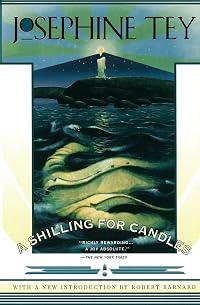
When a woman's body washes up on an isolated stretch of beach on the southern coast of England, Scotland Yard's Inspector Alan Grant is on the case. But the inquiry into her death turns into a nightmare of false leads and baffling clues. Was there anyone who didn't want lovely screen actress Christine Clay dead?Tags
Recommendations

















Member Recommendations
Member Reviews
Josephine Tey is one of my favorite mystery authors--easily top five. This isn't a favorite book among her works though. Sadly, she only wrote eight. The introduction to the latest editions by Robert Barnard name The Daughter of Time, The Franchise Affair and Brat Farrar as the standouts; I'd add Miss Pym Disposes to that list of her best. A Shilling for Candles is only her second book and her two earliest books are indeed imo her weakest, though I like A Shilling for Candles better than her first mystery featuring Inspector Alan Grant of Scotland Yard, The Man in the Queue. The strength of most Teys, including this one, isn't in a tidily plotted whodunnit with clues giving you a fair chance at the solution and a particularly clever show more twist. The introduction points particularly to A Shilling for Candles in that regard as an example, saying that Tey was not interested "in that kind of game."
So what are this novel's particular pleasures? Well, her prose for one. Lively, full of wry insights, humor, an apt way with descriptions. Her characters for another, and in this case I definitely thought this cast was more memorable than in her first Grant novel. There is an odious reporter, an eccentric astrologer, egotistical show business people and the delightful Erica Burgoyne, teen detective, who arguably proves better at the business than Inspector Grant. Grant isn't along Sherlock Holmes or Hercule Poirot or even Lord Peter Wimsey lines. He laments that himself at one point that he's "just a hard-working, well-meaning ordinarily intelligent detective." Barnard accuses Tey of anti-Semitism in his introduction, but doesn't cite examples, and I have to wonder if it's he just doesn't get that Grant isn't meant to be a Holmes or Poirot. I don't think we're to take his beliefs as that of the author. He's fallible. It may be that anti-Jewish lines are excised from the later or American editions, or that I have yet to find them in my reread of Tey with 3 more novels to go. Unless I missed it because it's encoded as "Eastern European" in this book. But I find it telling that in the first two books, every time Grant expresses a prejudice and makes assumptions based upon it, he's proven wrong--and the character of Eastern European origin in this book doesn't fit any negative stereotype. It could be I'm giving Tey too much credit for being subtle. Maybe. But I suspect Barnard doesn't give Tey enough credit.
I think what I found most poignant in this book though was the portrait of the murder victim we can only get to know through others--film actress Christine Clay. What emerges is a very sympathetic portrait, a vivid one both of her and the prices of celebrity. show less
So what are this novel's particular pleasures? Well, her prose for one. Lively, full of wry insights, humor, an apt way with descriptions. Her characters for another, and in this case I definitely thought this cast was more memorable than in her first Grant novel. There is an odious reporter, an eccentric astrologer, egotistical show business people and the delightful Erica Burgoyne, teen detective, who arguably proves better at the business than Inspector Grant. Grant isn't along Sherlock Holmes or Hercule Poirot or even Lord Peter Wimsey lines. He laments that himself at one point that he's "just a hard-working, well-meaning ordinarily intelligent detective." Barnard accuses Tey of anti-Semitism in his introduction, but doesn't cite examples, and I have to wonder if it's he just doesn't get that Grant isn't meant to be a Holmes or Poirot. I don't think we're to take his beliefs as that of the author. He's fallible. It may be that anti-Jewish lines are excised from the later or American editions, or that I have yet to find them in my reread of Tey with 3 more novels to go. Unless I missed it because it's encoded as "Eastern European" in this book. But I find it telling that in the first two books, every time Grant expresses a prejudice and makes assumptions based upon it, he's proven wrong--and the character of Eastern European origin in this book doesn't fit any negative stereotype. It could be I'm giving Tey too much credit for being subtle. Maybe. But I suspect Barnard doesn't give Tey enough credit.
I think what I found most poignant in this book though was the portrait of the murder victim we can only get to know through others--film actress Christine Clay. What emerges is a very sympathetic portrait, a vivid one both of her and the prices of celebrity. show less
From the time that a young woman's body is pulled from the surf of a lonely beach in Kent, lives are affected. When it becomes known that the woman was the famous stage and screen actress Christine Clay, the ripple effect nearly drowns the world. I like a mystery that has a wide range of suspects making it harder to solve and this one sure has them aplenty. There’s the likable young playboy who's been staying at her cottage. He seems the "right sort" but his story isn’t very believable. Then we have the songwriter who's reputed to have been her lover lurking in the shadows. Who knows what his motives might have been. The will mentions her next-of-kin, a brother to whom she has left only "a shilling for candles." …hence the name of show more the novel. This doesn’t sound like a very happy family at all. Of course there’s her husband. Husbands’ are always a good bet for the wife's murder. He’s an aristocrat who dabbles in foreign politics and who has an iron-clad alibi. Or maybe he doesn’t. Inspector Grant of Scotland Yard must sort through it all this and try to figure out if Christine Clay's sudden and violent death was really "written in the stars" I had a lot of fun with this one. show less
When I compare Tey to Christie, I'm always struck by the fact that Tey was actually a much better writer, in the literary sense, but Christie is by far the better plotter, in the sense that her books hold together and the clues are all there and the stories are tighter.
A Shilling for Candles is a little all over the place. Suspects come and go, each more outlandish then the next. The ending, for me, came a bit out of nowhere (whereas with Christie, one may not have figured out whodunnit, but when all is revealed it usually makes sense). The person who I thought was guilty turned out not to be, but on the other hand the reason I thought so was never satisfactorily explained away. I'll leave it at that.
Tey herself is definitely an show more enthusiastic product of the British Empire, and her satisfaction, not to say smugness, with her homeland comes through clearly. I do enjoy the Golden Age of crime fiction, partly for this cultural complacency when all was right with the world (even though it wasn't) and one could focus solely on one's particular puzzle. But knowing what we know now about the damage wrought by the Empire and other efforts at colonization, and the prejudices and attitudes of the day, does sometimes make for discomfort when an author is so steeped in these dated attitudes.
I guess what I'm trying to say is that Tey is a product of her time and place, and her writing can be a bit cringeworthy. But I still enjoy it. show less
A Shilling for Candles is a little all over the place. Suspects come and go, each more outlandish then the next. The ending, for me, came a bit out of nowhere (whereas with Christie, one may not have figured out whodunnit, but when all is revealed it usually makes sense). The person who I thought was guilty turned out not to be, but on the other hand the reason I thought so was never satisfactorily explained away. I'll leave it at that.
Tey herself is definitely an show more enthusiastic product of the British Empire, and her satisfaction, not to say smugness, with her homeland comes through clearly. I do enjoy the Golden Age of crime fiction, partly for this cultural complacency when all was right with the world (even though it wasn't) and one could focus solely on one's particular puzzle. But knowing what we know now about the damage wrought by the Empire and other efforts at colonization, and the prejudices and attitudes of the day, does sometimes make for discomfort when an author is so steeped in these dated attitudes.
I guess what I'm trying to say is that Tey is a product of her time and place, and her writing can be a bit cringeworthy. But I still enjoy it. show less
I enjoyed this book very much.
It is the second book in the Inspector Grant series and features the death of a very talented, popular movie star. There are few clues at the scene, since she was drowned at a secluded beach and the tide has obliterated anything of use. One suspect delivers himself up immediately, but claims to be innocent. The evidence, however circumstantial, all points to him and he is arrested.
The quickness and cleanliness of the arrest pleases everyone: the press, the public, and the constabulary all the way up to the Commissioner. Grant also acknowledges that it is “a good enough case”. But. Grant has a niggling feeling, based on a small anomaly. Why can’t he let this go, as everyone advises? Is it just his show more liking for the suspect getting in the way of the facts? Tey does a brilliant job of outlining the competing forces pulling at Grant: the conviction of his superiors about the solidity of the case versus his “feeling”.
This book also has a very interesting character in Erica Burgoyne, the 17-year-old daughter of the Chief Constable. At points the book breaks briefly to tell the story from her point of view before returning to Grant’s pursuits. She is unconventional, forthright, and has a keen intellect. I am hoping to see more of her in subsequent books!
In each of Tey’s books that I’ve read, she can in a few strokes give a realistic and detailed picture of a section of English society: touts at the racetrack, shopkeepers opening up on a Monday morning, London theatre-goers. The social satire is gentle but hits true even today. In one instance, she makes sharp observations about the symbiotic relationship between the sensationalist celebrity-obsessed press and its readers. Here is an excerpt, where a reporter (Jammy Hopkins) laments being chastised for printing hearsay:
In this novel, Tey shows the dogged, unglamorous work that policemen have to do to track down clues and gather evidence. What could be dry in other hands is smooth in Tey’s and does not slow down the story; rather, it gives a deeper dimension to Grant’s character.
Though it is second in the Grant series, this can be read out of order from the first book ([b:Man in the Queue|243400|The Man in the Queue|Josephine Tey|http://d202m5krfqbpi5.cloudfront.net/books/1327960525s/243400.jpg|1844331]) with no harm. show less
It is the second book in the Inspector Grant series and features the death of a very talented, popular movie star. There are few clues at the scene, since she was drowned at a secluded beach and the tide has obliterated anything of use. One suspect delivers himself up immediately, but claims to be innocent. The evidence, however circumstantial, all points to him and he is arrested.
The quickness and cleanliness of the arrest pleases everyone: the press, the public, and the constabulary all the way up to the Commissioner. Grant also acknowledges that it is “a good enough case”. But. Grant has a niggling feeling, based on a small anomaly. Why can’t he let this go, as everyone advises? Is it just his show more liking for the suspect getting in the way of the facts? Tey does a brilliant job of outlining the competing forces pulling at Grant: the conviction of his superiors about the solidity of the case versus his “feeling”.
This book also has a very interesting character in Erica Burgoyne, the 17-year-old daughter of the Chief Constable. At points the book breaks briefly to tell the story from her point of view before returning to Grant’s pursuits. She is unconventional, forthright, and has a keen intellect. I am hoping to see more of her in subsequent books!
In each of Tey’s books that I’ve read, she can in a few strokes give a realistic and detailed picture of a section of English society: touts at the racetrack, shopkeepers opening up on a Monday morning, London theatre-goers. The social satire is gentle but hits true even today. In one instance, she makes sharp observations about the symbiotic relationship between the sensationalist celebrity-obsessed press and its readers. Here is an excerpt, where a reporter (Jammy Hopkins) laments being chastised for printing hearsay:
“Jammy consigned them all to perdition…What did the Yard want to take it like that for? Everyone knew that what you wrote in a paper was just eye-wash. When it wasn’t bilge-water. If you stopped being dramatic over little tuppenny no-account things, people might begin to suspect that they were no-account, and then they’d stop buying papers….You’d got to provide emotions for all those moribund wage-earners who were too tired or too dumb to feel anything on their own behalf. If you couldn’t freeze their blood, then you could sell them a good sob or two.” (p.172)
In this novel, Tey shows the dogged, unglamorous work that policemen have to do to track down clues and gather evidence. What could be dry in other hands is smooth in Tey’s and does not slow down the story; rather, it gives a deeper dimension to Grant’s character.
Though it is second in the Grant series, this can be read out of order from the first book ([b:Man in the Queue|243400|The Man in the Queue|Josephine Tey|http://d202m5krfqbpi5.cloudfront.net/books/1327960525s/243400.jpg|1844331]) with no harm. show less
Another excellent example of "not your ordinary mystery novel". A body is discovered on a beach, and the immediate assumption of suicide is soon contradicted by the evidence. (I have to say I'm a little impressed that the article found with the body which indicates murder is never mentioned in anything I've read online about the book (and in fact morphed into something else for the film adaptation (1937's Young and Innocent, said to be Hitchcock's personal favorite among his British films); I'm glad to continue to keep the secret.) The most obvious suspect isn't after all so obvious – and turns up missing – and what for about a minute seemed neat and tidy turns out to be a tangled ball of false confessions, astrology, suspects show more requiring delicate handling, and wardrobe searches. Alan Grant's presence in this book is somewhere between that in The Franchise Affair – peripheral – and the his greater omnipresence in The Man in the Queue - in addition to his there are many points of view, beautifully handled and rewarding, but he is in the forefront here.
The plot is gripping; the characterizations natural; if the solution to the mystery is not necessarily one that can be worked out by the armchair detective, that isn't really the point of the book anyway – the impression is that A Shilling for Candles wasn't written primarily as a puzzle to solve. It was, I think, written more as a psychological exercise, an exploration of personality and the consequences of celebrity and of being involved in a homicide. There is the contrast of the rather extraordinary ordinary girl, Erica, with the glitter and sparkle and hollowness of the celebrities. And Alan Grant is a star, in all the best senses of the word.
A word I saw used in a summary of one of Miss Tey's other books used the word "excoriating" and it suits here as well. That reference was in regards to the attitude in To Love and Be Wise toward modern writers; here the recipient of the book's scorn is The Public, that seething mindless mass of neediness. The murder victim, Christine, was a star of the first magnitude, and thus even had it been natural her death is not something that could be quietly mourned in private by those closest to her. Her celebrity and the circumstances of her death break it wide open, making both privacy and quiet impossible. Since I read this, Whitney Houston died, and the constant invasion into her family's lives was appalling, down to disruptions of her teenaged daughter's life and, I believe, publication of photos of the nude corpse (see also Marilyn Monroe). I thought the menace of inexcusable paparazzi and the public appetite that allows for them was a more recent development; I honestly don't know if I'm relieved or saddened that it's always been this way.
This disparagement of the Masses put together with the little I know about Josephine Tey's career as Gordon Daviot, very successful playwright, gives me pause. Much of what I know about this aspect of her life is from the novel which uses her as a character, An Expert in Murder, by Nicola Upson; it was not entirely to my taste, but I don't question the research that went into it (though I take everything with a grain of salt, of course, if for no other reason that that I've also read Daughter of Time). If I don't plan to use the book as source material for anything, I will take the setting described as something like accurate: in the story, Daviot's play Richard of Bordeaux is at its height, and there are people who go to see the play over and over. And over. (In Daughter of Time, it is, disarmingly, mentioned that Alan Grant saw it four times.) They sought out the actors and snapped up souvenirs. While Miss Tey/Mr. Daviot might have escaped most of the throng (though for some reason I think the pseudonym was an open secret), she probably had a fair awareness of what it was like for her players, who had no such anonymity. It's sobering to read the following quote with that in mind; Alan has picked up Champneis, Christine Clay's husband, shortly after the funeral, which despite the precautions they tried to take became a circus:
"Those women. I think the end of our greatness as a race must be very near. We came through the war well, but perhaps the effort was too great and left us – epileptic. Great shocks do, sometimes." He was silent for a moment, evidently seeing it all again in his mind's eye. "I've seen machine guns turned on troops in the open – in China – and rebelled against the slaughter. But I would have seen that sub-human mass of hysteria riddled this morning with more joy than I can describe to you. Not because it was – Chris, but because they made me ashamed of being human, of belonging to the same species."
And I think I'll just let that resonate there without further comment. show less
The plot is gripping; the characterizations natural; if the solution to the mystery is not necessarily one that can be worked out by the armchair detective, that isn't really the point of the book anyway – the impression is that A Shilling for Candles wasn't written primarily as a puzzle to solve. It was, I think, written more as a psychological exercise, an exploration of personality and the consequences of celebrity and of being involved in a homicide. There is the contrast of the rather extraordinary ordinary girl, Erica, with the glitter and sparkle and hollowness of the celebrities. And Alan Grant is a star, in all the best senses of the word.
A word I saw used in a summary of one of Miss Tey's other books used the word "excoriating" and it suits here as well. That reference was in regards to the attitude in To Love and Be Wise toward modern writers; here the recipient of the book's scorn is The Public, that seething mindless mass of neediness. The murder victim, Christine, was a star of the first magnitude, and thus even had it been natural her death is not something that could be quietly mourned in private by those closest to her. Her celebrity and the circumstances of her death break it wide open, making both privacy and quiet impossible. Since I read this, Whitney Houston died, and the constant invasion into her family's lives was appalling, down to disruptions of her teenaged daughter's life and, I believe, publication of photos of the nude corpse (see also Marilyn Monroe). I thought the menace of inexcusable paparazzi and the public appetite that allows for them was a more recent development; I honestly don't know if I'm relieved or saddened that it's always been this way.
This disparagement of the Masses put together with the little I know about Josephine Tey's career as Gordon Daviot, very successful playwright, gives me pause. Much of what I know about this aspect of her life is from the novel which uses her as a character, An Expert in Murder, by Nicola Upson; it was not entirely to my taste, but I don't question the research that went into it (though I take everything with a grain of salt, of course, if for no other reason that that I've also read Daughter of Time). If I don't plan to use the book as source material for anything, I will take the setting described as something like accurate: in the story, Daviot's play Richard of Bordeaux is at its height, and there are people who go to see the play over and over. And over. (In Daughter of Time, it is, disarmingly, mentioned that Alan Grant saw it four times.) They sought out the actors and snapped up souvenirs. While Miss Tey/Mr. Daviot might have escaped most of the throng (though for some reason I think the pseudonym was an open secret), she probably had a fair awareness of what it was like for her players, who had no such anonymity. It's sobering to read the following quote with that in mind; Alan has picked up Champneis, Christine Clay's husband, shortly after the funeral, which despite the precautions they tried to take became a circus:
"Those women. I think the end of our greatness as a race must be very near. We came through the war well, but perhaps the effort was too great and left us – epileptic. Great shocks do, sometimes." He was silent for a moment, evidently seeing it all again in his mind's eye. "I've seen machine guns turned on troops in the open – in China – and rebelled against the slaughter. But I would have seen that sub-human mass of hysteria riddled this morning with more joy than I can describe to you. Not because it was – Chris, but because they made me ashamed of being human, of belonging to the same species."
And I think I'll just let that resonate there without further comment. show less
My previous exposure to Josephine Tey was a couple of decades ago with The Daughter of Time, about Inspector Grant, lying in bed recuperating and, to keep himself occupied, researching the history of Richard III, because he can't believe that someone with such a noble face could have been such an evil character as depicted by history. This book is an earlier Inspector Grant mystery, with him up and running about the English countryside, trying to unravel the murder of a young, beautiful woman. He's still interested in physiognomy, and has many an aside on class and society. He was a good character to read about, the book was very entertainingly English with its dry humour and stoic characters, and it is quite amusingly written with show more delightful asides that kept me smirking.
I particularly liked how it was such a different era to ours that was depicted, a fascinating slice of English life before the stresses of modern living. I don't know about you, but that's one of my favourite things about reading older books, getting a glimpse into a world that has gone, and it's all so unaffected and unresearched, since the author wrote about milkmen or being out without a hat or flannel trousers, because that's what life was about back then. (And what are flannel trousers, anyway?)
There was some discomfort with the description of the Jewish character as being "like one of his race", although he does subvert that with a fine Shylockian speech. (Which is then completely disregarded by Inspector Grant. *sigh*) A "product of its times" moment that you wish wasn't there, and not nearly as discomfiting as Merchant of Venice (and many others, I am sure).
But apart from that, it was a cleverly plotted book, charmingly written, with interesting characters. Well worth a read, especially for anyone with a fascination of England in a previous time. show less
I particularly liked how it was such a different era to ours that was depicted, a fascinating slice of English life before the stresses of modern living. I don't know about you, but that's one of my favourite things about reading older books, getting a glimpse into a world that has gone, and it's all so unaffected and unresearched, since the author wrote about milkmen or being out without a hat or flannel trousers, because that's what life was about back then. (And what are flannel trousers, anyway?)
There was some discomfort with the description of the Jewish character as being "like one of his race", although he does subvert that with a fine Shylockian speech. (Which is then completely disregarded by Inspector Grant. *sigh*) A "product of its times" moment that you wish wasn't there, and not nearly as discomfiting as Merchant of Venice (and many others, I am sure).
But apart from that, it was a cleverly plotted book, charmingly written, with interesting characters. Well worth a read, especially for anyone with a fascination of England in a previous time. show less
[A Shilling for Candles] is the first crime novel published under the Josephine Tey pen name. Oddly, it is the second novel featuring Tey's Inspector Alan Grant. Though not without shortcomings, the story is darn entertaining. Slight but fast-paced.
The lifeless body of a popular singin' and dancin' movie star, Christine Clay, was discovered in the early morning on a thumbnail beach along the English Channel coast. She drowned. Strangely, her death by drowning had been predicted by a well-known astrologer earlier in the year.
But was it accidental? A button tangled in her hair suggested foul play. A young man who'd been staying in her vacation cottage for a couple of days said she had left for an early-morning swim. Curiously, he didn't show more know who she was, only her first name. Curious also was the fact that he stole her car, though he did return it a day or two later. Suspicious was the revelation that the young man was a beneficiary of her will, she having added him only a couple of days before her death. show less
The lifeless body of a popular singin' and dancin' movie star, Christine Clay, was discovered in the early morning on a thumbnail beach along the English Channel coast. She drowned. Strangely, her death by drowning had been predicted by a well-known astrologer earlier in the year.
But was it accidental? A button tangled in her hair suggested foul play. A young man who'd been staying in her vacation cottage for a couple of days said she had left for an early-morning swim. Curiously, he didn't show more know who she was, only her first name. Curious also was the fact that he stole her car, though he did return it a day or two later. Suspicious was the revelation that the young man was a beneficiary of her will, she having added him only a couple of days before her death. show less
Members
- Recently Added By
Lists

Read the book and saw the movie
1,170 works; 195 members

Crime and Mysteries to Read
746 works; 31 members

British Mystery
469 works; 13 members

Anthony Boucher's Best Crime Fiction of the Year
115 works; 5 members

In or About the 1930s
198 works; 27 members

Books About Murder
313 works; 7 members

Detective Stories
343 works; 5 members

Books Read in 2018
4,360 works; 110 members

#JustTheFacts2021Gold
60 works; 1 member
#MysteryBingo2021Gold(Original)
36 works; 1 member
#MysteryBingo2021Gold(Revised)
36 works; 1 member

Books Read in 2023
5,547 works; 145 members
Author Information

51+ Works 20,100 Members
Josephine Tey is a pseudonym used by Elizabeth Mackintosh. She was born in 1896 in Inverness and died in 1952. She is a Scottish author best known for her mystery novels. She attended Inverness Royal Academy and then Anstey Physical Training College in Erdington, a suburb of Birmingham. She taught physical training at various schools in England show more and Scotland, but in 1926 she had to return to Inverness to care for her invalid father. There she began her career as a writer. In five of the mystery novels, the hero is Scotland Yard Inspector Alan Grant. The most famous of these is The Daughter of Time, in which Grant, laid up in hospital, has friends research reference books and contemporary documents so that he can puzzle out the mystery of whether King Richard III of England murdered his nephews, the Princes in the Tower. Grant comes to the firm conclusion that King Richard was totally innocent of the death of the Princes. In 1990, The Daughter of Time was selected by the British Crime Writers' Association as the greatest mystery novel of all time; The Franchise Affair was 11th on the same list of 100 books. (Bowker Author Biography) show less
Some Editions
Awards and Honors
Distinctions
Series

Belongs to Publisher Series
Work Relationships
Is contained in
Has the adaptation
Common Knowledge
- Canonical title
- A Shilling for Candles
- Original title
- A Shilling for Candles
- Original publication date
- 1936
- People/Characters
- Alan Grant (Inspector); Christine Clay; Robert Tisdall; Erica Burgoyne; Jason Harmer; Marta Hallard (show all 14); Judy Sellers; Herbert Gotobed; Lord Edward Champneis; Sergeant Williams; Sanger; Rimell; Lydia Keats; Jammy Hopkins
- Important places
- England, UK; Westover, England, UK
- Related movies
- Young and Innocent (1937 | IMDb)
- First words
- It was a little after seven on a summer morning, and William Potticary was taking his accustomed way over the short down grass of the cliff-top.
- Last words
- (Click to show. Warning: May contain spoilers.)"To Olympia at Christmas!" Grant said.
Classifications
Statistics
- Members
- 1,509
- Popularity
- 15,316
- Reviews
- 52
- Rating
- (3.74)
- Languages
- 7 — Dutch, English, French, Greek, Italian, Spanish, Swedish
- Media
- Paper, Audiobook, Ebook
- ISBNs
- 46
- UPCs
- 1
- ASINs
- 39