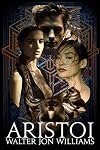
Aristoi
by Walter Jon Williams
On This Page
Description
Written with care, intelligence, and grace, [Aristoi] depicts a future society based on highly developed computers and biological engineering, the key skills of which are controlled by an elite known as the Aristoi. This world is depicted meticulously and vividly, and so is the near war of all against all that is unleashed when one of the Aristoi falls prey to the corruption of power. A fine, thoughtful work, highly recommended; Williams seems to grow with each book.—-Roland Green, show more Chicago Sun-Times
Beneath the facade of universal prosperity, however, lurks a tide of dissension and madness that can only be fought from within. Williams tests the borders of imagination in a novel that combines brilliant hard science and speculative vision with a firm grip on the central humanity of his characters. A priority purchase for sf collections.
—-Library Journal
In this complex and rewarding novel, Williams has created a future which features many of the wonders SF has been promising us for years: virtual reality, genetic engineering, faster-than-light travel, artificial intelligence, nanotechnology, telepathic links with computers, and more.
—-Publishers Weekly
Gabriel is one of the Aristoi, the elite class that hold dominion over a glittering interstellar culture, their rule more absolute than that of any Old Earth tyrant. When another of the Aristoi is murdered, Gabriel finds that the foundations of his civilization are tottering, and that his own power may have its roots in the greatest lie in all history.
In order to defend himself and the interstellar order, Gabriel must go on a quest into the heart of barbarism and chaos, and discover within himself his own lost, tattered humanity.
. show less
Tags
Recommendations












































Member Recommendations

whiten06 A similar view of transhumanism and augmented reality.
Member Reviews
This book was a great, long sci-fi with a healthy dose of adventure thrown in. It was rough to get into the world, vocabulary, and distinguishing between the real world/oneirochronon and what daimones were, but after about 30-40 pages it made sense. And then after the inciting action on about page 100, I was hooked. (That might seem like a long time before it comes in, but the character and world introductions beforehand are essential.) I read the whole thing (all 450 pages) in one day. I especially appreciated seeing a bisexual, polyamorous male lead character, in a society where it's not an issue, in a book written over 25 years ago. There is so much going on here: the thorough and fascinating worldbuilding, philosophical exploration show more of humanity and integrity, character and relationship development, scientific and technological advances, a realistic integration of cultural aspects from around Earth as we know it into a future society, high-energy action and adventure, secrecy and betrayal, and even some undercover work on a pre-technological world. Everything balanced perfectly, I was invested 100%, and I enjoyed every minute of this ride. show less
It's rare that I read something different enough to be considered unique, but the society and culture painted in this book is something I've never encountered before.
The world building is truly stupendous. A distant future humanity, scarred by the accidental destruction of Earth, rebuilds a new civilization. One of the core values of this civilization is that information must be free, but technology has become powerful enough, dangerous enough, that it can only be wielded in all its glory by gods. So the Aristoi are created, gods among men, to play the role of the divine (though perhaps they are are best viewed as philosopher kings).
Williams describes the Aristoi, saying: "Without doubt she would achieve the rank of Ariste: the show more long-latent synthesis, the tumbling-together of ideas, had begun. The integrative thinking of the Aristoi, wherein each thought, each skill and idea, began to expand and multiply and reinforce the other." Describing their relationship to the rest of humanity, an Aristos states: "We dominate humanity because we can't help it, and because the others couldn't stop it even if they wanted to."
The result is a society that is simultaneously a techno-utopia and a radical authoritarian dystopia (fascism without the nationalist connotations), made all the more frightening because the thought of disobedience to an Aristos is literally inconceivable to the vast majority of indoctrinated humanity.
This marvelous world building creates a set of main characters (Aristoi and their senior bureaucrats) that is simultaneously fascinating, desirable, and appalling. They believe they are superior and entitled...nearly godlike...and the reader has a hard time disagreeing, while all the while rebelling against such a notion notion as anathema to our current liberal society based upon the notion that all are created equal.
Combine that with the strange psychology of the characters (the society believes that multiple personalities - inner demons - are to be encouraged, named, and treasured, in order for multifaceted individuals to fully unlock their true potential), and this book is well worth reading. show less
The world building is truly stupendous. A distant future humanity, scarred by the accidental destruction of Earth, rebuilds a new civilization. One of the core values of this civilization is that information must be free, but technology has become powerful enough, dangerous enough, that it can only be wielded in all its glory by gods. So the Aristoi are created, gods among men, to play the role of the divine (though perhaps they are are best viewed as philosopher kings).
Williams describes the Aristoi, saying: "Without doubt she would achieve the rank of Ariste: the show more long-latent synthesis, the tumbling-together of ideas, had begun. The integrative thinking of the Aristoi, wherein each thought, each skill and idea, began to expand and multiply and reinforce the other." Describing their relationship to the rest of humanity, an Aristos states: "We dominate humanity because we can't help it, and because the others couldn't stop it even if they wanted to."
The result is a society that is simultaneously a techno-utopia and a radical authoritarian dystopia (fascism without the nationalist connotations), made all the more frightening because the thought of disobedience to an Aristos is literally inconceivable to the vast majority of indoctrinated humanity.
This marvelous world building creates a set of main characters (Aristoi and their senior bureaucrats) that is simultaneously fascinating, desirable, and appalling. They believe they are superior and entitled...nearly godlike...and the reader has a hard time disagreeing, while all the while rebelling against such a notion notion as anathema to our current liberal society based upon the notion that all are created equal.
Combine that with the strange psychology of the characters (the society believes that multiple personalities - inner demons - are to be encouraged, named, and treasured, in order for multifaceted individuals to fully unlock their true potential), and this book is well worth reading. show less
Ich muss gestehen, dass ich vor „Aristoi“ schon eine ganze Weile ziemlichen Respekt hatte. Williams schreibt hier eine Science-Fictiongeschichte, die auch stilistisch gesehen eine Herausforderung für mich dargestellt hat. Die Aristoi können ihren Geist nämlich in mehrere Persönlichkeiten, sogenannte Daimonen, spalten, die unabhängig von einander und vom eigentlichen Selbst Aufgaben übernehmen können und eigenständige Individuen innerhalb einer virtuellen Realität bilden. Williams hat das verdeutlicht, indem er den Text in zwei Spalten aufgeteilt hat, wo auf der einen Seite das Selbst etwas erlebt und auf der anderen Seite seine Daimonen dies kommentieren. Solche stilistischen Mittel finde ich zwar eigentlich nicht verkehrt, show more aber ich tue mich immer wahnsinnig schwer damit, sowas zu lesen, weil mich das immer völlig aus dem Lesefluss reißt. Dabei ist die Welt, die Williams hier geschaffen hat, sehr faszinierend und innovativ.
Auf den ersten Blick könnte man meinen es sei eine Utopie, wenn man aber das Klassensystem der beschriebenen Gesellschaft betrachtet, erkennt man sehr schnell, dass es sich entsprechend dem Titel des Buches um eine Aristokratie handelt. Einfache Menschen, sogenannte Demos, sehen in den Aristoi ihre Götter und beten diese entsprechend an. Durch Examen haben sie die Möglichkeit aufzusteigen und z.B. ein Therápôn zu werden, Mitglied einer Art Verwaltungsklasse, die selbst wiederum die Möglichkeit hat, zum Aristos aufzusteigen.
Aristos Gabriel ist wie alle anderen Aristoi auch für seine Welten und die Bewohner eben dieser verantwortlich. Wir folgen ihn und seinen Daimonen und schon zu Beginn erfährt man, dass in der Welt von „Aristoi“ auch Homosexualität etwas alltägliches ist, dass Geschlechter angepasst werden können, auch zeitweise um z.B. als Mann eine Schwangerschaft erleben zu können usw.
Die Themen sind sehr komplex und Williams entwirft eine Gesellschaft, die mir in dieser Form noch nicht untergekommen ist, eingebettet in eine spannende Geschichte, die den Leser auch über den spaltenweisen Schreibstil hinweg transportiert.
Fazit
Ein sehr anspruchsvolles Buch im Science Fiction-Bereich, das ich sicherlich noch ein zweites Mal lesen werde um zu sehen, was mir beim erstmaligen Lesen entgangen ist. Kein Buch für Genre-Einsteiger aber definitiv sehr lesenswert für alle Fans, die innovative Ideen zu schätzen wissen. show less
Auf den ersten Blick könnte man meinen es sei eine Utopie, wenn man aber das Klassensystem der beschriebenen Gesellschaft betrachtet, erkennt man sehr schnell, dass es sich entsprechend dem Titel des Buches um eine Aristokratie handelt. Einfache Menschen, sogenannte Demos, sehen in den Aristoi ihre Götter und beten diese entsprechend an. Durch Examen haben sie die Möglichkeit aufzusteigen und z.B. ein Therápôn zu werden, Mitglied einer Art Verwaltungsklasse, die selbst wiederum die Möglichkeit hat, zum Aristos aufzusteigen.
Aristos Gabriel ist wie alle anderen Aristoi auch für seine Welten und die Bewohner eben dieser verantwortlich. Wir folgen ihn und seinen Daimonen und schon zu Beginn erfährt man, dass in der Welt von „Aristoi“ auch Homosexualität etwas alltägliches ist, dass Geschlechter angepasst werden können, auch zeitweise um z.B. als Mann eine Schwangerschaft erleben zu können usw.
Die Themen sind sehr komplex und Williams entwirft eine Gesellschaft, die mir in dieser Form noch nicht untergekommen ist, eingebettet in eine spannende Geschichte, die den Leser auch über den spaltenweisen Schreibstil hinweg transportiert.
Fazit
Ein sehr anspruchsvolles Buch im Science Fiction-Bereich, das ich sicherlich noch ein zweites Mal lesen werde um zu sehen, was mir beim erstmaligen Lesen entgangen ist. Kein Buch für Genre-Einsteiger aber definitiv sehr lesenswert für alle Fans, die innovative Ideen zu schätzen wissen. show less
In a future world the Aristoi are the ones who, through genetic manipulation, control the worlds configured in reality and in simulation (think Second Life with tactile and odor added). The Aristoi are encouraged to call up their inner daemons (the more the merrier) and do whatever pleases them. This can and does lead to abuses. It can also lead to boredom and confusion on the part of the reader.
Interstellar meritocracy where the benevolent elite of the elite control nanotech to prevent repeat of "gray goo" which ate Earth. These "Aristoi" have great control of their somewhat eccentric societies, but mutual peer pressure and approval keep them in line. Until a small cabal goes rogue and creates secret worlds of humans to experiment on - godlike hubris of techno-overlords, why does that sound familiar?
Ratings
Members
- Recently Added By
Lists

Want to Read — open list
55 works; 2 members

SF&F Book Chat options
15 works; 1 member

Broderick and Di Filippo's Science Fiction: The 101 Best Novels 1985-2010
103 works; 7 members
Author Information

111+ Works 13,112 Members
Some Editions
Series
Belongs to Publisher Series
Work Relationships
Common Knowledge
- Original title
- Aristoi
- Original publication date
- 1992-09
- First words
- At Graduation, every five or seven or ten years, the Aristoi celebrated in Persepolis.
- Last words
- (Click to show. Warning: May contain spoilers.)His own, he considered, had somewhat further to go.
Classifications
Statistics
- Members
- 722
- Popularity
- 39,035
- Reviews
- 6
- Rating
- (3.83)
- Languages
- 5 — English, French, German, Italian, Polish
- Media
- Paper, Ebook
- ISBNs
- 11
- ASINs
- 3