Bible and Sword: England and Palestine from the Bronze Age to Balfour
by Barbara Tuchman
On This Page
Description
Two-time Pulitzer-Prize winning historian Barbara Tuchman explores the complex relationship of Britain to Palestine that led to the founding of the modern Jewish state--and to many of the problems that plague the Middle East today. From early times the British people have been drawn to the Holy Land through two major influences: the translation of the Bible into English and, later, the imperial need to control the road to India and access to the oil in the Middle East. Under these show more influences, one cultural and the other political, countless Englishmen-pilgrims, crusaders, missionaries, merchants, explorers, and surveyors-have made their way to the land of the ancient Hebrews. With the lucidity and vividness that characterizes her work, Barbara Tuchman brings to life the development of these twin motives-the Bible and the sword-in the consciousness of the British people, until they were finally brought together at the end of World War I when Britain's conquest of Palestine from the Turks and the solemn moment of entering Jerusalem were imminent. Requiring a gesture of matching significance, that event evoked the Balfour Declaration of 1917, establishing a British-sponsored national home for the modern survivors of the people of the Old Testament. In her account, first published in 1956, Ms. Tuchman demonstrates that the seeds of today's troubles in the Middle East were planted long before the first efforts at founding a modern state of Israel. show lessTags
Recommendations



















Member Reviews
The fifth book I've read of Tuchman's! I didn't know what to expect, but, as usual, a splendid romp! I have the impression this was the first book she wrote, if not the first published. She is looking at the Balfour Declaration - how did it come to be? Certainly Britain wanted to plant itself on the east bank of the Suez Canal, to protect the route to India. That's the sword. But it needed to salve its conscience, that's the Bible.
This is like Blake's seeing infinity in a grain of sand, the best kind of vision. The Balfour Declaration might be a big grain of sand, but Tuchman takes it back a few thousand years. Anything comprehensive would run into dozens of volumes at least. Tuchman selects a delightful set of dots for the reader's show more imagination and further research to connect.
I must say, the chapter on the Puritans ... whew! Back in the 1950s one could see how religion was becoming ever less powerful in public policy. But here we are in the USA with Dominionists in power. Should I be reassured that such fanaticism is nothing new? I do fear we're at the end of modern times... folks talk about WW1 being the end of the era defined by the Treaty of Westphalia. How much of the bloodshed do we need to repeat of the various wars that lead up to that treaty, and the attendant social disintegration.... anyway that's not what this book is about, it's just what it triggered in my mind.
The whole business of Israel and Palestine etc. has certainly gotten just messier since this book was written. Tuchman has her own perspective on the origins of the mess - she has Weizmann and Feisal in full agreement in Paris... I don't doubt that there are very many other perspectives on the matter and that Tuchman's declarations, of how things were, will incense many readers. But that's just a small part of the book. show less
This is like Blake's seeing infinity in a grain of sand, the best kind of vision. The Balfour Declaration might be a big grain of sand, but Tuchman takes it back a few thousand years. Anything comprehensive would run into dozens of volumes at least. Tuchman selects a delightful set of dots for the reader's show more imagination and further research to connect.
I must say, the chapter on the Puritans ... whew! Back in the 1950s one could see how religion was becoming ever less powerful in public policy. But here we are in the USA with Dominionists in power. Should I be reassured that such fanaticism is nothing new? I do fear we're at the end of modern times... folks talk about WW1 being the end of the era defined by the Treaty of Westphalia. How much of the bloodshed do we need to repeat of the various wars that lead up to that treaty, and the attendant social disintegration.... anyway that's not what this book is about, it's just what it triggered in my mind.
The whole business of Israel and Palestine etc. has certainly gotten just messier since this book was written. Tuchman has her own perspective on the origins of the mess - she has Weizmann and Feisal in full agreement in Paris... I don't doubt that there are very many other perspectives on the matter and that Tuchman's declarations, of how things were, will incense many readers. But that's just a small part of the book. show less
This is an oddity, but very interesting for the light it throws on an area I haven't seen discussed in detail before, the strange fascination of British protestants with Palestine and the Jewish people. Tuchman put her finger on two particular aspects of this: firstly the way 17th century protestants used the history described in the Old Testament as a metaphor for their own struggle to a point where they actually started thinking of themselves as new, better Israelites themselves; secondly the bizarre idea derived from biblical prophecies that the second coming of the Messiah would follow when the Jews returned to Palestine and converted to Christianity. Otherwise fairly sane and rational Victorians like the Earl of Shaftesbury have show more devoted huge amounts of energy to attempting to convert Jews and resettle them in Palestine, long before the modern variety of Zionism had established itself with the Jews themselves. All very odd, and it may help to explain the muddled combination of military strategy and religious idealism that led to the equally muddled Balfour Declaration, as Tuchman argues. In the end, this is a book about the British: if you haven't read much about the origins of the state of Israel you may be at a bit of a loss sometimes to fill in the remaining background. Irritating for modern readers, but entirely understandable when you consider that it was written barely ten years after World War II, is that Tuchman can never mention Germany or individual Germans without dropping in an insult of some kind. show less
This was Barbara Tuchman's first published work, and it shows already her ability to tell a great narrative. In this case, she tells the story of how Great Britain came to be so involved with the reestablishment of the nation of Israel, although the story only goes up to the Balfour Declaration.
The short answer to that question is that Britain was deeply influenced culturally by the Old Testament (Hebrew Bible) since the Middle Ages. Indeed, she makes a case for the Old Testament being more important than the New Testament to their culture, even though they were a Catholic nation, and later a Protestant one. I'll leave the details of that assertion to the reader, but it's a fascinating one.
What the title implies and Tuchman asserts at show more the end is that the British Empire wanted Palestine for strategic reasons: to control and defend Egypt and the Suez Canal in order to maintain trade routes and communication for the Empire. But culturally, the Empire needed a moral justification for taking control, and the restoration of Israel provided that justification. For many in the government, this was not a cynical manipulation of public justifications but a real concern for the People of God.
For me, it was a crystallization of a number of facts that I knew about English history: the impact of the Old Testament on its culture and attitudes. It makes a great deal of sense. One should keep this in mind whenever one reads the history of that nation and empire. An interesting question for me is: to what extent does the Old Testament still influence British culture and governmental policy? show less
The short answer to that question is that Britain was deeply influenced culturally by the Old Testament (Hebrew Bible) since the Middle Ages. Indeed, she makes a case for the Old Testament being more important than the New Testament to their culture, even though they were a Catholic nation, and later a Protestant one. I'll leave the details of that assertion to the reader, but it's a fascinating one.
What the title implies and Tuchman asserts at show more the end is that the British Empire wanted Palestine for strategic reasons: to control and defend Egypt and the Suez Canal in order to maintain trade routes and communication for the Empire. But culturally, the Empire needed a moral justification for taking control, and the restoration of Israel provided that justification. For many in the government, this was not a cynical manipulation of public justifications but a real concern for the People of God.
For me, it was a crystallization of a number of facts that I knew about English history: the impact of the Old Testament on its culture and attitudes. It makes a great deal of sense. One should keep this in mind whenever one reads the history of that nation and empire. An interesting question for me is: to what extent does the Old Testament still influence British culture and governmental policy? show less
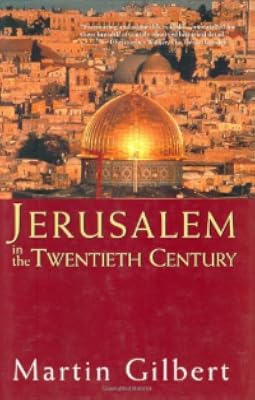
Tuchman is a lucid and wonderful writer and historian. Here, her first work, is just as good as her latter works. Here she shows the connections between Britain and Israel from olden times to the early twentieth century, with focus more on the times from say 1700 to 1917. It made me want to jump right in and tackle Martin Gilbert's history of Israel.
A masterful survey of the relationship between England and Israel, drawn back to the time before there was an England. The author traces the major players in the millennia of events that led toward the Balfour Declaration, and concludes that the declaration was not inevitable until a particular point in the nineteenth century; prior to that, things could have gone otherwise. There are some errors in the book that are hardly the fault of the author, since she could not be expected to report what was not known at the time she wrote the book, so her reports that archaeology always seemed to support the Biblical narrative jar in this day and time when new information shows that isn't so, but again, she worked with the best information she show more had. The main beef I have is that, in spite of her claims to be objective, explaining that she did not cover the period from Balfour on because she couldn't be objective, ring hollow when one reads her frequent cheerleading for Israel, the blunt statement that the anti-Zionists were wrong, and the use of fortunately and/or unfortunately when things went the direction she did not favor. In spite of all her well written rhetoric, she was unable to convince me that the Jewish community had any greater claim to the land of their desire than the inhabitants then in the land (who get mentioned a mere twice in passing as though there were some scattered goats and a shepherd or two). It would have been interesting to have heard more about the arguments of the anti-Zionists, especially during the late nineteenth/early twentieth century period as the creation of a Jewish state in Uganda vs. in Israel was being debated. Still, it is informative and interesting, and well worth reading, though it will not be a simple, quick read. You will need to commit yourself to the book for a period of many hours. If you do, you will come out with, hopefully, a clearer understanding of the history of this disputed area, though notably mostly from the standpoint of one country that was involved. show less
An excellent review of the historical factors that led to the close association of the British Empire and the concept of the return to the Jewish Homeland. For religious, military and economic reasons, it almost became inevitable. Tuchman focuses on the 18th and 19th centuries, though she traces the roots of the issue back to the first centuries. Very well done.
From the Bronze Age to the Balfour Declaration, this book does much to explain British and by extension Western European (Anglo-American) support of Zionistic policies. The author shows how the Protestant Reformation in its anti-Catholic tendencies in England brought about a focus on Old Testament and thus Jewish thought. Religiously motivated desire for a Jewish return (even in some cases millenarian thinking that this would bring about the return of Christ), 'crusades by other means' became traditional, in-grained and set foreign policy by the time of WW I. There was obviously much more success in reinstating Israel than in converting Jews to Christianity.
Members
- Recently Added By
Lists

The Emergence of the Modern Middle East
289 works; 13 members
Author Information

28+ Works 29,845 Members
Barbara W. Tuchman achieved prominence as a historian with The Zimmermann Telegram, and international fame with The Guns of August--a huge bestseller and winner of the Pulitzer Prize. There followed other successes, including The Proud Tower, Stilwell and the American Experience in China (also awarded the Pulitzer Prize), A Distant Mirror, The show more March of Folly, and The First Salute. show less
Common Knowledge
- Canonical title
- Bible and Sword: England and Palestine from the Bronze Age to Balfour
- Original publication date
- 1956
- People/Characters
- Anthony Ashley-Cooper, 7th Earl of Shaftesbury; Robert Gascoyne-Cecil, 3rd Marquess of Salisbury
- Important places
- Palestine; England, UK
- Important events
- Balfour Declaration (1917)
Classifications
Statistics
- Members
- 925
- Popularity
- 28,913
- Reviews
- 18
- Rating
- (3.62)
- Languages
- 5 — Dutch, English, German, Hebrew, Swedish
- Media
- Paper, Audiobook, Ebook
- ISBNs
- 23
- ASINs
- 15