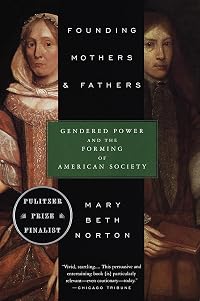
Founding Mothers & Fathers: Gendered Power and the Forming of American Society
by Mary Beth Norton
On This Page
Description
Focusing on the first half-century of English settlement - approximately 1620 to 1670 - Mary Beth Norton looks not only at what colonists actually did but also at the philosophical basis for what they thought they were doing. She weaves theory and reality into a tapestry that reveals colonial life as more varied than we have supposed. She draws our attention to all early dysfunctional family extending over several generations and colonies. The basic worldview of this early period, Norton show more demonstrates, envisaged family, society, and state as similar institutions. She shows us how, because of that familial analogy, women who wielded power in the household could also wield surprising authority outside the home. We see, for example, Mistress Margaret Brent given authority as attorney for Lord Baltimore, Maryland's Proprietor, and Mistress Anne Hutchinson, who sought and assumed religious authority, causing the greatest political crisis in Massachusetts Bay. Norton also describes the American beginnings of another way of thinking. She argues that an imbalanced sex ratio in the Chesapeake colonies made it impossible to establish "normal" familial structures, and thus equally impossible to employ the family model as unself-consciously as was done in New England. The Chesapeake, accordingly, became a practical laboratory for the working out of a "Lockean" political system that drew a line between family and state, between "public" and "private." In this scheme, women had no formal, recognized role beyond the family. It is this worldview that eventually came to characterize the Enlightenment and that still looms large in today's culture wars. show lessTags
Recommendations




Member Reviews
Margaret Atwood has noted that one of her inspirations for the "Handmaid’s Tale" was her study of 17th-century Puritan New England. That note in itself might be a reason to dip into this book, and a reader would find some satisfying parallels. But this was not why I read it. I’ve had a long-time interest in the lives and experiences of women (woman studies, as you will) ; I’ve read Mary Beth Norton’s work before (her book on the Salem Witch Trials is one of the best I’ve read, if not the best). and because my family roots almost entirely pass through this period in 17th century New England (literally many hundreds of them) so I read out of interest and curiosity, and because it provides context to my ancestry pursuits (oh, and show more yes, I live in New England). I felt compelled to take copious notes while reading this book, likely one of the reason it took me so long to get through it, and I find these notes of little use in my effort to write a review of this book, nor did notes really enhance my reading (note to self: skip the notes).
.
"Founding Mothers and Fathers" is a balanced study of gendered power in the early 17th century colonies of America (roughly 1620-1670), it notes English political and societal precedents (Filmer and Locke’s formulations of political power and the nature of government authority) and how the precedents were applied in the development of the early colonies of America. Because of the availability of records, Norton focuses mostly on two New England colonies (Massachusetts Bay and New Haven) and two in the Chesapeake (Maryland & Virginia). She discusses gendered power within the family, the community and in the state, and how similar these institutions were to each other. She also discusses how differently New England and the Chesapeake develop according to the differing makeup of their populations and their priorities.
One of the strengths of this book is Norton’s inclusion of the voices of real people presented as articulated through court documents or personal writings. And her illustrative examples are both very welcome and wonderfully effective elucidating the practical functioning of the societies. Much more could be included in this review, and if needed, one can search for the copiously more detailed and erudite reviews for this book online. Otherwise, here is a very modest, off-the-top-of-my-head list of some of the many fascinating and interesting bits of content:
*The importance of good relations with neighbors.
*The authority and investigative powers of the midwife.
*The complications or limitations of a widow becoming a head of household.
*How very little men of the time knew about pregnancy & childbirth and that women were known to be ‘especially knowledgable of sexual matters
*The importance of guarding one’s reputation.
*The power and societal functions of gossip.
*In 1648 the New England colony adopted a death penalty for rebellious children over 16 who cursed or struck either parent (very few were prosecuted).
*The most common insults between men (rogue, knave) and between women (whore, jade, thief, toad, slut).
*How in New England the family was the considered the lowest court in the court system.
*The existence of divorce as a legally voided civil contract.
*To sue a wife you had to sue the husband.
*The exceptions to many of the rules and norms.
*That men had many ways to express their anger and thus possibilities of a vengeful attack was endless.
*The standard punishment in Plymouth for adultery was for the woman to wear a badge on their sleeve with the letters “AD” on it for a period of time, and if found without it, she would be branded on her face.
*A misbehaving colonist was more likely to be tried & convicted in NE than in the Chesapeake and differences in law enforcement.
*Whipping was the 2nd most popular punishment in both regions.
*How in a very gendered world, a Chesapeake court handled the case of an ambiguously gendered person. show less
.
"Founding Mothers and Fathers" is a balanced study of gendered power in the early 17th century colonies of America (roughly 1620-1670), it notes English political and societal precedents (Filmer and Locke’s formulations of political power and the nature of government authority) and how the precedents were applied in the development of the early colonies of America. Because of the availability of records, Norton focuses mostly on two New England colonies (Massachusetts Bay and New Haven) and two in the Chesapeake (Maryland & Virginia). She discusses gendered power within the family, the community and in the state, and how similar these institutions were to each other. She also discusses how differently New England and the Chesapeake develop according to the differing makeup of their populations and their priorities.
One of the strengths of this book is Norton’s inclusion of the voices of real people presented as articulated through court documents or personal writings. And her illustrative examples are both very welcome and wonderfully effective elucidating the practical functioning of the societies. Much more could be included in this review, and if needed, one can search for the copiously more detailed and erudite reviews for this book online. Otherwise, here is a very modest, off-the-top-of-my-head list of some of the many fascinating and interesting bits of content:
*The importance of good relations with neighbors.
*The authority and investigative powers of the midwife.
*The complications or limitations of a widow becoming a head of household.
*How very little men of the time knew about pregnancy & childbirth and that women were known to be ‘especially knowledgable of sexual matters
*The importance of guarding one’s reputation.
*The power and societal functions of gossip.
*In 1648 the New England colony adopted a death penalty for rebellious children over 16 who cursed or struck either parent (very few were prosecuted).
*The most common insults between men (rogue, knave) and between women (whore, jade, thief, toad, slut).
*How in New England the family was the considered the lowest court in the court system.
*The existence of divorce as a legally voided civil contract.
*To sue a wife you had to sue the husband.
*The exceptions to many of the rules and norms.
*That men had many ways to express their anger and thus possibilities of a vengeful attack was endless.
*The standard punishment in Plymouth for adultery was for the woman to wear a badge on their sleeve with the letters “AD” on it for a period of time, and if found without it, she would be branded on her face.
*A misbehaving colonist was more likely to be tried & convicted in NE than in the Chesapeake and differences in law enforcement.
*Whipping was the 2nd most popular punishment in both regions.
*How in a very gendered world, a Chesapeake court handled the case of an ambiguously gendered person. show less
Ratings
Members
- Recently Added By
Lists

Best U.S. History Books (1754-1828)
363 works; 18 members

Books in the Bibliography of Contested Continent by Peter Mancall
495 works; 1 member
Author Information

27+ Works 2,853 Members
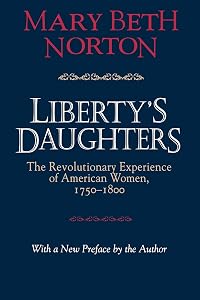
Mary Beth Norton is Mary Donlon Alger Professor of History at Cornell University. She is the author of many books, including Liberty's Daughters: The Revolutionary Experience of American Women, 1750-1800, also from Cornell; In the Devil's Snare: The Salem Witchcraft Crisis of 1692; and Founding Mothers Fathers: Gendered Power and the Forming of show more American Society. show less
Awards and Honors
Awards
Common Knowledge
- Important places
- USA
- Original language
- English
Classifications
- Genres
- Nonfiction, History, General Nonfiction, Sexuality and Gender Studies
- DDC/MDS
- 306.0973 — Society, government, & culture Social sciences, sociology & anthropology Social Behavior - Dating, Marriage, Divorce Social history North America United States
- LCC
- HQ1075.5 .U6 .N67 — Social sciences The family. Marriage, Women and Sexuality The Family. Marriage. Women Sex role
- BISAC
Statistics
- Members
- 256
- Popularity
- 126,486
- Reviews
- 1
- Rating
- (3.93)
- Languages
- English
- Media
- Paper, Ebook
- ISBNs
- 3
- ASINs
- 1