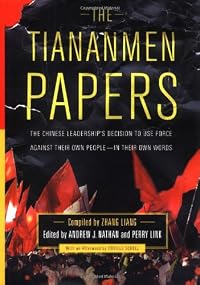
The Tiananmen Papers
by Liang Zhang
On This Page
Description
Compiles internal government and Communist Party documents to chronicle the 1989 pro-democracy demonstrations in China, revealing the decisions that led to the use of military force against the student demonstrators in Tiananmen Square.Tags
Recommendations







Member Reviews
OK I'll start with a disclaimer: you should not bring this book with you on your next vacation in China because this contains highly sensitive, confidential, and provocative contents. Books like these are what the Chinese government labels as materials that "threaten national security." The Tienanmen Paper is a collection of documents depicting the inner-workings and Chinese top leaders' decision on pulling in PLA (People's Liberation Army) into Beijing on June 3, 1989. These documents, which were secretively smuggled out of China, give a clear perspective on the events that lead to the massacre shortly after midnight on June 4, 1989.
While the book does not add on to what we already know about the Tienanmen massacre, it does give us a show more feel for how decision-making works at the very lop leadership. It clearly indicates that the turmoil split the top leadership into opposing fractions. The documents confirm the fact that dismissal of Party Secretary Zhao Ziyang, who was pro-reform in the Communist Party, was not a coincidence. He was removed from office upon his firm refusal to declare martial law and send in troops to drive students out of Tienanmen.
The leaders already had an idea of how to suppress any democratic sit-ins and riots as soon as students walked out from the classrooms and made their ways into Tienanmen square. A general who wanted to remain anonymous from a memoir commented, "Army is the Army. Power is what is most important to the rulers of this country. They don't care what foreigners think. They don't care what the students want. The demonstrators are threatening their power. That is what they are thinking about. So the students will die." Decisions had long been made. They just had to get rid of any opposing efforts and those who opposed. Outsiders (foreigners and Chinese who live in remote parts of the country) often think what they could not see and could not hear wasn't there. And Tienanmen Paper has filled this gap. Every gesture, voice, meeting, decision made by the leaders is laid bare.
We saw gunfire, screaming, and fighting. We saw students falling, laying in blood. We saw tear gas and rubber bullets. We saw trucks and tankers sitting bumper to bumper. We saw the officers in cars racing up and down the line supervising the caravan. We saw common people demanding the soldiers turn around and leave the city. We saw other people shaking their fists and denouncing the soldiers. We saw buses and vehicles burning at intersections, windows of apartment buildings flickering. But one thing we miss: the troops called into Beijing by Yang Sheungkun, or the 38th company of the PLA, has no clue of the democratic movement started by students. The troops were brought in from some remote province of the country and they knew they had to listen to the order from above. As one bystander recalled, "The soldiers made no eye contact with the street crowd. They looked absolutely clueless and blank." This confirms the invaluable contribution by The Tienanmen Paper, a book that gives us idea of how top leaders monopolize decision-making. show less
While the book does not add on to what we already know about the Tienanmen massacre, it does give us a show more feel for how decision-making works at the very lop leadership. It clearly indicates that the turmoil split the top leadership into opposing fractions. The documents confirm the fact that dismissal of Party Secretary Zhao Ziyang, who was pro-reform in the Communist Party, was not a coincidence. He was removed from office upon his firm refusal to declare martial law and send in troops to drive students out of Tienanmen.
The leaders already had an idea of how to suppress any democratic sit-ins and riots as soon as students walked out from the classrooms and made their ways into Tienanmen square. A general who wanted to remain anonymous from a memoir commented, "Army is the Army. Power is what is most important to the rulers of this country. They don't care what foreigners think. They don't care what the students want. The demonstrators are threatening their power. That is what they are thinking about. So the students will die." Decisions had long been made. They just had to get rid of any opposing efforts and those who opposed. Outsiders (foreigners and Chinese who live in remote parts of the country) often think what they could not see and could not hear wasn't there. And Tienanmen Paper has filled this gap. Every gesture, voice, meeting, decision made by the leaders is laid bare.
We saw gunfire, screaming, and fighting. We saw students falling, laying in blood. We saw tear gas and rubber bullets. We saw trucks and tankers sitting bumper to bumper. We saw the officers in cars racing up and down the line supervising the caravan. We saw common people demanding the soldiers turn around and leave the city. We saw other people shaking their fists and denouncing the soldiers. We saw buses and vehicles burning at intersections, windows of apartment buildings flickering. But one thing we miss: the troops called into Beijing by Yang Sheungkun, or the 38th company of the PLA, has no clue of the democratic movement started by students. The troops were brought in from some remote province of the country and they knew they had to listen to the order from above. As one bystander recalled, "The soldiers made no eye contact with the street crowd. They looked absolutely clueless and blank." This confirms the invaluable contribution by The Tienanmen Paper, a book that gives us idea of how top leaders monopolize decision-making. show less
Fantastic insider account of Teanamen fiasco. Propulsive, fair and suspenseful! Great job by editors.
Ratings
Members
- Recently Added By
Lists

All Things China
205 works; 3 members
Author Information
2 Works 287 Members
Work Relationships
Is an abridged version of
Common Knowledge
- People/Characters
- Tank Man
- Important places
- Beijing, China; Tiananmen Square; China
Classifications
- Genres
- History, Nonfiction, General Nonfiction, Politics and Government
- DDC/MDS
- 951.058 — History & geography History of Asia East Asia: China, Taiwan, Hong Kong, Korea History 1949- (People's Republic, 20th century) 1980-1989
- LCC
- DS779.32 .L54 — History of Europe, Asia, Africa and Oceania Asia History of Asia China History
- BISAC
Statistics
- Members
- 283
- Popularity
- 113,474
- Reviews
- 2
- Rating
- (3.83)
- Languages
- Dutch, English, German
- Media
- Paper, Ebook
- ISBNs
- 6
- ASINs
- 1