
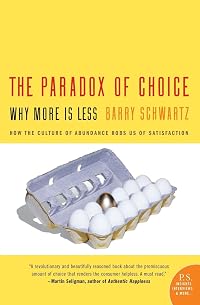
The Paradox of Choice: Why More Is Less
by Barry Schwartz
On This Page
Description
Whether we're buying a pair of jeans, ordering a cup of coffee, selecting a long-distance carrier, applying to college, choosing a doctor, or setting up a 401(k), everyday decisions-both big and small-have become increasingly complex due to the overwhelming abundance of choice with which we are presented. As Americans, we assume that more choice means better options and greater satisfaction. But beware of excessive choice: choice overload can make you question the decisions you make before show more you even make them, it can set you up for unrealistically high expectations, and it can make you blame yourself for any and all failures. In the long run, this can lead to decision-making paralysis, anxiety, and perpetual stress. And, in a culture that tells us that there is no excuse for falling short of perfection when your options are limitless, too much choice can lead to clinical depression. In The Paradox of Choice, Barry Schwartz explains at what point choice-the hallmark of individual freedom and self-determination that we so cherish-becomes detrimental to our psychological and emotional well-being. In accessible, engaging, and anecdotal prose, Schwartz shows how the dramatic explosion in choice-from the mundane to the profound challenges of balancing career, family, and individual needs-has paradoxically become a problem instead of a solution. Schwartz also shows how our obsession with choice encourages us to seek that which makes us feel worse. By synthesizing current research in the social sciences, Schwartz makes the counter intuitive case that eliminating choices can greatly reduce the stress, anxiety, and busyness of our lives. He offers eleven practical steps on how to limit choices to a manageable number, have the discipline to focus on those that are important and ignore the rest, and ultimately derive greater satisfaction from the choices you have to make. show lessTags
Recommendations




Member Recommendations
Member Reviews
2,5/5
I've made a bad choice by reading this book out of MILLIONS out there. What a fool I am!
Just kidding. But I gotta say, he focuses a lot on the exemplifying and the such. And when I mean a lot, I mean it.
It's frustrating, it's exhausting, it's time wasting and he did it with less than 300 pages. I think he or its publisher didn't wanted to release such a short book, so they filled it with repetition.
I also need to point there that it's even worse if you're already read [b:Thinking, Fast and Slow|11468377|Thinking, Fast and Slow|Daniel Kahneman|https://images.gr-assets.com/books/1317793965s/11468377.jpg|16402639] by Daniel Kahneman (quite probably you did), and because it's pretty pessimist overall. I don't agree with many things show more presented and some conclusions are questionable.
"As this chapter has shown, decisions like these arouse discomfort, and they force indecision. Students take time off, take on odd jobs, try out internships, hoping that the right answer to the “What should I be when I grow up?” question will emerge. One quickly learns that “What are you going to do when you graduate?” is not a question many students are eager to hear, let alone answer. It is hard to avoid the conclusion that my students might be better off with a little less talent or with a little more of a sense that they owed it to their families to settle down back home, or even a dose of Depression-era necessity—take the secure job and get on with it! With fewer options and more constraints, many trade-offs would be eliminated, and there would be less self-doubt, less of an effort to justify decisions, more satisfaction, and less second-guessing of the decisions once made."
Really?
If you've read this and you're still willing to read the book, skip Part I. Seriously. You won't miss anything. It talks about the overload of choices we have e.g. at the supermarket and gives the advice to not care much about so many choices... but if we weren't already doing so, we couldn't live our lives. The main problem with repetition is that he does it throughout the whole book.
I would say that you can skip the first half from Part III too. It could easily be a 4/5 book, but there are many things to improve. show less
I've made a bad choice by reading this book out of MILLIONS out there. What a fool I am!
Just kidding. But I gotta say, he focuses a lot on the exemplifying and the such. And when I mean a lot, I mean it.
It's frustrating, it's exhausting, it's time wasting and he did it with less than 300 pages. I think he or its publisher didn't wanted to release such a short book, so they filled it with repetition.
I also need to point there that it's even worse if you're already read [b:Thinking, Fast and Slow|11468377|Thinking, Fast and Slow|Daniel Kahneman|https://images.gr-assets.com/books/1317793965s/11468377.jpg|16402639] by Daniel Kahneman (quite probably you did), and because it's pretty pessimist overall. I don't agree with many things show more presented and some conclusions are questionable.
"As this chapter has shown, decisions like these arouse discomfort, and they force indecision. Students take time off, take on odd jobs, try out internships, hoping that the right answer to the “What should I be when I grow up?” question will emerge. One quickly learns that “What are you going to do when you graduate?” is not a question many students are eager to hear, let alone answer. It is hard to avoid the conclusion that my students might be better off with a little less talent or with a little more of a sense that they owed it to their families to settle down back home, or even a dose of Depression-era necessity—take the secure job and get on with it! With fewer options and more constraints, many trade-offs would be eliminated, and there would be less self-doubt, less of an effort to justify decisions, more satisfaction, and less second-guessing of the decisions once made."
Really?
If you've read this and you're still willing to read the book, skip Part I. Seriously. You won't miss anything. It talks about the overload of choices we have e.g. at the supermarket and gives the advice to not care much about so many choices... but if we weren't already doing so, we couldn't live our lives. The main problem with repetition is that he does it throughout the whole book.
I would say that you can skip the first half from Part III too. It could easily be a 4/5 book, but there are many things to improve. show less
I had such high hopes for this book. I was expecting it to focus largely on consumer culture, and to have some profound 'light bulb' moments that would really make me stop and think. Not that it didn't try, but unfortunately it never really hit the spot for me.
In actual fact, Schwartz focuses more on the psychological than the sociological, and widens his arguments to cover the choices we make in everything from education and careers to houses and cars to jeans and jam. The prevailing theme of the book is how the growth of choice in modern society, and the emphasis on the individual as the maker of choices, has taken us beyond freedom and into the realms of tyranny. Choice no longer liberates us; it spins us into its web and holds us show more there, stuck in our own uncertainty and fear. We no longer choose between three pairs of jeans in a store - we choose between ten different fits, three different leg lengths and four different colours. The same decision, however trivial it might be, now has higher stakes and many more alternatives to consider. This, Schwartz argues, plunges us into a constant whirlwind of regret, comparison, uncertainty, disappointment and even depression.
I think Schwartz provides a compelling and relatable case against excessive choice, which certainly made me stop to ponder just how much of our time we devote to comparing, researching and choosing between different options in even the most inconsequential areas of our lives. His eleven methods for reducing the negative effects of choice make sense, though for me as one of his 'satisficers' (people happy with 'good enough', as opposed to 'maximisers' who make their task more difficult by always looking for the best) I didn't feel I really had too much to learn from them.
My main problem with the book was that it was just too long. There was a lot of repetition - of ideas, anecdotes and examples - and the middle of the book really started to drag. Cutting the whole thing down by about 50 pages and sharpening the pace would have improved the reading experience without damaging the argument. I also noticed from the notes at the back that some of Schwartz's examples had been directly lifted from other people's work, without it being evident in the main body of text (the notes aren't numbered), which I thought was a bit sneaky. To sum up, maximisers and perfectionists might learn something important from this book, but satisficers - I wouldn't bother. It'd be like preaching to the choir anyway, so use your superior powers of choice to take you on to the next book! show less
In actual fact, Schwartz focuses more on the psychological than the sociological, and widens his arguments to cover the choices we make in everything from education and careers to houses and cars to jeans and jam. The prevailing theme of the book is how the growth of choice in modern society, and the emphasis on the individual as the maker of choices, has taken us beyond freedom and into the realms of tyranny. Choice no longer liberates us; it spins us into its web and holds us show more there, stuck in our own uncertainty and fear. We no longer choose between three pairs of jeans in a store - we choose between ten different fits, three different leg lengths and four different colours. The same decision, however trivial it might be, now has higher stakes and many more alternatives to consider. This, Schwartz argues, plunges us into a constant whirlwind of regret, comparison, uncertainty, disappointment and even depression.
I think Schwartz provides a compelling and relatable case against excessive choice, which certainly made me stop to ponder just how much of our time we devote to comparing, researching and choosing between different options in even the most inconsequential areas of our lives. His eleven methods for reducing the negative effects of choice make sense, though for me as one of his 'satisficers' (people happy with 'good enough', as opposed to 'maximisers' who make their task more difficult by always looking for the best) I didn't feel I really had too much to learn from them.
My main problem with the book was that it was just too long. There was a lot of repetition - of ideas, anecdotes and examples - and the middle of the book really started to drag. Cutting the whole thing down by about 50 pages and sharpening the pace would have improved the reading experience without damaging the argument. I also noticed from the notes at the back that some of Schwartz's examples had been directly lifted from other people's work, without it being evident in the main body of text (the notes aren't numbered), which I thought was a bit sneaky. To sum up, maximisers and perfectionists might learn something important from this book, but satisficers - I wouldn't bother. It'd be like preaching to the choir anyway, so use your superior powers of choice to take you on to the next book! show less
This is another in a seemingly endless procession of recent pop-psych/pop-econ books. So many to choose from!
Like so many others, Schwartz describes concepts and phenomena like opportunity cost, diminishing returns, loss aversion etc. in terms of his thesis. That is, contrary to popular wisdom (side note: with all these pop-psych/pop-econ books out there, I'm beginning to think that only the ideas that have any merit are those that run contrary to popular wisdom.), the widening array of choices everywhere in life has a detrimental effect on our happiness.
For starters, I partially disagree with his premise that freer markets lead to more choice. Freer markets also lead to firm concentration and scale or volume effects, which put downward show more pressure on the number of choices available. For example, shirts that used to be sold by collar size are now S, M, L, XL. I can't find jeans made with heavier gauge denim anymore. The quirky independent bookstore with the eclectic selection went out of business. But, overall it seems like there are more choices out there in many markets, and that is enough to make his premise functional. Whether there has actually been an increase in the differences between choices (personally, I would bet on a decrease) is another matter.
Next quibble: it isn't until you are well into the book that Schwartz admits the abundance of choice negatively affects only a subset of the population: the maximizers, or those who try to wring every last drop of utility from their decisions. The paradox is not universal. At this point it turns into more of a self-help book for maximizers.
Final complaint: This book is padded for length. Badly. Many sections reminded me of a student trying to stretch his or her essay out to the minimum number of pages, much to the detriment of the book. The thesis is stretched beyond its limits of applicability. A section on the downside of peoples' choices of religion? Another on their choices of race??? And there is example, after example, after example. I will be so, so relieved when today's technological upheavals in the publishing industry finally do away with this standard length (~75,000 words) for popular non-fiction.
Overall I think this is a worthwhile read, especially for those who tend to agonize over their decisions. show less
Like so many others, Schwartz describes concepts and phenomena like opportunity cost, diminishing returns, loss aversion etc. in terms of his thesis. That is, contrary to popular wisdom (side note: with all these pop-psych/pop-econ books out there, I'm beginning to think that only the ideas that have any merit are those that run contrary to popular wisdom.), the widening array of choices everywhere in life has a detrimental effect on our happiness.
For starters, I partially disagree with his premise that freer markets lead to more choice. Freer markets also lead to firm concentration and scale or volume effects, which put downward show more pressure on the number of choices available. For example, shirts that used to be sold by collar size are now S, M, L, XL. I can't find jeans made with heavier gauge denim anymore. The quirky independent bookstore with the eclectic selection went out of business. But, overall it seems like there are more choices out there in many markets, and that is enough to make his premise functional. Whether there has actually been an increase in the differences between choices (personally, I would bet on a decrease) is another matter.
Next quibble: it isn't until you are well into the book that Schwartz admits the abundance of choice negatively affects only a subset of the population: the maximizers, or those who try to wring every last drop of utility from their decisions. The paradox is not universal. At this point it turns into more of a self-help book for maximizers.
Final complaint: This book is padded for length. Badly. Many sections reminded me of a student trying to stretch his or her essay out to the minimum number of pages, much to the detriment of the book. The thesis is stretched beyond its limits of applicability. A section on the downside of peoples' choices of religion? Another on their choices of race??? And there is example, after example, after example. I will be so, so relieved when today's technological upheavals in the publishing industry finally do away with this standard length (~75,000 words) for popular non-fiction.
Overall I think this is a worthwhile read, especially for those who tend to agonize over their decisions. show less
The author points out the inherent contradiction between our political ideology that says that personal freedom should be unlimited, leaving us free to choose whatever we want, and the psychological reality that too many choices leads to increased dissatisfaction and unhappiness.
This outcome is the confluence of multiple factors: Increased choice means we bear a greater responsibility for the outcomes of decisions; this responsibility compels some people to seek to maximize the value of each choice, which alone is a time-consuming effort that deprives them of other things in life that are known to be more directly related to life satisfactions, like social relationships; but because we cannot consider all possible options, any decision show more made is already tainted with regret and other negative emotions that decrease the psychological satisfaction and enjoyment of the thing chosen. Although Americans live in a world of increased affluence and choices, the cumulative effect is that we are increasingly miserable and depressed. show less
This outcome is the confluence of multiple factors: Increased choice means we bear a greater responsibility for the outcomes of decisions; this responsibility compels some people to seek to maximize the value of each choice, which alone is a time-consuming effort that deprives them of other things in life that are known to be more directly related to life satisfactions, like social relationships; but because we cannot consider all possible options, any decision show more made is already tainted with regret and other negative emotions that decrease the psychological satisfaction and enjoyment of the thing chosen. Although Americans live in a world of increased affluence and choices, the cumulative effect is that we are increasingly miserable and depressed. show less
This is a thoughtful and thorough analysis about the overwhelm heaped on us by modern consumerism. The author draws from research, personalizing it through is own experiences and observations. At times he takes a stance against having so much choice. I'm more inclined to hope human awareness and technological advancements will help mitigate the worse cases and their effects.
Interesting ideas about abundant choice and its effect on emotional well-being. My main complaint is that this book is a bit oversimplified -- I would have liked more supporting details/citations/anecdotes than Schwartz tended to give... I felt like I already knew most of this coming in based on his appearance on Radio Lab.
Still, interesting.
Still, interesting.
Schwartz describes how having an excessive amount of choice in our lives can bring unhappiness and suffering. He describes some of the many sources of choices in modern life, some psychological factors relating to choice making, how choices can cause unhappiness, and some techniques for dealing with this unhappiness.
First of all, Schwartz emphasizes that choice is good. It is vital to happiness. However, he claims that in the here and now of the 21st century US, we are overwhelmed with choices, most of which are not important and many of which were not faced in the past. Schwartz's claim is that while choice is important, having to use brain power on unimportant choices slowly chips away at happiness. The important choices differ for show more each individual, so society should not necessarily work to decrease the choices available. However, individuals need to learn how to focus on choices that are important for them and ignore the rest.
Schwartz then discusses decision making. Decision making includes figuring out goals, evaluating the importance of each goal, arraying the options, evaluating each option relative to the goals, pick the winning option, and later using the consequences of the choice to modify future decision making processes. In practice, this process if followed partially and with limited consciousness.
Schwartz proposes that there are two types of choosers: maximizers and satisficers. Maximizers want to make the best decisions. Satisficers have a set of goals and are satisfied with any choice that fulfills those goals. Schwartz claims that maximizers might get objectively better results than satisficers, but satisficers get better subjective results (that is, they are happier). Everyone is a maximizer in some areas and a satisficer in others, but most people have a general tendency one way or the other.
The core of the book explores how choice decreases happiness. There are two key points. First, comparing a choice made with a choice that could have been made generally decreases happiness; it is likely that there is some way in which the another choice was superior to the chosen option, even if it was the best choice overall. Second, people adapt; over time, the happiness derived from a choice decreases, contrary to expectations that the happiness would remain constant. These two factors make people more likely to regret the choices they and more likely to feel they do not have control over their happiness. Furthermore, these factors will be more potent for maximizers because they cannot fall back on the idea that their goals were met.
After making a convincing case that excessive choice can decrease happiness, Schwartz discusses a set of tips for preventing too much choice from decreasing your happiness:
- Choose when to choose. Not all decisions on important. Decide which ones are important to you, and do not worry about the rest.
- Be a chooser, not a picker. Make your decisions based on your goals, not just by picking something out of all the choices available. This means that if nothing fits your goals, you may choose not to take any of the options.
- Satisfice more and maximize less.
- Think about the opportunity costs of opportunity costs. That is, limit how much you think about the opportunities you are missing out on.
- Make your decisions non-reversible. This one seems counter intuitive, but the idea is that if you cannot unmake a choice, you are more likely to try to be satisfied with it and making it work.
- Practice an "attitude of gratitude". If you focus on why the choices you have already made were the right choice to make, you will have an easier time not comparing it negatively to the choices you could have made.
- Regret less. Be a satisficer, not a maximizer. Reduce the number of options you have; you cannot miss what you do not know about.
- Anticipate adaption. Know that the pleasure a choice brings you in the future will probably not be as much as the initial pleasure it gives you so that you will not be disappointed when that happens.
- Control expectations. Set your expectations based on your goals and your needs. Be especially wary of letting others (especially the media or advertising) set your expectations.
- Curtail social comparison. Compare yourself to others less. Try to let your satisfaction be determined by how you feel about a decision, not how the actions or choices of others make you think you should feel.
- Learn how to love constraints. Constraints can decrease the amount of time you spend on the unimportant choices and give you the time to focus on the important ones.
Schwartz justifies his claims reasonably well with citations of psychological studies, and he is generally good at pointing out which claims are his own hypotheses and inferences and which are not. Overall, his arguments are convincing, and his claims generally consistent with my own experience, so I am willing to believe with his overall premise that too much choice can decrease happiness.
My main criticism of The Paradox of Choice is that it often seemed like Schwartz was bulking up his points with repetition to make the book longer. The primary content of the book could have fit into a long essay. Since there is not really a market for long essays these days, I do not blame Schwartz for bulking things up to make it book length.
After reading this book, I am going to consciously try to be aware of when I am making choices, when those choices are decreasing my happiness, and what choices are important to me. That awareness alone is reason enough to have read the book for me. show less
First of all, Schwartz emphasizes that choice is good. It is vital to happiness. However, he claims that in the here and now of the 21st century US, we are overwhelmed with choices, most of which are not important and many of which were not faced in the past. Schwartz's claim is that while choice is important, having to use brain power on unimportant choices slowly chips away at happiness. The important choices differ for show more each individual, so society should not necessarily work to decrease the choices available. However, individuals need to learn how to focus on choices that are important for them and ignore the rest.
Schwartz then discusses decision making. Decision making includes figuring out goals, evaluating the importance of each goal, arraying the options, evaluating each option relative to the goals, pick the winning option, and later using the consequences of the choice to modify future decision making processes. In practice, this process if followed partially and with limited consciousness.
Schwartz proposes that there are two types of choosers: maximizers and satisficers. Maximizers want to make the best decisions. Satisficers have a set of goals and are satisfied with any choice that fulfills those goals. Schwartz claims that maximizers might get objectively better results than satisficers, but satisficers get better subjective results (that is, they are happier). Everyone is a maximizer in some areas and a satisficer in others, but most people have a general tendency one way or the other.
The core of the book explores how choice decreases happiness. There are two key points. First, comparing a choice made with a choice that could have been made generally decreases happiness; it is likely that there is some way in which the another choice was superior to the chosen option, even if it was the best choice overall. Second, people adapt; over time, the happiness derived from a choice decreases, contrary to expectations that the happiness would remain constant. These two factors make people more likely to regret the choices they and more likely to feel they do not have control over their happiness. Furthermore, these factors will be more potent for maximizers because they cannot fall back on the idea that their goals were met.
After making a convincing case that excessive choice can decrease happiness, Schwartz discusses a set of tips for preventing too much choice from decreasing your happiness:
- Choose when to choose. Not all decisions on important. Decide which ones are important to you, and do not worry about the rest.
- Be a chooser, not a picker. Make your decisions based on your goals, not just by picking something out of all the choices available. This means that if nothing fits your goals, you may choose not to take any of the options.
- Satisfice more and maximize less.
- Think about the opportunity costs of opportunity costs. That is, limit how much you think about the opportunities you are missing out on.
- Make your decisions non-reversible. This one seems counter intuitive, but the idea is that if you cannot unmake a choice, you are more likely to try to be satisfied with it and making it work.
- Practice an "attitude of gratitude". If you focus on why the choices you have already made were the right choice to make, you will have an easier time not comparing it negatively to the choices you could have made.
- Regret less. Be a satisficer, not a maximizer. Reduce the number of options you have; you cannot miss what you do not know about.
- Anticipate adaption. Know that the pleasure a choice brings you in the future will probably not be as much as the initial pleasure it gives you so that you will not be disappointed when that happens.
- Control expectations. Set your expectations based on your goals and your needs. Be especially wary of letting others (especially the media or advertising) set your expectations.
- Curtail social comparison. Compare yourself to others less. Try to let your satisfaction be determined by how you feel about a decision, not how the actions or choices of others make you think you should feel.
- Learn how to love constraints. Constraints can decrease the amount of time you spend on the unimportant choices and give you the time to focus on the important ones.
Schwartz justifies his claims reasonably well with citations of psychological studies, and he is generally good at pointing out which claims are his own hypotheses and inferences and which are not. Overall, his arguments are convincing, and his claims generally consistent with my own experience, so I am willing to believe with his overall premise that too much choice can decrease happiness.
My main criticism of The Paradox of Choice is that it often seemed like Schwartz was bulking up his points with repetition to make the book longer. The primary content of the book could have fit into a long essay. Since there is not really a market for long essays these days, I do not blame Schwartz for bulking things up to make it book length.
After reading this book, I am going to consciously try to be aware of when I am making choices, when those choices are decreasing my happiness, and what choices are important to me. That awareness alone is reason enough to have read the book for me. show less
Members
- Recently Added By
Published Reviews
ThingScore 75
Schwartz, in an effort to help us mend our ways, applies to individual shoppers Simon’s distinction between maximizing and satisficing. A maximizer is someone who “can’t be certain that she has found the best sweater unless she’s looked at all the sweaters,” Schwartz writes.
added by mikeg2
Lists

Psicología - Clásicos
165 works; 2 members

Books Read in 2015
3,299 works; 126 members

Mind Expanding Books by hackerkid
581 works; 8 members

My List
302 works; 1 member
Author Information

17+ Works 3,695 Members
Barry Schwartz is the Dorwin Cartwright Professor of Social Theory and Social Action at Swarthmore College. He is the author of several books, including Practical Wisdom: The Right Way to Do the Right Thing, with Kenneth Sharpe, and Why We Work. His articles have appeared in many of the leading journals in his field, including American show more Psychologist. show less
Some Editions
Awards and Honors
Notable Lists
Work Relationships
Has as a student's study guide
Common Knowledge
- Original title
- The Paradox of Choice: Why More Is Less
- Original publication date
- 2005-01-18
- People/Characters
- Daniel Kahneman; Martin Seligman; Amos Tversky
- Dedication
- For Ruby and Eliza, with love and hope
- First words
- About six years ago, I went to the Gap to buy a pair of jeans.
- Last words
- (Click to show. Warning: May contain spoilers.)Choice without constraints, freedom within limits, is what enables the little fish to imagine a host of marvelous possibilities.
Classifications
Statistics
- Members
- 3,118
- Popularity
- 5,606
- Reviews
- 50
- Rating
- (3.74)
- Languages
- 10 — Chinese, Danish, Dutch, English, French, German, Hungarian, Portuguese, Spanish, Swedish
- Media
- Paper, Audiobook, Ebook
- ISBNs
- 29
- ASINs
- 12