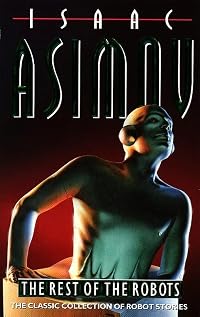
The Rest of the Robots
by Isaac Asimov
Isaac Asimov's Robot Series (Collections and Selections — 2), Asimov's Universe (Collections and Selections — 2)
On This Page
Description
Matz examines the writing of such modernists as James, Conrad and Woolf, who used the word impression to describe what they wanted their fiction to present. This study addresses the problems of perception and representation that occupied writers in the early decades of the twentieth century.Tags
Recommendations




















Member Reviews
As the title says(i.e. "The rest..."), this book contains short stories related to robots that couldn't fit into I Robot. I was initially somewhat reticent about the quality of the stories; the title made me think they'd be more like "discarded stuff" that someone thought they could monetize.
Perhaps it was the stories-in-a-story scenario which ended up changing my mind about these short stories. The book reads sort of like an interview where the author talks about his work, and inspiration for it, only instead of mere snippets we get the entire story. Despite the fact that the book was published 50 years ago, there is barely anything that reads dated about it. Actually, I'm not even sure I could pinpoint something that wouldn't seem show more "contemporary".
The book starts out with a little back story on Mary Shelley and her novel Frankenstein, whose main idea is then skillfully inserted into Asimov's short stories about robots. After all, a robot is (in a manner) also a type of monster, because a lot people don't understand it.
Once again, we get a lot of incredibly realistic stories about robots, their working mechanisms and the 3 Laws which govern their existence. Reading about Dr. Calvin's work is just basic algorithm analysis, which is right up my (professional) alley.
I loved all these stories, but my absolute favorite must've been the one about the woman asked to beta test a butler robot, which was slated for mass-production.
That excerpt really stayed with me, and in an odd sort of way I can relate to it. I don't build robots myself, but I have found myself getting overly attached to software that I've developed.
I loved this book for all its geekyness and its actuality. Others may, perhaps, find it dull or wouldn't get the point. If you like playing with logical puzzles, and if you like mind-stimulating games (like light Maths), this is just the bedtime book for you.
============================================
review of book 0.1: I, Robot
review of book 1: The Caves of Steel
review of book 2: The Naked Sun
review of book 3: The Robots of Dawn
review of book 4: Robots and Empire show less
Perhaps it was the stories-in-a-story scenario which ended up changing my mind about these short stories. The book reads sort of like an interview where the author talks about his work, and inspiration for it, only instead of mere snippets we get the entire story. Despite the fact that the book was published 50 years ago, there is barely anything that reads dated about it. Actually, I'm not even sure I could pinpoint something that wouldn't seem show more "contemporary".
The book starts out with a little back story on Mary Shelley and her novel Frankenstein, whose main idea is then skillfully inserted into Asimov's short stories about robots. After all, a robot is (in a manner) also a type of monster, because a lot people don't understand it.
Once again, we get a lot of incredibly realistic stories about robots, their working mechanisms and the 3 Laws which govern their existence. Reading about Dr. Calvin's work is just basic algorithm analysis, which is right up my (professional) alley.
I loved all these stories, but my absolute favorite must've been the one about the woman asked to beta test a butler robot, which was slated for mass-production.
You see, Peter, machines can't fall in love, but— even when it's hopeless and horrifying— women can.
That excerpt really stayed with me, and in an odd sort of way I can relate to it. I don't build robots myself, but I have found myself getting overly attached to software that I've developed.
I loved this book for all its geekyness and its actuality. Others may, perhaps, find it dull or wouldn't get the point. If you like playing with logical puzzles, and if you like mind-stimulating games (like light Maths), this is just the bedtime book for you.
============================================
review of book 0.1: I, Robot
review of book 1: The Caves of Steel
review of book 2: The Naked Sun
review of book 3: The Robots of Dawn
review of book 4: Robots and Empire show less
The Rest of the Robots – Isaac Asimov (1967, my copy 1970 PB)
This won't be an extensive review but it's Asimov, I'll admit I'm a huge fan and cant remember a year in my life when I've not read one of his books. This was a Reread because I just needed something I knew I'd enjoy and was a shortish read.
The Rest of the Robots is a a follow on to IRobot (1950) and like IRobot is a collection of Short stories linked by unsurprisingly Robots. My version unlike some does not include The Naked Sun or The caves of Steel.
The Book is split into 3 sections, The Coming of the Robots, The Laws of Robotics and Susan Calvin. The Two stories in the coming of the Robots do not feel less connected than the others but these were both written in 1941 (Pre show more IRobot) they are both still interesting well written stories.
I have seen people state that the stories in this collection are IRobot rejects but as two thirds of them were written after the Publication of IRobot that is a false assumption. The stories are as good quality as Asimov does, sometimes people focus on his ideas and forget what a good storyteller he is, probably my favourite story is the final one Galley Slave (1957). I find with authors of the Golden Age that because they wrote so many short stories to submit to publications they have a way to keep the Narrative interesting and to the point, a technique a lot of newer writers could do with. The stories may not feel as connected to each other as IRobot but even if technology and some social ideas have caught up with some of them they are still fun and thought provoking stories, and it's Asimov you cant go wrong in my humble opinion.
If Goodreads allowed half Stars this would be a 3 1/2 rating but they don't so it gets the benefit of the doubt show less
This won't be an extensive review but it's Asimov, I'll admit I'm a huge fan and cant remember a year in my life when I've not read one of his books. This was a Reread because I just needed something I knew I'd enjoy and was a shortish read.
The Rest of the Robots is a a follow on to IRobot (1950) and like IRobot is a collection of Short stories linked by unsurprisingly Robots. My version unlike some does not include The Naked Sun or The caves of Steel.
The Book is split into 3 sections, The Coming of the Robots, The Laws of Robotics and Susan Calvin. The Two stories in the coming of the Robots do not feel less connected than the others but these were both written in 1941 (Pre show more IRobot) they are both still interesting well written stories.
I have seen people state that the stories in this collection are IRobot rejects but as two thirds of them were written after the Publication of IRobot that is a false assumption. The stories are as good quality as Asimov does, sometimes people focus on his ideas and forget what a good storyteller he is, probably my favourite story is the final one Galley Slave (1957). I find with authors of the Golden Age that because they wrote so many short stories to submit to publications they have a way to keep the Narrative interesting and to the point, a technique a lot of newer writers could do with. The stories may not feel as connected to each other as IRobot but even if technology and some social ideas have caught up with some of them they are still fun and thought provoking stories, and it's Asimov you cant go wrong in my humble opinion.
If Goodreads allowed half Stars this would be a 3 1/2 rating but they don't so it gets the benefit of the doubt show less
I find Asimov so easy to read.
No surprise that a lot of these stories are dated and haven't aged particularly well.
Some of them actually made me cringe a little.
But, he does manage to inject personality into his characters - even in these short stories and make them feel quite real.
I think Galley Slave was my favourite - a bit of a courtroom drama.
No surprise that a lot of these stories are dated and haven't aged particularly well.
Some of them actually made me cringe a little.
But, he does manage to inject personality into his characters - even in these short stories and make them feel quite real.
I think Galley Slave was my favourite - a bit of a courtroom drama.
I love Asimov!!! He's just such a great storyteller! And, as always the thing I like most about him is that he talks about robots, spaceships and aliens, but in the end he's always talking about humans! :)
Eight stories, each one more beautiful than the other, in the true sense of the word, because the more I went on reading, the more I liked them! In fact, my favourites stories were undoubtedly the last ones, starring the robopsychologist Susan Calvin, a character that I liked very much in the previous anthology (I, robot). Once again Asimov “analyses” different aspects of robotics, in particular we almost always deal with the three famous laws.
This was the second time I read this book, but the first time in English. In this second show more reading I really appreciated the introductions written by Asimov himself to the three parts into which the book is divided. In the first, for example, he explains how he had the idea of the three laws: in the previous stories about artificial men, like Frankenstein, robots always killed humans, but robots are just human artifacts, and we have many security measures for those, since ancient times (for example the handle in a knife or the railing in a staircase), so why not put a safety measure in a robot too? Brilliant as always!
http://www.naufragio.it/iltempodileggere/6329 show less
Eight stories, each one more beautiful than the other, in the true sense of the word, because the more I went on reading, the more I liked them! In fact, my favourites stories were undoubtedly the last ones, starring the robopsychologist Susan Calvin, a character that I liked very much in the previous anthology (I, robot). Once again Asimov “analyses” different aspects of robotics, in particular we almost always deal with the three famous laws.
This was the second time I read this book, but the first time in English. In this second show more reading I really appreciated the introductions written by Asimov himself to the three parts into which the book is divided. In the first, for example, he explains how he had the idea of the three laws: in the previous stories about artificial men, like Frankenstein, robots always killed humans, but robots are just human artifacts, and we have many security measures for those, since ancient times (for example the handle in a knife or the railing in a staircase), so why not put a safety measure in a robot too? Brilliant as always!
http://www.naufragio.it/iltempodileggere/6329 show less
Published in 1967 this is a short story collection of Asimov’s robot stories. They come with a general introduction by the author and then a note about each story and this all adds up to a sort of historical document of the robot series.
Asimov laid down the now famous Three Laws of Robotics in 1941:
1) A robot may not injure a human being, or through inaction, allow a human being to come to harm
2) A robot must obey given it by human beings except where such orders conflict with the first law
3) A robot must protect its own existence as long as such protection does not conflict with the first or second law.
The stories are based around these three laws. Situations are developed that give robots and humans dilemmas as to how they should show more act and it is to Asimov’s credit that he makes all the stories interesting and some are just very good science fiction. The earliest stories date from 1941 and the latest is 1957 and so some feel a little quaint and outdated, but making allowances for this and they are still entertaining.
Asimov’s introduction is a little essay in itself which trumpets his breaking away from the traditional Frankenstein tales of robots. His innovation was to make the reader feel sympathy for the machines and for some of the people involved in their invention/production. Asimov’s notes also reveal a little about the author himself and so if like me you are a fan of Asimov’s science fiction these stories will not disappoint, but if you are a fan then you may have read several of them before. They make great holiday reading and so 4 stars. show less
Asimov laid down the now famous Three Laws of Robotics in 1941:
1) A robot may not injure a human being, or through inaction, allow a human being to come to harm
2) A robot must obey given it by human beings except where such orders conflict with the first law
3) A robot must protect its own existence as long as such protection does not conflict with the first or second law.
The stories are based around these three laws. Situations are developed that give robots and humans dilemmas as to how they should show more act and it is to Asimov’s credit that he makes all the stories interesting and some are just very good science fiction. The earliest stories date from 1941 and the latest is 1957 and so some feel a little quaint and outdated, but making allowances for this and they are still entertaining.
Asimov’s introduction is a little essay in itself which trumpets his breaking away from the traditional Frankenstein tales of robots. His innovation was to make the reader feel sympathy for the machines and for some of the people involved in their invention/production. Asimov’s notes also reveal a little about the author himself and so if like me you are a fan of Asimov’s science fiction these stories will not disappoint, but if you are a fan then you may have read several of them before. They make great holiday reading and so 4 stars. show less
I liked this one better than I, Robot, actually. I thought it was a smooth read. Even though it's a collection of short stories I thought the narrative flowed well from one story to the next. Asimov's insights were interesting as well.
I just reread my old 1964 (used) hardback edition of this and it's still great. Although it is obvious in many places that this was written in the 1950s, it's still a great cautionary tale of the future and man's relationship with artificial intelligence. It's a keeper.
Members
- Recently Added By
Lists

Books Read in 2024
4,727 works; 128 members
Author Information

2,439+ Works 294,760 Members
Isaac Asimov was born in Petrovichi, Russia, on January 2, 1920. His family emigrated to the United States in 1923 and settled in Brooklyn, New York, where they owned and operated a candy store. Asimov became a naturalized U.S. citizen at the age of eight. As a youngster he discovered his talent for writing, producing his first original fiction at show more the age of eleven. He went on to become one of the world's most prolific writers, publishing nearly 500 books in his lifetime. Asimov was not only a writer; he also was a biochemist and an educator. He studied chemistry at Columbia University, earning a B.S., M.A. and Ph.D. In 1951, Asimov accepted a position as an instructor of biochemistry at Boston University's School of Medicine even though he had no practical experience in the field. His exceptional intelligence enabled him to master new systems rapidly, and he soon became a successful and distinguished professor at Columbia and even co-authored a biochemistry textbook within a few years. Asimov won numerous awards and honors for his books and stories, and he is considered to be a leading writer of the Golden Age of science fiction. While he did not invent science fiction, he helped to legitimize it by adding the narrative structure that had been missing from the traditional science fiction books of the period. He also introduced several innovative concepts, including the thematic concern for technological progress and its impact on humanity. Asimov is probably best known for his Foundation series, which includes Foundation, Foundation and Empire, and Second Foundation. In 1966, this trilogy won the Hugo award for best all-time science fiction series. In 1983, Asimov wrote an additional Foundation novel, Foundation's Edge, which won the Hugo for best novel of that year. Asimov also wrote a series of robot books that included I, Robot, and eventually he tied the two series together. He won three additional Hugos, including one awarded posthumously for the best non-fiction book of 1995, I. Asimov. "Nightfall" was chosen the best science fiction story of all time by the Science Fiction Writers of America. In 1979, Asimov wrote his autobiography, In Memory Yet Green. He continued writing until just a few years before his death from heart and kidney failure on April 6, 1992. (Bowker Author Biography) show less
Some Editions
Awards and Honors
Distinctions
Series

Isaac Asimov's Robot Series
4 works (Collections and Selections — 2)

Asimov's Universe
14 works (Collections and Selections — 2)
Belongs to Publisher Series
Work Relationships
Is contained in
Contains
Common Knowledge
- Canonical title*
- Un défilé de robots
- Original title
- The rest of the robots
- Alternate titles
- Eight Stories From Rest of the Robots
- Original publication date
- 1964
- People/Characters
- Susan Calvin; Albert Minnim; AL-76; Jonathan Quell; Sam Tobe; Randolph Payne (show all 34); ZZ One; ZZ Two; ZZ Three; Mike Donovan; MacFarlane; MA Two; Elias Lynn; Ralph G. Breckenridge; Humphrey Carl Laszlo; Claire Belmont; Larry Belmont; TN-3 (Tony); Peter Bogert; Gladys Claffern; Gerald Black; Richard Kallner (Major General); Mayer Schloss; Nigel Ronson; Alfred Lanning; Mortimer W. Jacobson; LNE-Prototype (Lenny); Charles Randow; Harlow Shane; Barnabas H. Goodfellow; Scott Robertson; Francis J. Hart; Simon Ninheimer; Jim Baker
- Important places
- U.S. Robots and Mechanical Men factory; Hannaford, Virginia, USA; Duckbill Mountain, Virginia, USA; Jupiter; Ganymede; Titan (show all 13); Kornsk, Titan; Cheyenne, Wyoming, USA; Washington, D.C., USA; USA; Hyper Base; It, Asteroid Belt (Asteroid H937); Asteroid Belt
- Dedication
- To Tim,
Tom and Dick
My stalwart supporters at Doubleday - First words
- Would you like to hear a writer's nightmare?
- Last words
- (Click to show. Warning: May contain spoilers.)She did not entirely succeed.
- Original language
- English
- Canonical DDC/MDS
- 813.08762
- Disambiguation notice
- There are two distinct Isaac Asimov works entitled The Rest of the Robots. This version is approximately 200 pages and reprints only the eight short stories noted below. It has at various points been published under th... (show all)e titles The Rest of the Robots and Eight Stories from the Rest of the Robots. The other version is 550 pages and collects these same stories as well as the novels The Caves of Steel and The Naked Sun.
Contents:
I. The Coming of the Robots
• Robot AL-76 Goes Astray
• Victory Unintentional
II. The Laws of Robotics
• First Law
• Let's Get Together
III. Susan Calvin
• Satisfaction Guaranteed
• Risk
• Lenny
• Galley Slave
Combination issue: LibraryThing currently has two separate work records for the short story collection. They cannot be combined currently as they each have more than 200 records attached. The other record is here: https://www.librarything.com/work/1231...
*Some information comes from Common Knowledge in other languages. Click "Edit" for more information.
Classifications
- Genres
- Science Fiction, Fiction and Literature
- DDC/MDS
- 813.08762 — Literature & rhetoric American literature in English American fiction in English By type Genre fiction Adventure fiction Speculative fiction Science fiction
- LCC
- PZ3 .A8316 — Language and Literature Fiction and juvenile belles lettres Fiction and juvenile belles lettres Fiction in English
- BISAC
Statistics
- Members
- 1,801
- Popularity
- 12,213
- Reviews
- 21
- Rating
- (3.87)
- Languages
- 8 — Dutch, English, French, Italian, Japanese, Portuguese, Spanish, Swedish
- Media
- Paper, Ebook
- ISBNs
- 22
- ASINs
- 41