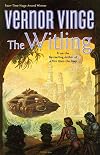
The Witling
by Vernor Vinge
On This Page
Description
This second novel by multiple award-winner Vernor Vinge, from 1976, is a fast-paced adventure where galactic policies collide and different cultures clash as two scientists and their faith in technology are pitted against an elusive race of telekinetic beings. Marooned on a distant world and slowly dying of food poisoning, two anthropologists are caught between warring alien factions engaged in a battle that will affect the future of the world's inhabitants and their deadly telekinetic show more powers. If the anthropologists can't help resolve the conflict between the feuding alien factions, no one will survive. This edition features sixteen full-page illustrations by Doug Beekman. show lessTags
Recommendations






















Member Reviews
I started out giving this book 3 stars, as a perfectly serviceable sci-fi adventure; although certainly not up to the standards of Vernor Vinge’s later work (I absolutely love Fire Upon the Deep).
It’s a First Contact story, and the premise is a little familiar, but not bad: anthropologists from Earth arrive at a seemingly non-advanced alien planet and gradually figure out that the native people have highly-developed mental abilities (teleportation). Those who lack these abilities are generally seen as useless slaves – Witlings – but in a twist, the crown prince is also a Witling. Naturally, he’s delighted to hear about a society where no one has the powers he lacks.
So – all that is fine. However, the ending of the book show more bothered me, and kept bothering me until I deducted a star.Spoilers: At the end of the book, one of the anthropologists (who happens to be the only female character of any note in the entire book) is nearly killed in a conflict, and ends up with severe, irreversible brain damage. Amnesiac, and now lacking the intelligence and initiative she showed throughout the book, she will be happy to end up being cared for by the crown prince, who’s had an unrequited crush on her since the day they first met. OK, fine. That’s kind of yucky, but I don’t demand ‘nice’ outcomes for everyone. Tragedy can be great. What bothers me is the one line at the end, where an authorial voice feels the need to say something about ‘knowing a happy ending when you see one.’ Is this supposed to be ironic? That a brilliant, successful woman who’s always been given a hard time and never been considered attractive is now rendered ‘happy’ by having her personality and abilities removed and left in the care of a man who never really knew her, but finds her physically beautiful? I’m really not sure. Does the author really have these opinions? I would like to think better of Vinge than that.
Oh, and the illustrations are juvenile and rather dreadfully inaccurate. show less
It’s a First Contact story, and the premise is a little familiar, but not bad: anthropologists from Earth arrive at a seemingly non-advanced alien planet and gradually figure out that the native people have highly-developed mental abilities (teleportation). Those who lack these abilities are generally seen as useless slaves – Witlings – but in a twist, the crown prince is also a Witling. Naturally, he’s delighted to hear about a society where no one has the powers he lacks.
So – all that is fine. However, the ending of the book show more bothered me, and kept bothering me until I deducted a star.
Oh, and the illustrations are juvenile and rather dreadfully inaccurate. show less
REALLY BIG SPOILER ALERT. I quite liked this book up until the last few pages. The last few pages utterly spoiled for me a big part of why I liked it.There are two things I liked about this book.1. In general I like the way Vinge takes an idea and thinks through a lot of the ramifications of that idea and builds a world and a plot on them. (He does a really good job of this in A Fire Upon the Deep which has a species in which a single entity is made up of a pack of telepathic bodies.) In this book, the idea he explores is that the humanoids (and some other higher order animals) living on a particular plant can use telekinesis to teleport themselves and other things to certain locations. This creates a society where, for example, the show more "wings" of a palace can be spread apart over hundreds of miles, because the people inhabiting the palace can teleport easily from one wing to another. Because of this ability, these people never developed a lot of the technology that was primarily developed on Earth for getting people and things from one place to another. 2. One of the main characters is a human woman, a scientist who has come to study this planet. She is portrayed through the eyes of her partner (another scientist) -- and to some extent through her own eyes -- as very intelligent, physically unattractive (short, stout, and awkward), and having a brusque personality. None of this is a big deal. At the same time, the people native to this planet are even shorter and stouter, and so they see her as tall, willowy, and elf-like. She has some conflicted reactions to this. I don't see a lot of well-done explorations of body image in science fiction and especially in books written by men so I thought this was pretty cool.Toward the end of the story, she becomes brain-damaged. At the very end of the story, she's back with humans who have the medical facilities to treat some of the damage, but she probably won't get her mind and intelligence back again. But that's OK, she's perfectly happy because someone is in love with her and that's all that matters. Somehow I guess we are supposed to think this is a perfectly suitable ending for the character. But I think it's like crumpling the character up and throwing her in the wastebasket. Feh. show less
What this book taught me: Vernor Vinge is brilliant when he's writing great SciFi, but boring when he is writing pulp. This book is dated, and if you're hoping for more of what makes Across Realtime or Fire Upon The Deep so great, stay away from The Witling. I gave up in chapter 3, returning this to the friend I borrowed it from.
Originally published in 1976, Vinge's carefully thought through science also addresses social issues like beauty and status. I particularly enjoyed that the "stocky" abrasive woman pilot was, essentially, the heroine and perceived as beautiful by the planet's inhabitants (who had evolved from humans).
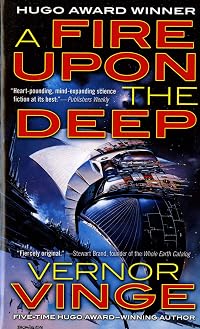
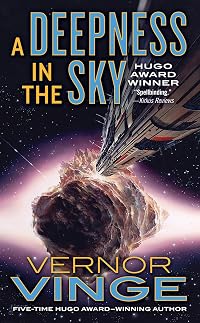
There wasn't really a lot TO this book--it was entertaining enough, but it really suffers in comparison with his later books like [b:A Deepness in the Sky|226004|A Deepness in the Sky (Zones of Thought, #2)|Vernor Vinge|http://d.gr-assets.com/books/1350952749s/226004.jpg|1270006] and [b:a Fire Upon the Deep|77711|A Fire Upon the Deep (Zones of Thought, #1)|Vernor Vinge|http://d.gr-assets.com/books/1333915005s/77711.jpg|1253374], which I think are some of the most interesting alien books I've read.
I think someone mentioned this one on a mailing list I belong to, and it sounded kind of interesting: basically there's this planet where everyone has psychic powers, so they can teleport themselves and kill people at a distance and so on. show more People without the powers are called "witlings", hence the title. And the thing is that the crown prince guy is a witling! oh no!
But then these other people show up who are explorers from other worlds, or something like the Federation, I think, and of course they're witlings too, but they're not all embarrassed about it, and the crown prince is enthralled by the idea of a world where everyone is like him.
Oh, and then there's the 'charming' subplot where one of the explorers is this very surly woman, who is UGLY. but guess what, EVERYONE IS UGLY ON THE PSYCHIC PLANET. So the crown prince thinks she is BEAUTIFUL!! So they live happily ever after. The end.
(Of course, the many illustrations in the book don't show her as short and squarish, like she's supposed to be, even though the crown prince looks rather lumpish and featureless like HE is supposed to. Oh well.)
ONE MORE THING:
I just had to also mention that this book uses one of the absolutely lamest Lazy Plot Devices ever, (a favorite of Dan Brown) where you've been going along in a 3rd-person-omniscient-type narrative style, and then all of a sudden WE GO DEAF as the protagonist explains her brilliant plan to foil the bad guys, or discovers something that would ruin the plot if we knew about it.
E.g. "And then she said something SO SHOCKING that the archaeologists assembled there could HARDLY BELIEVE IT. Then she outlined the plan for the next three days of work, and they all nodded, greatly impressed. 'Let's get to it, boys!' she said, and picked up her sextant." show less
I think someone mentioned this one on a mailing list I belong to, and it sounded kind of interesting: basically there's this planet where everyone has psychic powers, so they can teleport themselves and kill people at a distance and so on. show more People without the powers are called "witlings", hence the title. And the thing is that the crown prince guy is a witling! oh no!
But then these other people show up who are explorers from other worlds, or something like the Federation, I think, and of course they're witlings too, but they're not all embarrassed about it, and the crown prince is enthralled by the idea of a world where everyone is like him.
Oh, and then there's the 'charming' subplot where one of the explorers is this very surly woman, who is UGLY. but guess what, EVERYONE IS UGLY ON THE PSYCHIC PLANET. So the crown prince thinks she is BEAUTIFUL!! So they live happily ever after. The end.
(Of course, the many illustrations in the book don't show her as short and squarish, like she's supposed to be, even though the crown prince looks rather lumpish and featureless like HE is supposed to. Oh well.)
ONE MORE THING:
I just had to also mention that this book uses one of the absolutely lamest Lazy Plot Devices ever, (a favorite of Dan Brown) where you've been going along in a 3rd-person-omniscient-type narrative style, and then all of a sudden WE GO DEAF as the protagonist explains her brilliant plan to foil the bad guys, or discovers something that would ruin the plot if we knew about it.
E.g. "And then she said something SO SHOCKING that the archaeologists assembled there could HARDLY BELIEVE IT. Then she outlined the plan for the next three days of work, and they all nodded, greatly impressed. 'Let's get to it, boys!' she said, and picked up her sextant." show less
A rather short novel for Vinge, and one of his earlier works. This is basically about a splinter colony of humans that have developed the ability to teleport and manipulate matter mentally. When 'normal' humans rediscover the colony, it almost becomes a first contact situation. An interesting book, but too short and a bit contrived.
Our protagonists come down on an unexplored planet where mental abilities have developed to a high degree and are able to defeat the (unprepared) technology. The details on how a non-technological civilization copes with the consequences of teleportation are fascinating, though the basic plot driving the story is a little lame. Of course technology comes to the rescue in the end to solve the final problem. And there's even an inter-species love story for those who like that kind of thing. I'd call it a satisfying, if undemanding, read.
Members
- Recently Added By
Lists

Forced Exposure
83 works; 1 member
Author Information

58+ Works 23,215 Members
Some Editions
Series
Belongs to Publisher Series
DAW Book Collectors (179)
Work Relationships
Is contained in
Common Knowledge
- Original title
- The Witling
- Original publication date
- 1976
- People/Characters
- Yoninne Leg-Wot; Ajão Bjault; Pelio-nge-Shozheru; Thengets del Prou
- Dedication
- To Joan D. Vinge, for all her support in the writing of this novel
- First words
- Fall had come to Bodgaru-by-the-Sea, and winter was not now far away.
- Last words
- (Click to show. Warning: May contain spoilers.)She knew a happy ending when she found one.
- Original language
- English
Classifications
Statistics
- Members
- 519
- Popularity
- 57,760
- Reviews
- 14
- Rating
- (3.16)
- Languages
- English, French, German
- Media
- Paper, Ebook
- ISBNs
- 10
- ASINs
- 8