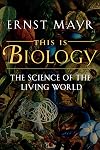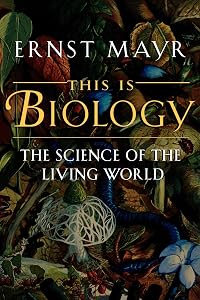
This Is Biology: The Science of the Living World
by Ernst Mayr
On This Page
Description
Biology until recently has been the neglected stepchild of science, and many educated people have little grasp of how biology explains the natural world. Yet to address the major political and moral questions that face us today, we must acquire an understanding of their biological roots. This magisterial new book by Ernst Mayr will go far to remedy this situation. An eyewitness to this century's relentless biological advance and the creator of some of its most important concepts, Mayr is show more uniquely qualified to offer a vision of science that places biology firmly at the center, and a vision of biology that restores the primacy of holistic, evolutionary thinking. As he argues persuasively, the physical sciences cannot address many aspects of nature that are unique to life. Living organisms must be understood at every level of organization; they cannot be reduced to the laws of physics and chemistry. Mayr's approach is refreshingly at odds with the reductionist thinking that dominated scientific research earlier in this century, and will help to redirect how people think about the natural world. This Is Biology can also be read as a "life history" of the discipline - from its roots in the work of Aristotle, through its dormancy during the Scientific Revolution and its flowering in the hands of Darwin, to its spectacular growth with the advent of molecular techniques. Mayr maps out the territorial overlap between biology and the humanities, especially history and ethics, and describes important distinctions between science and other systems of thought, including theology. Both as an overview of the sciences of life and as the culmination of a remarkable life in science, This Is Biology will richly reward professionals and general readers alike. show lessTags
Recommendations









Member Reviews
I thought this was a very good introduction to the foundations of biology, explaining such things as proximate and ultimate causation, or whether in science (especially biology) advances, the role of the different subdisciplines, etc.
.
However, the last two chapters did not really fit in, as they were not about the foundations, but biology proper, specifically the evolution of the human being. Interesting enough, but they belong in a different book.
.
However, the last two chapters did not really fit in, as they were not about the foundations, but biology proper, specifically the evolution of the human being. Interesting enough, but they belong in a different book.
Biology explained by experience itself: Ernst Mayr is one of my favorite natural science writers. He has the experience of a lifetime (to say the least, since he has over 70 active years in the field) in biology. Mayr has an exquisite writing style and lots of anecdotes to share, besides he surely is an intellectual though never makes you feel neophyte, on the contrary, he guides you with ease and a critic view on nature itself. "This is Biology" is enriched with personal opinions and, of course, reflects the authors' view modeled by only seven decades of experience among the best.
The science of the living world
Ratings
Members
- Recently Added By
Author Information

73+ Works 2,530 Members
Ernst Mayr is Professor Emeritus in the Museum of Comparative Zoology at Harvard University
Awards and Honors
Awards
Classifications
Statistics
- Members
- 262
- Popularity
- 123,269
- Reviews
- 3
- Rating
- (3.65)
- Languages
- 7 — English, Finnish, French, German, Portuguese, Spanish, Turkish
- Media
- Paper, Ebook
- ISBNs
- 13
- ASINs
- 2