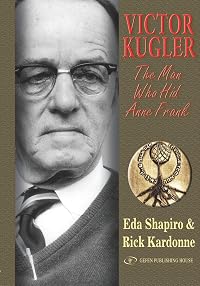
Victor Kugler: The Man Who Hid Anne Frank
by Rick Kardonne
On This Page
Description
Of all the personalities associated with Anne Frank, the most important figure, without whom Anne Frank would never have been able to write her diary, is perhaps the least known. He is Victor Kugler, the Mr Kraler of the diary. The principal business partner of Otto Frank, Victor Kugler assumed managerial control of the Franks' Amsterdam spice-importing business when Nazi persecution forced the Frank family into hiding. It was Victor Kugler who kept the business going and obtained food show more rations under what was the harshest German wartime occupation in all of Western Europe. Without Victor Kugler, Anne Frank and her family would have starved to death a month after going into hiding. For this heroism, Victor Kugler himself was arrested and sent to a series of German labour camps in Holland where he survived by his wits and finally escaped a few weeks before the end of the war. Several years after the end of the war, when the Dutch spice business collapsed following the Indonesian revolution that nationalised Dutch holdings, Victor Kugler emigrated to Toronto, Canada. There, he led a quiet life where nobody knew who he was and what he had done during the war. Only twenty years later he began to reveal his story. The modern-day saga of this Righteous Gentile, who was honoured as such at Israel's Yad Vashem Holocaust Martyrs' and Heroes' Remembrance Authority, is told here in semi-documentary style, largely in his own words as told to Torontonian Eda Shapiro, herself of Eastern European Jewish background; and by many others who knew him, as compiled by well-known Toronto writer-journalist Rick Kardonne. show lessTags
Recommendations
























Member Reviews
I first encountered Anne Frank when I was in the 4th grade. After hearing about her in school my best friend and I rushed to the library that same day to check out her diary. There was only one copy, so we decided to read it together. Because I was a faster reader, I peeked ahead to the end of the book, curious to find out what had happened to Anne after the war. Where was she now? What had happened to the rest of her family?
I was shocked to discover that Anne had died in the Bergen-Belsen concentration camp a few days before the camp was liberated. Although our teacher had told us the family had been discovered, he neglected to mention that Anne’s father was the only one to survive the war. I think this was the first time I had show more encountered a “story” where everything had not turned out all right for the protagonist. I was devastated. And yet I persevered in reading Anne’s diary and, like so many people before and since, I was changed by this lively, curious, and talented young woman.
When I was 17, I visited the Secret Annexe in Amsterdam where Anne and her family had hidden. I saw the bookcase door and the photos of movie stars Anne had pasted to the wall. I saw how small the space was where eight people had hidden for so long and how exposed their hiding place was to the outside world. It is truly astonishing that they escaped detection for as long as they did.
Those who sheltered the Franks and van Daams did not seek publicity, fame, or recognition, and it was many years before any of them stepped forward to supply the other side of the story. In 1987, Miep Gies wrote Anne Frank Remembered, and in 1997, Memories of Anne Frank recounted the story of Anne’s friend Hannah Goslar. And now Victor Kugler’s story fleshes out the picture of what happened to Anne and her family.
Victor Kugler: The Man Who Hid Anne Frank, by Eda Shapiro and Rick Kardonne, is an important book in its contribution to Holocaust history, and it has an interesting publication history. One of the authors, Eda Shapiro, met Kugler in Canada where he eventually settled after the war. In 1969, she began a series of interviews with him that lasted for the next four years. In 1973, Shapiro was instrumental in having Kugler honored as a Righteous Gentile. After Shapiro died in 1992, her husband worked to have the memoirs published, and eventually journalist Rick Kardonne took on the task of organizing the interviews and providing additional information, including a succinct overview of Holland’s role in World War II, and theories postulating why so many Dutch Jews perished in the Holocaust.
Why did Kugler’s personal memories take so long to come to light? I suspect it was his modesty and humility, which ultimately seemed to limit how much he shared with Shapiro, and this is a definite drawback in the book. I suspect Kugler did not see his actions as being particularly heroic and could not have anticipated that future generations would be interested to know the details of how he fed and clothed those in hiding, obtained extra ration cards, and kept the spice business going. Many of those details of the day-to-day challenges of hiding the Secret Annexe residents are not found here.
Kugler’s most detailed recollections begin the day the Secret Annexe residents were discovered and arrested. Kugler and Mr. Kleiman, one of the others responsible for hiding the group, were also arrested. Kugler spent about eight months in various prisons and forced labor camps and came close to death on numerous occasions. Still Kugler found ways to pass information on to the Dutch Underground before he found a way to escape (true to Kugler’s low-key approach, while waiting for darkness to fall to cover their escape, he mended his clothes).
After the war, Kugler lived a quiet life in Toronto, and even after Anne’s diary was published, few knew that he was Mr. Kraler. He was reluctant to share his role in the story. Sadly, after Kugler retired, he and his wife faced financial difficulties, and Kugler died of complications from Alzheimer’s disease in 1981. The last part of the book focuses on how Kugler came to be known as Mr. Kraler and how Eda Shapiro and others worked to gain recognition for him and to help him financially.
I commend Gefen for publishing the book and highly recommend it for all school libraries and for anyone who is interested in Anne Frank and Shoah history. The image I will take away from this book is that of a quiet, courageous, and humble man who picked up a small leaf from the tree he planted in the Avenue of Righteous Gentiles at Yad Vashem and wore it on his lapel until the day he died. I cherish what he chose to share in this account but wish he had shared so much more. show less
I was shocked to discover that Anne had died in the Bergen-Belsen concentration camp a few days before the camp was liberated. Although our teacher had told us the family had been discovered, he neglected to mention that Anne’s father was the only one to survive the war. I think this was the first time I had show more encountered a “story” where everything had not turned out all right for the protagonist. I was devastated. And yet I persevered in reading Anne’s diary and, like so many people before and since, I was changed by this lively, curious, and talented young woman.
When I was 17, I visited the Secret Annexe in Amsterdam where Anne and her family had hidden. I saw the bookcase door and the photos of movie stars Anne had pasted to the wall. I saw how small the space was where eight people had hidden for so long and how exposed their hiding place was to the outside world. It is truly astonishing that they escaped detection for as long as they did.
Those who sheltered the Franks and van Daams did not seek publicity, fame, or recognition, and it was many years before any of them stepped forward to supply the other side of the story. In 1987, Miep Gies wrote Anne Frank Remembered, and in 1997, Memories of Anne Frank recounted the story of Anne’s friend Hannah Goslar. And now Victor Kugler’s story fleshes out the picture of what happened to Anne and her family.
Victor Kugler: The Man Who Hid Anne Frank, by Eda Shapiro and Rick Kardonne, is an important book in its contribution to Holocaust history, and it has an interesting publication history. One of the authors, Eda Shapiro, met Kugler in Canada where he eventually settled after the war. In 1969, she began a series of interviews with him that lasted for the next four years. In 1973, Shapiro was instrumental in having Kugler honored as a Righteous Gentile. After Shapiro died in 1992, her husband worked to have the memoirs published, and eventually journalist Rick Kardonne took on the task of organizing the interviews and providing additional information, including a succinct overview of Holland’s role in World War II, and theories postulating why so many Dutch Jews perished in the Holocaust.
Why did Kugler’s personal memories take so long to come to light? I suspect it was his modesty and humility, which ultimately seemed to limit how much he shared with Shapiro, and this is a definite drawback in the book. I suspect Kugler did not see his actions as being particularly heroic and could not have anticipated that future generations would be interested to know the details of how he fed and clothed those in hiding, obtained extra ration cards, and kept the spice business going. Many of those details of the day-to-day challenges of hiding the Secret Annexe residents are not found here.
Kugler’s most detailed recollections begin the day the Secret Annexe residents were discovered and arrested. Kugler and Mr. Kleiman, one of the others responsible for hiding the group, were also arrested. Kugler spent about eight months in various prisons and forced labor camps and came close to death on numerous occasions. Still Kugler found ways to pass information on to the Dutch Underground before he found a way to escape (true to Kugler’s low-key approach, while waiting for darkness to fall to cover their escape, he mended his clothes).
After the war, Kugler lived a quiet life in Toronto, and even after Anne’s diary was published, few knew that he was Mr. Kraler. He was reluctant to share his role in the story. Sadly, after Kugler retired, he and his wife faced financial difficulties, and Kugler died of complications from Alzheimer’s disease in 1981. The last part of the book focuses on how Kugler came to be known as Mr. Kraler and how Eda Shapiro and others worked to gain recognition for him and to help him financially.
I commend Gefen for publishing the book and highly recommend it for all school libraries and for anyone who is interested in Anne Frank and Shoah history. The image I will take away from this book is that of a quiet, courageous, and humble man who picked up a small leaf from the tree he planted in the Avenue of Righteous Gentiles at Yad Vashem and wore it on his lapel until the day he died. I cherish what he chose to share in this account but wish he had shared so much more. show less
 This review was written for LibraryThing Early Reviewers.
I read "Anne Frank: The Diary of a Young Girl" in my early teens. It made a powerful impression on me. Anne, the people in the attic, and Mr. Kraler, the man who hid them, left me awe struck. Consequently, when I was given the opportunity to review this title I was excited and immediately sat down to read it.
Overall, I enjoyed this book. It is well organized and puts into perspective the historical events of these times, but most importantly it gives insight into the courageous man who hid his friends "because morally he had no choice. It did not occur to him to do otherwise." Victor Kugler, the man Anne referred to as Mr. Kraler, hid his friends for two years. After the hiding place was discovered, he was sent to various labor camps to show more pay for his "crime." This book chronicles these events and documents the rest of his life.
Overall, the authors did a good job of recounting the events of Mr. Kugler's life. My only criticism is that I expected the book to contain more of his personal words, letters, etc. Nonetheless, I recommend this book to anyone interested in the holocaust, WWII, or if you simply want to believe in humanity again. show less
Overall, I enjoyed this book. It is well organized and puts into perspective the historical events of these times, but most importantly it gives insight into the courageous man who hid his friends "because morally he had no choice. It did not occur to him to do otherwise." Victor Kugler, the man Anne referred to as Mr. Kraler, hid his friends for two years. After the hiding place was discovered, he was sent to various labor camps to show more pay for his "crime." This book chronicles these events and documents the rest of his life.
Overall, the authors did a good job of recounting the events of Mr. Kugler's life. My only criticism is that I expected the book to contain more of his personal words, letters, etc. Nonetheless, I recommend this book to anyone interested in the holocaust, WWII, or if you simply want to believe in humanity again. show less
This review was written for LibraryThing Early Reviewers.I really had to think hard about what to write in this review of Victor Kugler: The Man Who Hid Anne Frank. Like many young girls I first read the “Diary of Anne Frank” when I was a preteen. I devoured my copy obsessively and was heartbroken to find out that Anne (A girl about my own age) had died in the war. Therefore I was excited by the prospect of reviewing a book that would add to my knowledge of Anne Frank.
This book certainly did that. I never knew that the Mr. Kraler was alive when I first read the diary and living in Toronto. Victor Kugler (The Mr. Kraler from the diary) put his life in great jeopardy to save the Franks and the others in the Annex. The story of his stay in the labor camp is harrowing and he showed real show more courage and genuine affection for the people he helped hide and regret when he found that all but Otto Frank had died. This book leaved no doubt that he deserved the many honors which he received.
Unfortunately my main impression of this book is that the writing seemed to be more that of an enthusiastic amateur than a professional scholar. For example, in a non fiction book, I would have expected a fairly large bibliography of cited sources. Also this book had a discernible Jewish bias which I felt colored the entire text. Because of this, despite the new light that this this book shines on the Anne Frank story, I cannot wholeheartedly recommend this book. show less
This book certainly did that. I never knew that the Mr. Kraler was alive when I first read the diary and living in Toronto. Victor Kugler (The Mr. Kraler from the diary) put his life in great jeopardy to save the Franks and the others in the Annex. The story of his stay in the labor camp is harrowing and he showed real show more courage and genuine affection for the people he helped hide and regret when he found that all but Otto Frank had died. This book leaved no doubt that he deserved the many honors which he received.
Unfortunately my main impression of this book is that the writing seemed to be more that of an enthusiastic amateur than a professional scholar. For example, in a non fiction book, I would have expected a fairly large bibliography of cited sources. Also this book had a discernible Jewish bias which I felt colored the entire text. Because of this, despite the new light that this this book shines on the Anne Frank story, I cannot wholeheartedly recommend this book. show less
This review was written for LibraryThing Early Reviewers.I am sorry to say that I was disappointed in this book. Victor Kugler was a fascinating and honorable man, and much work went into the research of his life, but unfortunately the same cannot be said of the execution of the text of the book. I found the prose to be heavy-handed and unprofessional, more like a passionate middle-schooler's writing than that of a serious biographer.
Despite my disappointment in the way the book was written, I would recommend this book to those interested in the life of Anne Frank and in the stories of non-Jews who worked to preserve life during the Holocaust. There is a lot of information of which I was not previously aware, and it has added to my understanding of the subjects it covers.
Despite my disappointment in the way the book was written, I would recommend this book to those interested in the life of Anne Frank and in the stories of non-Jews who worked to preserve life during the Holocaust. There is a lot of information of which I was not previously aware, and it has added to my understanding of the subjects it covers.
This review was written for LibraryThing Early Reviewers.Most of us are very familiar with the story of Anne Frank, but many are left to wonder what happened to the man that hid Anne and her family. In the book authored by Rick Kardonne, we are walked through the history of Holland, especially it's state during the blemish of Nazism as well as Kuglers' early life and business life with Otto Frank. We then face the years of hiding through the eyes of Kugler, glimpse into Kugler's fond rememberance of the life that Anne exuded without even trying as well as harrowing days of effortlessly trying to protect the family. We then see the tragedy as the Annex is discovered. Most of the stories we read usually ends here, but Kardonne takes the reader on another adventure of arrests, imprisonment in show more concentration camps and escapes. The will to live for all the right reasons. The reader is even allowed to see the work that Eda Shapiro underwent to gain Kugler the recognition of Righteous Gentile by Yad Vashem. A must read for fans of Ms. Frank as well as for those fine men and women like Victor Kugler: the fearless, silent hero's. show less
Almost everyone knows the story of Anne Frank. Far fewer people know the story of one of the men who hid her and her family from the Gestapo for 2 years. The mere fact of having his story of bravery be told makes this book worthwhile.
Victor Kugler's story shines brightest when told in his own voice. Unfortunately, this doesn't happen very often. Large portions of the book are taken from the notes of Eda Shapiro, who interviewed Kugler late in his life. This is fine, as far as it goes, but Shapiro's words are also used to give us historical background information on topics such as WWII and the history of Jews in Holland. Surely a more authoritative source could have been found for these subjects.
At least this historical background is show more interesting. Not so the rest of the book's padding, including descriptions of various dramatic and musical productions of Anne Frank's story that Kugler attended and his reaction to them, and descriptions awards and honors that Kugler was given, including his inclusion among the Righteous Gentiles at Yad Vashem, all well-deserved. I could have lived with a lot less of this extraneous material, especially since Kugler's story stands so well on its own.
FTC disclaimer: I received this book free from the publisher in exchange for this review. show less
Victor Kugler's story shines brightest when told in his own voice. Unfortunately, this doesn't happen very often. Large portions of the book are taken from the notes of Eda Shapiro, who interviewed Kugler late in his life. This is fine, as far as it goes, but Shapiro's words are also used to give us historical background information on topics such as WWII and the history of Jews in Holland. Surely a more authoritative source could have been found for these subjects.
At least this historical background is show more interesting. Not so the rest of the book's padding, including descriptions of various dramatic and musical productions of Anne Frank's story that Kugler attended and his reaction to them, and descriptions awards and honors that Kugler was given, including his inclusion among the Righteous Gentiles at Yad Vashem, all well-deserved. I could have lived with a lot less of this extraneous material, especially since Kugler's story stands so well on its own.
FTC disclaimer: I received this book free from the publisher in exchange for this review. show less
I was 11 when I first read the story of Anne Frank. It was horrifying to think that a girl little older than me had to go through such hardship, and when I found out that she didn't survive, it struck an even deeper chord. It is because of Victor Kugler that the story of Anne Frank exists. I can't believe it has taken me 10 more years to discover his story, but I am glad that I was able to eventually read it.
The parts of this book that detail Kugler's life and gives us his own words are truly magnificent. I was disappointed to find that this wasn't the sole subject of the book. I did appreciate the historical context, because it helped me understand the atmosphere of Amsterdam and the Netherlands in general at the time of The Secret show more Annex. However, the information about various retellings of Anne Frank's stories is extensive and almost irrelevant (except when detailing Kugler's reactions to the adaptations).
The writing itself wasn't particularly interesting (it falls rather dry and flat), but the story is certainly one worth knowing about. show less
The parts of this book that detail Kugler's life and gives us his own words are truly magnificent. I was disappointed to find that this wasn't the sole subject of the book. I did appreciate the historical context, because it helped me understand the atmosphere of Amsterdam and the Netherlands in general at the time of The Secret show more Annex. However, the information about various retellings of Anne Frank's stories is extensive and almost irrelevant (except when detailing Kugler's reactions to the adaptations).
The writing itself wasn't particularly interesting (it falls rather dry and flat), but the story is certainly one worth knowing about. show less
This review was written for LibraryThing Early Reviewers.Members
- Recently Added By
Author Information
2 Works 45 Members
Eda Shapiro interviewed Victor Kugler from 1969 to 1973, and wrote these memoris as he dictated them to her. After her passing in 1992, her husband Irving Naftolin took it upon himself to have them published so the details of this shy hero's life would be presented for the world to see. Without this endeavor by Eda and Irving, important facts show more about Anne Frank would have remained forever hidden. Rick Kardonne is a journalist and a composer. He has written for the Jewish Tribune for over a decade during which he interviewed such people as Ariel Sharon, Benjamin Netanyahu, Shimon Perez, Mikhail Gorbachev, Lech Walesa and Liza Minelli. Rick was also a music critic for the Canadian Jewish News for fifteen years. He has had six stage musicals produced in Canada and he composed the original soundtrack for Cayle Chemin's film I Am Home, which opened the Cape Town Film Festival of 1977. Rick is married to the former Eda Golub and they have two daughters. show less
Classifications
Statistics
- Members
- 43
- Popularity
- 688,121
- Reviews
- 23
- Rating
- (3.67)
- Languages
- English
- Media
- Paper, Ebook
- ISBNs
- 2