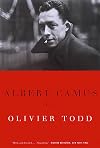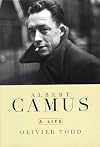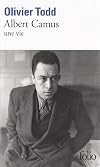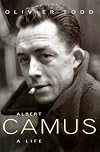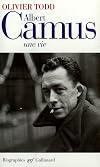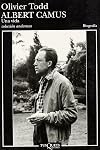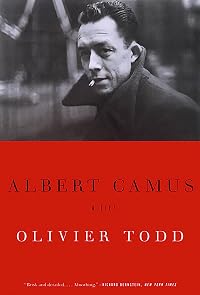
Albert Camus: A Life
by Olivier Todd
On This Page
Description
This volume is a biography of French Algerian author, philosopher, and journalist Albert Camus (1913-1960). Camus won the Nobel Prize for Literature in 1957. He was a key philosopher of the 20th-century and his most famous work is the novel L'Étranger (The Stranger). This work is the study of a man caught in conflicts between family loyalties and his own passionate nature, between the call to political action and devotion to his art, between his support of the native Algerians and his show more identification with the forgotten poor whites. Exploring Camus's impoverished childhood in the Algerian city of Belcourt, his underground activities during the Occupation in Paris, the intrigues of the French literati who embraced him after the publication of his first novel, L'Étranger, the author uncovers the solitary private man behind the mask of his celebrity. He shows us a writer isolated by his own success, crippled by the charms of women he could not resist, debilitated by the tuberculosis that did not kill him. The auto accident that did adds only to the ironies in the life of this international giant of twentieth-century literature. In this enormously engaging, vibrant, and richly researched biography of Albert Camus, the French writer and journalist Olivier Todd has drawn on personal correspondence, notebooks, and public records never before tapped, as well as interviews with Camus's family, friends, fellow workers, writers, mentors, and lovers. Todd shows us a Camus who struggled all his life with irreconcilable conflicts -- between his loyalty to family and his passionate nature, between the call to political action and the integrity to his art, between his support of the native Algerians and his identification with the forgotten people, the poor whites. A very private man, Camus could be charming and prickly, sincere and theatrical, genuinely humble, yet full of great ambition. Todd paints a vivid picture of the time and place that shaped Camus -- his impoverished childhood in the Algerian city of Belcourt, the sea and the sun and the hot sands that he so loved (he would always feel an exile elsewhere), and the educational system that nurtured him. We see the forces that lured him into communism, and his attraction to the theater and to journalism as outlets for his creativity. The Paris that Camus was inevitably drawn to is one that Todd knows intimately, and he brings alive the war years, the underground activities that Camus was caught up in during the Occupation and the bitter postwar period, as well as the intrigues of the French literati who embraced Camus after his first novel, L'Etranger, was published. Todd is also keenly attuned to the French intellectual climate, and as he takes Camus's measure as a successful novelist, journalist, playwright and director, literary editor, philosopher, he also reveals the temperament in the writer that increasingly isolated him and crippled his reputation in the years before his death and for a long time after. He shows us the solitary man behind the mask -- debilitated by continuing bouts of tuberculosis, constantly drawn to irresistible women, and deeply troubled by his political conflicts with the reigning French intellectuals, particularly by the vitriol of his former friend Sartre over the Algerian conflict. Filled with sharp observations and sparkling with telling details, here is a wonderfully human portrait of the Nobel Prize-winning writer, who died at the age of 46 and who remains one of the most influential literary figures of our time. - Jacket flap. show lessTags
Recommendations



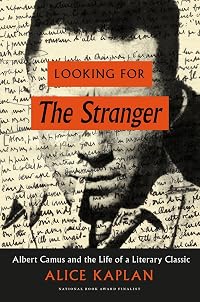

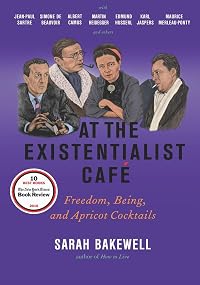


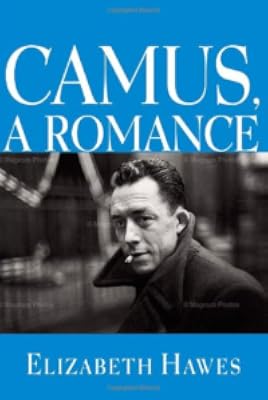

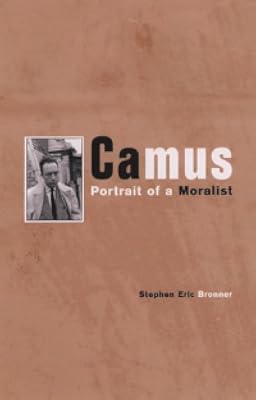







Member Recommendations

Member Reviews
“Freedom means being able to defend what I don’t agree with, even in a government or a world I approve of. It’s being able to admit your opponent is right.”
Women - “They inspire in us the desire to create masterpieces and prevent us from finishing them”
“The (Liason group) proposes to create communities of men beyond borders, which are united by things other than abstract ties of ideology”
“Only one thing is stupider than absolute pessimism and that is absolute optimism”
Albert Camus kept working notebooks throughout his life as well as being a pamphleteer and a journalist and was always ready with a maxim or aphorism to convey his message. There is much of his work in the public domain and Olivier Todd’s biography show more uses this material to such an extent that it almost feels, at times, that Camus is telling his story in his own words. As an attempt to get into the creative mind of Camus; I think it works fairly well, my only issue is that Camus wrote almost exclusively in French and I fear that some of what he has said may have been lost in translation.
Olivier Todd does an excellent job of painting a vivid picture of the life and times of his subject. There are excellent chapters on his early life in Algiers. He was born to a poor working class French family and he made his name in the colony as a novelist, playwright and journalist, not moving to Paris until 1940 when he was 27 years old. He had been diagnosed with tuberculosis as a teenager and his health problems, which plagued him all his life prevented him from doing active service in World War II. During the war years he became editor of Combat a journal sympathetic to the resistance movement. The extent of Camus involvement in the resistance is still not clear: he claimed never to have touched a gun, but typically at the end of the war he involved himself in pleas for mercy for collaborators who came up for trial. In Paris he was a powerful figure in the literary world and his allegiances and then enmity with Sartre and many of the left wing intellectuals is well documented. Camus led a busy life at one time he was editor in chief of Combat, a reader with the publishing firm Gallimard and desperately trying to find time for his own writing, His love life was complicated and he always had the threat of his own and his wife’s ill health to sap his spirits. After his break from the circle of Parisian left wing intellectuals he felt himself to be in exile and when the Algerian war of independence loomed; as a pied-noir he felt himself even more out on a limb when he refused to endorse the FLN (The Arab independence organisation). He made a lecture tour of the USA and accepted the award of the Nobel prize; he was hardly ever out of the public limelight and always it seemed found himself tied up in knots by politics.
Oliver Todd does not lose sight of the fact that it is Camus’s novels, plays, essays and journalism that is his real legacy and does well in describing his working methods, his constant re-writing, his dissatisfaction with much of his output and his contention that hard work and study got him through rather than any innate genius. Todd manages to incorporate in his narrative, reviews and comments on the novels, plays, essays and their impact on the literary world. His narrative helps the reader to get a feel for Camus thoughts and influences and Todd takes time out to explain what Camus meant by the Absurd and how it differed from Existentialism.
Albert Camus always had an eye for the ladies and was a noted seducer of women. His long lasting second marriage to Francine survived his affairs. He comes across as a man of infinite charm, who managed to juggle his women around his working life. His mistresses tended to stay with him, accepting the man for what he was, a marvellous companion with an honesty and sensibility that was tremendously appealing. In fact honesty is a character trait that exudes from these pages. I got the feeling that Camus always tried to be honest with himself and with other people. He cared deeply about humanity and although not a pacifist would not support any group that advocated violence. It was Camus stand against the horrors perpetrated by the Stalinist regime in Russia that alienated him from many of the left wing groupings in Paris.
Olivier Todd in a fine conclusion to his biography says about Camus
His enduring human warmth and goodness embarrass some thinkers. The present book is neither an expose nor a hagiography, nor is it a compendium of Camus’s good deeds. Camus could seem brusque or unpleasant, but he was more often understanding and kind. Vulnerable, he was faithful in friendship and love, despite his numerous affairs. He gave an encapsulated view of his emotional beliefs: ‘No great work… has ever been based on hatred and contempt. The true creator always reconciles people through some part of his heart and life’
Todd’s admiration for the man shines through and this is no bad thing for a biographer. I also found myself agreeing with much of what Camus said and thought and so I am eagerly looking forward to reading some Camus over the coming year. This is a very good biography and at just over 400 pages it gives a well rounded portrait of the man and his works. Unhesitatingly recommended for anyone wishing to get to know more about Albert Camus before, or while reading him. My only quibble is, that although Camus is extensively quoted there are no references or notes as to where they originate from. A minor quibble with a biography that I rate as 4.5 stars. show less
Women - “They inspire in us the desire to create masterpieces and prevent us from finishing them”
“The (Liason group) proposes to create communities of men beyond borders, which are united by things other than abstract ties of ideology”
“Only one thing is stupider than absolute pessimism and that is absolute optimism”
Albert Camus kept working notebooks throughout his life as well as being a pamphleteer and a journalist and was always ready with a maxim or aphorism to convey his message. There is much of his work in the public domain and Olivier Todd’s biography show more uses this material to such an extent that it almost feels, at times, that Camus is telling his story in his own words. As an attempt to get into the creative mind of Camus; I think it works fairly well, my only issue is that Camus wrote almost exclusively in French and I fear that some of what he has said may have been lost in translation.
Olivier Todd does an excellent job of painting a vivid picture of the life and times of his subject. There are excellent chapters on his early life in Algiers. He was born to a poor working class French family and he made his name in the colony as a novelist, playwright and journalist, not moving to Paris until 1940 when he was 27 years old. He had been diagnosed with tuberculosis as a teenager and his health problems, which plagued him all his life prevented him from doing active service in World War II. During the war years he became editor of Combat a journal sympathetic to the resistance movement. The extent of Camus involvement in the resistance is still not clear: he claimed never to have touched a gun, but typically at the end of the war he involved himself in pleas for mercy for collaborators who came up for trial. In Paris he was a powerful figure in the literary world and his allegiances and then enmity with Sartre and many of the left wing intellectuals is well documented. Camus led a busy life at one time he was editor in chief of Combat, a reader with the publishing firm Gallimard and desperately trying to find time for his own writing, His love life was complicated and he always had the threat of his own and his wife’s ill health to sap his spirits. After his break from the circle of Parisian left wing intellectuals he felt himself to be in exile and when the Algerian war of independence loomed; as a pied-noir he felt himself even more out on a limb when he refused to endorse the FLN (The Arab independence organisation). He made a lecture tour of the USA and accepted the award of the Nobel prize; he was hardly ever out of the public limelight and always it seemed found himself tied up in knots by politics.
Oliver Todd does not lose sight of the fact that it is Camus’s novels, plays, essays and journalism that is his real legacy and does well in describing his working methods, his constant re-writing, his dissatisfaction with much of his output and his contention that hard work and study got him through rather than any innate genius. Todd manages to incorporate in his narrative, reviews and comments on the novels, plays, essays and their impact on the literary world. His narrative helps the reader to get a feel for Camus thoughts and influences and Todd takes time out to explain what Camus meant by the Absurd and how it differed from Existentialism.
Albert Camus always had an eye for the ladies and was a noted seducer of women. His long lasting second marriage to Francine survived his affairs. He comes across as a man of infinite charm, who managed to juggle his women around his working life. His mistresses tended to stay with him, accepting the man for what he was, a marvellous companion with an honesty and sensibility that was tremendously appealing. In fact honesty is a character trait that exudes from these pages. I got the feeling that Camus always tried to be honest with himself and with other people. He cared deeply about humanity and although not a pacifist would not support any group that advocated violence. It was Camus stand against the horrors perpetrated by the Stalinist regime in Russia that alienated him from many of the left wing groupings in Paris.
Olivier Todd in a fine conclusion to his biography says about Camus
His enduring human warmth and goodness embarrass some thinkers. The present book is neither an expose nor a hagiography, nor is it a compendium of Camus’s good deeds. Camus could seem brusque or unpleasant, but he was more often understanding and kind. Vulnerable, he was faithful in friendship and love, despite his numerous affairs. He gave an encapsulated view of his emotional beliefs: ‘No great work… has ever been based on hatred and contempt. The true creator always reconciles people through some part of his heart and life’
Todd’s admiration for the man shines through and this is no bad thing for a biographer. I also found myself agreeing with much of what Camus said and thought and so I am eagerly looking forward to reading some Camus over the coming year. This is a very good biography and at just over 400 pages it gives a well rounded portrait of the man and his works. Unhesitatingly recommended for anyone wishing to get to know more about Albert Camus before, or while reading him. My only quibble is, that although Camus is extensively quoted there are no references or notes as to where they originate from. A minor quibble with a biography that I rate as 4.5 stars. show less
Albert Camus: A Life is an uneven biography, which provides very little critical analysis of Camus' writings and philosophy, and overemphasizes his numerous affairs, marital problems, and petty squabbles with Sartre, de Beauvoir and other writers. The best parts of the book are its discussions of the creation of L'Etranger and La Peste, but most of the rest of the book was trivial and a chore to read.
A solid, fair-minded and enlightening biography of Camus. I could have stood for a little more literary criticism and examination of his place in the culture at large, but otherwise I can’t complain much at all.
Fairly comprehensive biography with some enlightening episodes, but continuously repeats itself, presenting ground already covered as if it were new. Poor writing or bad editing I don't know, but it's awfully annoying!
9.78068E 12
The great challenge for every biographer lies in the selection: which details or aspects do you include in the description of someone's life, and especially which do you leave out? Olivier Todd clearly is an adept of the school that you can only reconstruct a life if you provide all, or at least as many details as possible. And that results in a book of almost 800 pages, not counting footnotes. Let there be no doubt: Albert Camus is certainly worth it. However, do you as a reader really want to read and process all those details? Do you really need to know where Camus was at what time of day? Which street he walked down? Who he spoke to? I am now taking liberties with it, I know, because of course Todd does not do that, otherwise this show more book would have become a diary or chronicle of thousands of pages. But I must admit that I regularly started reading diagonally, the flood of names and facts was simply too overwhelming. In that sense, this biography, despite its impressive size, is not successful.
Did I learn nothing at all about Camus? No, of course I did, that would be ridiculous. To begin with, there are the many elements about the writer's personal life: Todd portrays Camus as a sometimes very headstrong, rude, arrogant and downright unpleasant man. That was quite surprising. I clearly had too flattering an image of this idol, I must admit. But at the same time there is the contrast: Camus could also be very endearing, empathetic and compassionate. And of course there is the endless procession of women who played a role in his life; Todd only picks out the most important ones, but you still get the impression that Camus was a real womanizer who would have been branded firmly in our time. Todd certainly makes no secret of that, and does not excuse it either, although it is strange that at one point he does mention that "Camus was, after all, also a North African".
But let us focus on the literary, philosophical and political merits of Camus. Of course, Todd extensively discusses the genesis of Camus' literary and philosophical works: certainly in the case of the smaller, lesser-known works, this biography provided me with new and very relevant background information, as well as personal interpretations by Todd himself. As a result, I think that those works that I valued less will perhaps speak more upon a second reading.
Of course, I was mainly interested in what Todd could teach us about Camus as a political person: his attitude towards communism and towards the Algerian war of independence. Todd goes into this in such detail that you sometimes lose your bearings. But overall, a Camus appears on the scene who absolutely refused to think in simplistic terms or to adopt black-and-white points of view. He was not thanked for this in either case; just think of the way in which Sartre, De Beauvoir and a whole lot of other left-wing friends settled accounts with him. The recurring reproach to Camus was that he did not dare to take a clear position, not to choose sides. Todd manages to prove that this certainly had to do with Camus' idiosyncratic personality, but also with his firm, and elaborately argued refusal to go along with superficial reasonings. In that connection - and I will definitely not be the first and only one - I immediately had to think of Erasmus of Rotterdam (c1466-1536), who also refused to clearly choose sides in the feud between Catholicism and Protestantism, and was therefore also portrayed as a weakling. No, this biography has strengthened my conviction that Albert Camus can be called one of the most authentic and honest voices of the twentieth century, a man who realized that you cannot avoid reality (and therefore must engage), but that reality never is black and white. In that sense, this thick biography by Todd is absolutely successful. show less
Did I learn nothing at all about Camus? No, of course I did, that would be ridiculous. To begin with, there are the many elements about the writer's personal life: Todd portrays Camus as a sometimes very headstrong, rude, arrogant and downright unpleasant man. That was quite surprising. I clearly had too flattering an image of this idol, I must admit. But at the same time there is the contrast: Camus could also be very endearing, empathetic and compassionate. And of course there is the endless procession of women who played a role in his life; Todd only picks out the most important ones, but you still get the impression that Camus was a real womanizer who would have been branded firmly in our time. Todd certainly makes no secret of that, and does not excuse it either, although it is strange that at one point he does mention that "Camus was, after all, also a North African".
But let us focus on the literary, philosophical and political merits of Camus. Of course, Todd extensively discusses the genesis of Camus' literary and philosophical works: certainly in the case of the smaller, lesser-known works, this biography provided me with new and very relevant background information, as well as personal interpretations by Todd himself. As a result, I think that those works that I valued less will perhaps speak more upon a second reading.
Of course, I was mainly interested in what Todd could teach us about Camus as a political person: his attitude towards communism and towards the Algerian war of independence. Todd goes into this in such detail that you sometimes lose your bearings. But overall, a Camus appears on the scene who absolutely refused to think in simplistic terms or to adopt black-and-white points of view. He was not thanked for this in either case; just think of the way in which Sartre, De Beauvoir and a whole lot of other left-wing friends settled accounts with him. The recurring reproach to Camus was that he did not dare to take a clear position, not to choose sides. Todd manages to prove that this certainly had to do with Camus' idiosyncratic personality, but also with his firm, and elaborately argued refusal to go along with superficial reasonings. In that connection - and I will definitely not be the first and only one - I immediately had to think of Erasmus of Rotterdam (c1466-1536), who also refused to clearly choose sides in the feud between Catholicism and Protestantism, and was therefore also portrayed as a weakling. No, this biography has strengthened my conviction that Albert Camus can be called one of the most authentic and honest voices of the twentieth century, a man who realized that you cannot avoid reality (and therefore must engage), but that reality never is black and white. In that sense, this thick biography by Todd is absolutely successful. show less
Mar 6, 2025Dutch
Olivier Todd rend hommage à l'auteur de 'L' étranger' dans cette biographie éclairée par des correspondances inédites de l'écrivain et de nombreuses photos.
Le lecteur est invité à découvrir la personnalité complexe de l'auteur, souvent incompris, mais aussi la démarche artistique de ce dernier.
Le lecteur est invité à découvrir la personnalité complexe de l'auteur, souvent incompris, mais aussi la démarche artistique de ce dernier.
Jan 11, 2012 (Edited)French
Members
- Recently Added By
Published Reviews
ThingScore 50
Dieser postume Ruhm war es wohl auch, der Olivier Todd auf die Suche getrieben hat, die Hintergründe des Denksystems eines Mannes zu erfahren, der sich jeglicher Unterordnung entzieht. Doch gelingt es dem Biografen leider nicht, bis in die Tiefen des Gegenstandes seiner Betrachtung vorzudringen. Die von Camus formulierte Absurdität der Existenz, die exakte Beobachtung der show more Widersprüchlichkeit religiöser und politischer Lehren, die Hoffnung auf die ideale psychische und physische Freiheit des Menschen - kurz: sein Gedankengut kommt hinter der Faktensammlung leider zu kurz. show less
added by Indy133
Talk Discussions
Past Discussions
Les Justes Albert Camus in Existentialism (October 2008)
Author Information

25+ Works 617 Members
Awards and Honors
Series
Belongs to Publisher Series
Gallimard, Folio (3263)
Common Knowledge
- Canonical title*
- Albert Camus. Une vie
- Original title
- Albert Camus. Une vie
- People/Characters
- Albert Camus; Jean-Paul Sartre; Simone de Beauvoir
- Original language*
- Français
*Some information comes from Common Knowledge in other languages. Click "Edit" for more information.
Classifications
- Genres
- Biography & Memoir, Literature Studies and Criticism
- DDC/MDS
- 848.91409 — Literature & rhetoric French Literature French miscellaneous writings 1900- 1900-1999 1945-1999 Individual authors
- LCC
- PQ2605 .A3734 .Z76513 — Language and Literature French, Italian, Spanish and Portuguese literatures French literature Modern literature 1900-1960
- BISAC
Statistics
- Members
- 385
- Popularity
- 80,945
- Reviews
- 7
- Rating
- (3.55)
- Languages
- 7 — Dutch, English, French, German, Italian, Portuguese, Spanish
- Media
- Paper, Ebook
- ISBNs
- 17
- ASINs
- 3