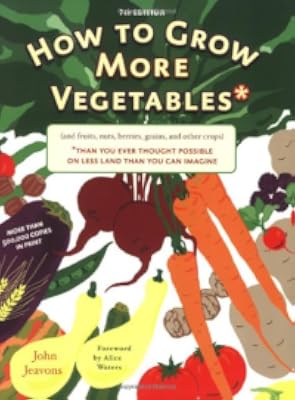
How to Grow More Vegetables Than You Ever Thought Possible on Less Land Than You Can Imagine
by John Jeavons
On This Page
Description
Presents the basic principles of biointensive gardening with tips on what to grow, preparing growing beds, and planning and planting crops.Tags
Recommendations





Member Reviews
This should have been right up my street: sustainable, organic gardening being something I'm pretty passionate about. But it was a disappointing read: simultaneously didactic and uninformative. I found it repetitive in places and with the exception of the section on plants to repel certain bugs, was left feeling that I had learnt very little. There were numerous mentions of other booklets published by the Ecology Action group which were rather irritating: if it's important enough to keep referring to, why not just put the booklet's text into the book? The fact that they'd turned the GROW BIOINTENSIVE process into a capitalised brandname was annoying, too. It's not what organic gardening should about, in my opinion.
I have no question that "How to Grow More Vegetables" is a great resource for an experienced gardener. For a beginner like me, it was a little overwhelming... and a little too technical for my taste. I did like the spacing charts and the simple mini-garden plans. Don't get me wrong, I learned a lot from reading the book, but I think a good portion of it was just over my head.
This is the handbook of the Grow Biointensive® method of food gardening: a combination of the French intensive technique (a method used around Paris in the 1700s and 1800s using copious amounts of horse manure and very close plant spacing) and the 1920s biodynamic technique of Austrian Rudolph Steiner (one of the first the rail against synthetic fertilizers and pesticides).
The system is complicated. Depending on your soil, you may need to begin with one of four double-digging processes (Initial, Ongoing, Complete Texturizing, or U-Bar). Tests are then taken and amendments chosen and incorporated to form a bed that is flat-topped but not contained, so that the edges are rounded shoulders (these are planted into at the same rate as the show more top). Crops to be planted need to be chosen according to which of three categories they fall into (based on their production of calories and/or carbon), and certain percentages of these categories must be planted. These crops are then planted in triangular or hexagonal patterns at a distance that will allow their leaves to just touch when they reach harvest size (an extraordinarily detailed and complicated chart spanning the better part of chapter 6 details planting spaces and yields for common vegetable, fruit, and cereal crops). Certain watering techniques must be used. Companion planting (both in the “companionship” sense and in the sense of crop rotation) must also be considered. Gardening by the moon is also mentioned, though they do concede that it is controversial.
Complicated though it may be (and I don't think I did it justice), most of the reasoning is quite sound and based on old, proven systems used by terracing farmers and farmers in difficult growing areas worldwide for centuries. The spacing element in particular fascinates me, and I will be experimenting with it.
If you happen by this book at the library I would advise you to check it out. It's not an easy read but you can pick and choose parts of the overall method to incorporate into your own. If nothing else, you'll boggle at the astounding 68 page long bibliography of recommended reading. show less
The system is complicated. Depending on your soil, you may need to begin with one of four double-digging processes (Initial, Ongoing, Complete Texturizing, or U-Bar). Tests are then taken and amendments chosen and incorporated to form a bed that is flat-topped but not contained, so that the edges are rounded shoulders (these are planted into at the same rate as the show more top). Crops to be planted need to be chosen according to which of three categories they fall into (based on their production of calories and/or carbon), and certain percentages of these categories must be planted. These crops are then planted in triangular or hexagonal patterns at a distance that will allow their leaves to just touch when they reach harvest size (an extraordinarily detailed and complicated chart spanning the better part of chapter 6 details planting spaces and yields for common vegetable, fruit, and cereal crops). Certain watering techniques must be used. Companion planting (both in the “companionship” sense and in the sense of crop rotation) must also be considered. Gardening by the moon is also mentioned, though they do concede that it is controversial.
Complicated though it may be (and I don't think I did it justice), most of the reasoning is quite sound and based on old, proven systems used by terracing farmers and farmers in difficult growing areas worldwide for centuries. The spacing element in particular fascinates me, and I will be experimenting with it.
If you happen by this book at the library I would advise you to check it out. It's not an easy read but you can pick and choose parts of the overall method to incorporate into your own. If nothing else, you'll boggle at the astounding 68 page long bibliography of recommended reading. show less
An excellent and thought provoking book that talks about sustainable gardening (really turning your garden into a self-contained food source). This book challenged my view of the garden, moving it from being just a hobby to being a long term project for reducing our dependance on the "grid". The information leads down the path of master gardener or full scale farmer, and also down the path of sustainability and balanced agriculture. For now, I refer to this book every time I plant something. It's my top reference, closely followed by The Kitchen Garden, by Sylvia Thompson.
Originally published in 1974.
I've read this book 3 times already and have it all marked up and highlighted throughout. It's the perfect reference and organic gardening motivation book. Down to earth and simple to read. Love it!
I've read this book 3 times already and have it all marked up and highlighted throughout. It's the perfect reference and organic gardening motivation book. Down to earth and simple to read. Love it!
One of my go-to garden books. Lots of information on how to improve soil, protect plants, companion planting, how get a great yield, and much more. The biointensive method fits well with the principles of Permaculture. This book is in the top few gardening books I would keep if I had to get rid of all the rest.
A great reference, full of helpful information and planting charts.
Members
- Recently Added By
Lists

Penguin Random House
458 works; 4 members
Author Information

All Editions
Some Editions
Common Knowledge
- Canonical title
- How to Grow More Vegetables Than You Ever Thought Possible on Less Land Than You Can Imagine
- Original title
- How to Grow More Vegetables Than You Ever Thought Possible on Less Land Than You Can Imagine
- Alternate titles
- How to Grow More Vegetables* *Than You Ever Thought Possible on Less Land Than You Can Imagine; How to Grow More Vegetables: Than You Ever Thought Possible on Less Land Than You Can Imagine; How to Grow More Vegetables Than You Ever Thought Possible on Less Land Than You Can Imagine: Fruits, Nuts, Berries, Grains, and Other Crops
- Original publication date
- 1974
- Epigraph
- ...for, lo, the eternal and sovereign luminous space,
where rule the unnumbered stars,
is the air we breathe in
and the air we breathe out.
And in the moment betwixt the breathing in
and the breathing out
of the Infinite Garden.
--Essene Gospel of Peace - First words
- The Biointensive method of horticulture is a quiet, vitally alive art of organic gardening which relinks people with the whole universe--a universe in which each of us is an interwoven part of the whole.
--Introduction - Blurbers
- Chadwick, Alan; Bergland, Robert
- Original language
- English US
Classifications
Statistics
- Members
- 960
- Popularity
- 27,476
- Reviews
- 13
- Rating
- (3.79)
- Languages
- English
- Media
- Paper, Ebook
- ISBNs
- 13
- ASINs
- 9