
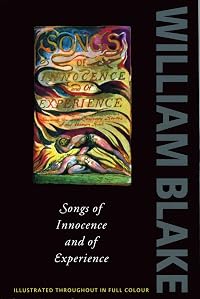
Songs of Innocence and of Experience
by William Blake
On This Page
Description
Songs of Innocence and of Experience compiles two contrasting but directly related books of poetry by William Blake. Songs of Innocence honors and praises the natural world, the natural innocence of children and their close relationship to God. Songs of Experience contains much darker, disillusioned poems, which deal with serious, often political themes. It is believed that the disastrous end to the French Revolution produced this disillusionment in Blake. He does, however, maintain that show more true innocence is achieved only through experience.. show less
Tags
Recommendations





Member Reviews
First of all, I would like to state in my defense that I picked up this slim volume days before I started freaking out about getting to 50 books by any means necessary. Ever since I catalogued my poetry shelf, I've been making an effort to get more of it read. Plus, in the story currently in my head, I'm a teacher, leading a unit on poetry. And apparently now I'm doing research for the stories I tell myself on long walks and as I fall asleep.
Yes? Well, okay. I don't know exactly what I was expecting when I first picked this up, but it certainly wasn't the poems I found in Songs of Innocence. This first volume is so excessively sweet, devoid of any hint of adult cynicism, that I felt a bit unmoored, and it actually took me days to work show more my way through them. It wasn't until I made it into Songs of Experience and heard the call and response between volumes that everything fell into place. Each side is illuminated and brought into relief by the other.
This volume contains what must surely be one of the most famous poems in the English language -- "The Tyger," which somehow I think I had never previously read in its entirety, though certainly I have seen its opening lines quoted often enough. Myself, I prefer "the Little Vagabond."
Worth its reputation after all, I'd have to say. show less
Yes? Well, okay. I don't know exactly what I was expecting when I first picked this up, but it certainly wasn't the poems I found in Songs of Innocence. This first volume is so excessively sweet, devoid of any hint of adult cynicism, that I felt a bit unmoored, and it actually took me days to work show more my way through them. It wasn't until I made it into Songs of Experience and heard the call and response between volumes that everything fell into place. Each side is illuminated and brought into relief by the other.
This volume contains what must surely be one of the most famous poems in the English language -- "The Tyger," which somehow I think I had never previously read in its entirety, though certainly I have seen its opening lines quoted often enough. Myself, I prefer "the Little Vagabond."
Worth its reputation after all, I'd have to say. show less
Visionary and prophet; he saw angels in trees, but wisely acknowledged they were in his own head. I remember at choir practice a few years ago, a young man rubbishing the words of “Jerusalem”: “And did those feet in ancient time walk upon England’s mountains green? Obviously not!” Ah, but there is poetic truth, the mythos, and logical everyday truth, the logos. Blake is referring to an old legend, and inviting us to ponder how we might behave if this were true. But you could argue for ever with these commonsensical folk who call a spade a spade and see no further than the end of their own noses. What can you do with a guy who looks at his mobile phone all through the intercessions…. Favourites are: “Night”, show more “Eternity”, "Mock on, mock on" and “Auguries of Innocence”. We still need Blake to remind us of how we should treat creation. show less
William Blake’s remarkably written and illustrated poems have endured the test of time and continue to amaze and delight me, even though I have read them dozens of times over the years.
My favorite poems from the Songs of Innocence are, sadly, about innocence abused. It seems such a contrast to me to read Nurse’s Song, in which the children beg for more time to play and frolic in the open air and the “laughing is heard on the hill”, and the Chimney Sweeper, which opens with the death of a mother and selling of a child to work in the soot and suffocation of the chimney sweep. That the sweeper is able to maintain his innocence and trust in the face of such a fate is a remarkable testament to the faith of the yet unspoiled child.
Of show more course, there are religious implications in each of the poems, which are intended and profound. The symbol of the lamb, as standing for both the children and their saviour, runs through several of the poems, including the most famous, The Lamb, which begins, familiarly, “Little lamb who made thee?”
These poems would be quite impressive had Blake written only of innocence, but he wrote a second set of poems, Songs of Experience, which contrast diametrically with the innocence poems. In fact, many of them bear the same name, as in the poems titled Holy Thursday. The poem from Songs of Innocence portrays the children, lined up in twos, entering the cathedral with angelic faces and voices, close to heaven. It’s counterpart in Songs of Experience speaks of the poverty and hunger suffered by so many children of the time.
Parallels exist between many of the poems, contrasting innocence and experience. As The Lamb is the most famous of the Innocence poems, The Tiger is the most famous of the Experience poems. The poems represent the natural world and God’s creation of both the predator and the prey. Blake’s exploration of the two aspects of God and the complexity of His creation.
Cannot close without including my favorite of all the poems:
A POISON TREE
I was angry with my friend:
I told my wrath, my wrath did end.
I was angry with my foe:
I told it not, my wrath did grow.
And I watered it in fears
Night and morning with my tears,
And I sunnèd it with smiles
And with soft deceitful wiles.
And it grew both day and night,
Till it bore an apple bright,
And my foe beheld it shine,
And he knew that it was mine,—
And into my garden stole
When the night had veiled the pole;
In the morning, glad, I see
My foe outstretched beneath the tree. show less
My favorite poems from the Songs of Innocence are, sadly, about innocence abused. It seems such a contrast to me to read Nurse’s Song, in which the children beg for more time to play and frolic in the open air and the “laughing is heard on the hill”, and the Chimney Sweeper, which opens with the death of a mother and selling of a child to work in the soot and suffocation of the chimney sweep. That the sweeper is able to maintain his innocence and trust in the face of such a fate is a remarkable testament to the faith of the yet unspoiled child.
Of show more course, there are religious implications in each of the poems, which are intended and profound. The symbol of the lamb, as standing for both the children and their saviour, runs through several of the poems, including the most famous, The Lamb, which begins, familiarly, “Little lamb who made thee?”
These poems would be quite impressive had Blake written only of innocence, but he wrote a second set of poems, Songs of Experience, which contrast diametrically with the innocence poems. In fact, many of them bear the same name, as in the poems titled Holy Thursday. The poem from Songs of Innocence portrays the children, lined up in twos, entering the cathedral with angelic faces and voices, close to heaven. It’s counterpart in Songs of Experience speaks of the poverty and hunger suffered by so many children of the time.
Parallels exist between many of the poems, contrasting innocence and experience. As The Lamb is the most famous of the Innocence poems, The Tiger is the most famous of the Experience poems. The poems represent the natural world and God’s creation of both the predator and the prey. Blake’s exploration of the two aspects of God and the complexity of His creation.
Cannot close without including my favorite of all the poems:
A POISON TREE
I was angry with my friend:
I told my wrath, my wrath did end.
I was angry with my foe:
I told it not, my wrath did grow.
And I watered it in fears
Night and morning with my tears,
And I sunnèd it with smiles
And with soft deceitful wiles.
And it grew both day and night,
Till it bore an apple bright,
And my foe beheld it shine,
And he knew that it was mine,—
And into my garden stole
When the night had veiled the pole;
In the morning, glad, I see
My foe outstretched beneath the tree. show less
This was reportedly the only book (actually two) with which William Blake had a very modest commercial success during his life (1757-1827). And I can understand that: compared to his later work, these early poems still come across as very appealing. Songs of Innocence (1789) offers what the title suggests: children's verses and songs, very pastoral, with many sheep, children and angels. There some shadowy sides (such as in the Chimney Sweeper), but it always ends well, the stories radiate confidence and security, especially in God. But that pleasing simplicity is deceptive, as evidenced by Songs of Experience (1794), published 5 years later. This is very different in tone, much more somber and even grim, “it is eternal winter show more there”. Blake has clearly constructed this as a negative reflection of the first book. Of course, an evergreen in this tome is the Tiger poem, which is perhaps best known for its rhythmic alliterations, but which actually ingeniously confronts us with the question of evil in the world: why does the God, who appears as the caring father in the first book, tolerates such horrible animals to exist? Here, Blake clearly shows that he has much more to offer than nursery rhymes. show less
Brief review
Of all the books I own, this is one that I cherish most. If I could choose only one book by one poet to teach, this would probably be it. Indeed, there would be other poems that I would teach from memory if necessary, but as a unified book this one is incomparable, each poem a satisfying experience, but the work as a whole even incredibly more rewarding: pairs of poems, groups of poems, poems and designs, two complementary books in one, and ultimately one long work of a good many parts. As an artifact, this book is a work of art – or rather this book within a book (or two books within a third book), and each of them commendable for its design and execution. As literature, Songs of Innocence and of Experience is unusual, show more almost unique. It is complex enough to challenge the scholar, the critic, the mystic, the cultural historian; but at the same time it is open to the common reader, some of its poems appealing even to children and unsophisticated readers of poetry. As a message, or vision as Blake would prefer we say, it lifts us up and it brings us down to earth, it calms us and disturbs us, it comforts us and unsettles us, it is reassuring and provocative – often all at the same time.
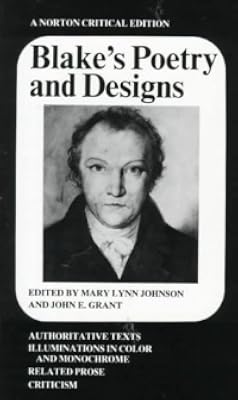
I am speaking, of course, of this edition of the work (The Orion Press in association with The Trianon Press, 1967), a replica of the original Songs of Innocence and Of Experience : Showing the Two Contrary States of the Human Soul 1789 – 1794 The Author & Printer W. Blake. According to the publisher’s note, this is a “reproduction in the original size of William Blake’s Illuminated Book”; it has an introduction and commentary by Sir Geoffrey Keynes, at one time a noted British Blakean scholar. I purchased my copy when it first came out, for $16.50, an unbelievably reasonable price for a book with plates “printed in 6 and 8-colour offset on paper especially manufactured to match that used by Blake.” Of course, the facsimile published in 1955 by The Trianon Press in Paris had been itself a work of technological perfection, unmatched by any ordinary printer. It is usually available only in special rare-book collections of major research libraries. I have actually held it in my hands and examined every page closely. It is awe-inspiring. The original, on which all these reproductions are based, was first published in 1794 using Blake’s own printing technique, a kind of reverse lithography, hand colored, sometimes (it is said) by Mrs. Blake. The twenty-seven copies we know of now were printed with finishing touches by hand for over thirty years, right up until Blake's last illness and death. But that itself is an interesting story, one not told by Sir Geoffrey in this edition. (Cf. Blake's Poetry and Designs, ed. Mary Lynn Johnson [Grant] and John E. Grant, Norton, 2008, and the biography Blake by Peter Ackroyd,, Knopf, 1996.)
The format of this edition of the Songs has a letterpress copy of each poem on a verso page facing the plate from Blake’s work on the recto page, then a blank page, then a brief (usually one-paragraph) comment by Sir Geoffrey. The book is bound in blue cloth and enclosed in a box with similar binding, and with plates of the title pages from Songs of Innocence and Songs of Experience pasted on the front and back covers of the box. Later versions of this work are available in several different formats, but, if you can, find one of the originals, for they are magnificent. Be sure the publisher is The Orion Press in association with The Trianon Press, Paris, and that the book is in its original blue binding and box. Occasionally a copy comes available from a used-book dealer for around $50 plus shipping.
Extended Review/Comments
To review the work itself, Songs of Innocence and of Experience, would require at least a book-length work. (See, for example, The Piper and the Bard, by Robert F. Gleckner, Wayne State UP, 1959, which I have already reviewed for LibraryThing, q.v.). What I shall do here instead is simply make some suggestions about reading the work as a whole, and illustrate what I mean with a few examples. Whether you are reading it for the first or the fiftieth time, you will find these pertinent: (1) Read the designs as well as the texts. (2) Go from Plate 1 to Plate 2, etc., in order. (3) Consider Blake’s introductions as instructions on how to read the poems. (4) Re-read, finding contraries among the texts and the designs in the two books. . (5) Finally, find ways to read the work as a whole –not just as series of individual poems/designs – though they certainly make rewarding reading in precisely that way.
The way to begin reading a Blake work is to begin with Plate 1, for each plate prepares the reader for the next one and the one after that. The title page of this work is no exception. A nude couple, whom Blake’s readers in the eighteenth century would have immediately recognized as Adam and Eve, are being driven from Paradise (Innocence) by waves of flames. They are hiding their faces with their arms, as if they are weeping. The male figure is hovering over the female, perhaps in a protective position, perhaps with sexual suggestiveness. They have attempted to clothe themselves with foliage, as all readers then would have recognized, though the slight lines do not look much like foliage. Indeed, they are suggestive of pubic hair, perhaps implying another kind of passage from Innocence to Experience, that is, from childhood to adolescence, from unawareness to awareness, from asexuality to sexual passions, from childlike curiosity to moral responsibility, from a sense of oneness with family, home, nature, the universe to a sense of separation, even alienation.
The dark flames whipping the nude couple and ascending up the page dominate this initial design, suggesting the gate of flame in the Garden of Eden, but also the flames of Hell. This design dominates the page visually, but set against the flames and focusing one’s attention, of course, are the words of the title:
Songs
Of
Innocence
& Of
Experience
Showing the Two Conrtrary States
of the Human Soul
The words Innocence and Experience are set in block letters in the yellowish and red of the flames against the clouds of smoke; but dominant among the words on the title page is Songs, set in green, larger than the other text, sprouting tendrils, as it were, almost like the vines and foliage of nature. In other words, Songs rises above Innocence and Experience, vastly outweighs both, and indeed stands out against the fallen experience suggested by the page as a whole. The very appearance of the word Songs partakes of the Garden, the profusion and sinuous curvatures of nature, defying the square, mechanical correctness of the other words on the title page but also the suffering and vehemence of the design.
In other words, the Songs to which we are about to be treated in this book may be seen as growing out of – and outgrowing – both the states of Innocence and of Experience. The Songs themselves – the poetry and the illustrations – transcend both states of Innocence and Experience and achieve a higher innocence, a higher, freer level of vision.
As we are aware, and probably Blake’s original readers were also aware, Songs of Innocence had already appeared on its own as a separate book, but Songs of Experience would rarely appear in such a stand-alone format. Somehow that seems ironically appropriate; for the Innocent One is naïve and unaware of the pressures and tensions of Experience, but after one has entered the state of Experience one is always aware of memories of Innocence. As modern psychology has demonstrated time and time again, we never move very far away from the child-within, that innocent whom we never completely forget or abandon. We are keenly aware of the state which we have already passed through, though in that state we were blissfully unaware of the state into which we had not yet entered. As prospective readers, at this point we immediately find ourselves wanting to jump ahead to various ones of the familiar songs to illustrate these points, but – no – let’s take one plate at a time.
From this point on, every plate deserves and rewards this kind of reflection. The two books (26 more plates with nineteen songs for Songs of Innocence, 27 plates with twenty-six songs for Songs of Experience) are parallel, contrastive, and complementary – or to use Blake’s own term, contrary. They do NOT refute or negate one another but are contraries, each reflecting and correcting the other. The Songs, however, do not always achieve this in precisely parallel ways, not at all. However, each book does have a frontispiece, a title page, and an introduction which are more or less parallel. These introduce the Piper and the Bard, the voices of Innocence and Experience. The title pages themselves are contraries: Songs of Innocence rich with foliage, living creatures, curves, frills, and soft, italic lettering; Songs of Experience hard, square, and barren, a scene of old age, even senility or death, the very word itself stiff and Roman; however, curiously, even here Songs has a bit of foliage, especially on the left-hand side and two (loving?) humans flying towards each other under its coverage.
Of my suggestions for reading the Songs, I think I have amply illustrated two: read the designs as well as the texts, begin with Plate 1. You really should proceed the first time from Plate 1 to Plate 2 to Plate 3 to Plate 4, and so on. Plate 4 is the first song simply titled “Introduction” (the frontispiece to Innocence, by the way, is an illustration to “Introduction”).
In this prefatory poem we meet the Piper, who receives his instructions from a child on a cloud. “Pipe a song about a Lamb.” “Piper pipe that song again.” “Sing thy songs of happy chear.” “Piper sit thee down and write / In a book that all may read.” The piper follows the instructions step by step, and the child’s response, to each one, is the response of a ideal, or idyllic child: “Merry chear.” “He wept to hear.” “He wept with joy to hear.” What you have here is an approach to Blake's "fourfold vision": Innocence (“merry chear,” happy but naïve, unaware), Experience (“wept to hear,” awareness of sorrow, troubles, struggling but uncreatively), and Innocence & Experience (“wept with joy,” a balance of the two, captured creatively; for example, in songs). We might think of the third level as a higher Innocence, approaching what I have called “seeing the work as a whole.” (Later, in Blake's Four Zoas and prophecies, this higher innocence would itself become twofold.)
To comply with the child’s fourth instruction – sit down and write, the Piper once again takes four steps, again corresponding to the fourfold vision, this time on the part of the writer/designer that Blake himself had become:
And I pluck’d a hollow reed.
And I made a rural pen,
And I stain’d the water clear,
And I wrote my happy songs.
The artist draws his tools from natural materials (a hollow reed, empty, meaningless of itself), shapes them to his use (a pen), takes a creative risk that, based on experience, he knows may go wrong (stains the water), and produces his art (wrote the songs), capturing them in the lasting form of a book
Every child may joy to hear.
The response to that fourth step (writing the songs) is that he recreates for all time, for all folk, what has been lost and is found again: Paradise, Innocence. In his later version of the fourfold vision Blake will call this Eden, or the New Jerusalem. Songs of Innocence is one gate to that eternal city, one room in that heavenly mansion – the vestibule maybe. Songs of Innocence and Experience is another, maybe stairs that lead to the Grand Foyer. “The Introduction” instructs us to look carefully for these four steps as we proceed. As readers too, like the Piper, we may begin with what we’ve perceived in nature and learned from our own experience, but eventually we have to take a risk – use our imaginations to recreate what can never be perceived or experienced or achieved with our own senses or reasoning. We must “stain the water clear.” (What an amazing ambiguity this reversal of nous and modifier presents us: we must stain the clear water, and by so doing make the water clearer; or to put it another way, what is clear/pure in innocence and stained by experience, by the arts is made clearer/purer.) Blake, the piper/bard, has etched the songs in stone, as it were, and imprinted them on paper for all time, for all people. Our task is to recreate them in our own vision – to read them, yes; to sing them ourselves, yes; but also to construct within them a meaningful vision.
Henceforth, each book has songs that are obvious contraries: “The Chimney Sweeper” (Plates 12 and 37), “Holy Thursday” (Plates 19 and 33), nurses’ songs (Plates 24 and 38), little boys lost (Plates 13 and 50), and the like. Best known are “The Lamb” (Plate 8) and “The Tyger” (Plate 42), not exact contraries, but close; likewise, there are “The Divine Image” (Plate18) and “The Human Abstract” (Plate 47); notice the association of “image” with “divine” and “abstract” with “human,” or fallen nature (that is, visual arts vs. abstract reasoning). Note too that Blake did a much more brutal contrastive plate, “A Divine Image,” which he never included in the book or hand-colored as far as we know, but which is appended to the end of this copy.
Let us explore one set of contraries: “Infant Joy” and “Infant Sorrow,” though the two are hardly parallel at all. “Infant Joy” (Plate 23) is the most genuine “song of innocence,” and its design is perhaps the most beautiful, the most striking, and the most colorful of all fifty-four plates. It is dominated by a large, generic blossom, arising from roots at the bottom right, its stem rising gracefully up the left margin, the blossom itself taking up almost half the plate with its brilliant scarlet color (in this copy) and its inviting, open shape. Also arising from the root is an unopened bud, hanging in the right margin. The foliage is bright green, the background, shades of blue. Inside the blossom, in the place of a stamen and pistil, is a miniature “annunciation” or "incarnation" scene, in pastel yellows: a mother holding a presumably newborn or newly conceived child, and a winged creature standing before them, hands raised, as in a blessing.
The words of the song are a dialog: the voices of the Innocent and of a respondent (perhaps the mother, the winged messenger, the child’s father, the piper himself, or even you the reader).
I have no name
I am but two days old. –
What shall I call thee?
I happy am
Joy is my name, –
Sweet joy befall thee!
The epitome of simplicity, this text is almost meaningless, and certainly unelaborated, without the accompanying design. The ideal Innocent, a sweet babe in both word and design, has just emerged (from birth, from conception, from creation, from the artist’s/poet’s imagination?); it has no name; then almost immediately, the Innocent, emerges into language: “Joy is my name – “ The language of the poem is plain, exclamatory, emotive, even prayerful. “Sweet joy befall thee.”
“Infant Sorrow” (Plate 48) in Songs of Experience, on the other hand, gives us a realistic picture of the unhappy child we all know from experience – perhaps even remember from our own childhood. Its parents groan and weep, not only with the pangs of birth but with the disconsolate feeling of having brought a child into a hard, “fallen” world, a child not at all pleasant and compliant. The child speaks articulately of its own fate, describing itself as helpless, naked, “piping loud,” struggling, striving – not unlike all children in the “real world.” Finally, exhausted, this infant concludes, “Bound and weary, I thought best / To sulk upon my mother’s breast.” The idyllic “Infant Joy,” has been reduced to a realistic “Infant Sorrow,” which itself has been reduced to sulkiness. One can almost envision young parents anticipating their first child, the creation of their passionate union, the ideal they pictured before its birth, and then the hardships of the colicky, restless, helpless, naked baby, “piping loud.” Indeed, they do find themselves groaning and weeping, resenting this sulky child, and consequently growing sulky themselves. That’s Experience! That child is all of us - human in a fallen world.
There is, however, no parallel between the design for “Infant Sorrow,” and its Innocent predecessor. No gloriously beautiful blossoms here; no annunciation scenes. Instead, a nursemaid (or perhaps a mother), looking angry or at least very solemn; she is putting the naked child down on a hard “bassinette” or “changing board” beside a comfy, soft, lushly curtained bed in the background. If you look for the contrary of this design in Songs of Innocence, you will find it accompanying the poem “A Cradle Song” (Plates 16-17): the nursemaid (or mother) in the same long, purple gown is seated, tenderly watching over the sleeping infant, who is covered (well, yes, bound, if you will) on a soft pillow in an elaborate “bassinette” with a high, stately headpiece, a super-dignified version of the cocoon-like sleeping place provided for infants for the first few months: almost an exact contrary of the design for “Infant Sorrow.”
And where is the parallel for the design of “Infant Joy”? Get ready for something of a shock. It’s “The SICK ROSE” [caps Blake’s, not mine].
O Rose thou art sick.
The invisible worm,
That flies in the night
In the howling storm:
Has found out thy bed
Of crimson joy:
And his dark secret love
Does thy life destroy.
If “Infant Joy” is read as the moment of conception, the ecstasy of sexual union, “The SICK ROSE” (Plate 39) is its contrary – illicit, joyless sex, perhaps even rape. The design is a precise contrary for “Infant Joy”: the blossom springs from roots on the left-hand (or sinister) side of the page; the vine is thorny and the leaves spiky; the rose itself has fallen to the ground, all the way to the right side of the page; two human figures on the vine are weeping, hiding their countenances; crawling up the vine is a caterpillar, noted in Blake’s age for its destructive power with plants; a worm is entering the rose and a winged figure (Joy?) is attempting to escape. The red of the rose, unlike the brilliant scarlet of the blossom in “Infant Joy,” is a grayish-pink. There is no promising rosebud in this illustration. One does not have to be a student of visual symbolism or psychosexual imagery to apply this picture of the sick rose to “thy bed / Of crimson joy” in the poem – or to contrast the pleasure, passion, ecstatic delight, and release of sexual conception (in the design for “Infant Joy”) and the anguish, pain, disappointment, flaccidity, and burden of, say, an unwanted pregnancy or the birth of a child into poverty, hardship, and/or homelessness (in the design for “The SICK ROSE”).
This example alone is enough to demonstrate the complexity and subtlety – the surprise; indeed, the shock – of some of the contrary “states” represented in the two books. By the way, the textual contrary of “The SICK ROSE,” is “The Blossom” (Plate 11) in Songs of Innocence.
Merry Merry Sparrow
Under leaves so green
A happy blossom
Sees you swift as arrow
Seek your cradle narrow
Near my bosom.
Without going into detail, you can immediately see connections with the design for “Infant Joy,” the text for “The SICK ROSE,” and, considering the “sobbing sobbing” Robin of its second stanza, with the text for “Infant Sorrow.” The design for “The Blossom” is, however, NOT “leaves so green,” but what appears to be a flame of yellows and reds, arching up the right-hand margin and over the text of the poem with many fairy-like, infantile creatures playing on the arch. Of course, if the flames had been colored green they would have been perfectly designed foliage. Given the sexual allusions in the texts, Sir Geoffrey is not too far off in identifying the flames as “the organ of generation both flaccid and erect.” And, if the petals of the blossom in the design for “Infant Joy” had been colored orange instead of scarlet (as I’ve heard they are in some of Blake’s original copies), they would have been closely akin to the flames in this design for “The Blossom.”
Oh, and to continue the connections, the text for “The Divine Image” in Songs of Innocence is framed by arches of flames, almost exactly like those for “The Blossom.”
To Mercy Pity Peace and Love,
All pray in their distress:
And to these virtues of delight
Return their thankfulness.
And all these flames, trees, foliage, blossoms are explained by the Bard in “The Human Abstract.” The human mind has formulated its own explanation, but that abstract statement is given imaginative form in the song and its design: a tree of life drawn by the artist (it’s pictured as a very dead tree) and written in the figurative language of the poet:
The Gods of the earth and sea,
Sought thro’ Nature to find this Tree
But their search was all in vain;
There grows one in the Human Brain.
You can keep seeing connections among texts, designs, Innocence and Experience, almost ad infinitum. After all, that is a major part of the pleasure of the book(s) and the challenge of Blake’s message/vision. For Innocence and Experience turn out to be two sides of the same coin, two insights into the same reality, parallel, contrastive, complementary, and interlocking. Indeed, if you now reread the work as a whole, you will find the two states underlying (and undermining) each other, one often if not always implicit in the other.
Take, for example, the two most familiar poems from the work, “The Lamb” and “The Tyger.” They begin with parallel questions:
Little Lamb who made thee
Does thou know who made thee
Tyger, Tyger, burning bright,
In the forests of the night;
What immortal hand or eye,
Could frame thy fearful symmetry?
The question in “The Lamb,” as you will recall, is answered simply but allusively:
He is called by thy name,
For he calls himself a Lamb:
and immediately in this sweet poem of innocence, all wooly delight, the perceptive reader is thrust onto the apex of human suffering and sacrifice (“Behold the Lamb of God who takes away the sins of the world”; “like a lamb that is led to slaughter, and like a sheep before its shearers is dumb”).
The question in “The Tyger,” as you will also recall, is answered with a whole series of questions, culminating with the ultimate one:
Did he smile his work to see?
Did he who made the Lamb make thee?
. . . .
What immortal hand or eye
Dare frame thy fearful symmetry?
[note the change in wording and tone from the first stanza]
But, just in case you’re overwhelmed by these questions – their irony, their complexity, their cynicism, their disbelief, or their horror – look at the design that accompanies the text. Who dares to “frame” the “fearful symmetry” of the Tyger? Well, Blake himself, of course: the illustrator, who has “framed” the tiger, beneath the barren tree. Frankly it doesn’t look all their fearsome; it looks rather unintimidating, the eye apprehensive, if not downright fearful (i.e., full of fear). But wait, the text didn’t say that the Tyger, Tyger was fearsome, did it? In fact the whole poem is about the creator of the Tyger (his hand or eye, his wings, his shoulder & art, his hammer, his chain, his furnace, his anvil, his dread grasp, and the like). All we hear of the Tyger in the text is that it is “burning bright” and has burning, fiery eyes. But wait. Even those eyes are ambivalent:
In what distant deeps or skies,
Burnt the fire of thine eyes?
On what wings dare he aspire?
What the hand, dare seize the fire?
So, as it turns out, “The Tyger” is not about a fearsome creature at all, but about the creative act that could “frame”such a creature. “Did he smile his work to see?” Well, if he’s William Blake and has just etched the design for the rather ordinary tiger, actually just a big pussy cat, I think he probably did smile to see his work. “Fearful symmetry”? Oh, yes, I’m sure he must have. Did he also make (i.e., write/illustrate) the Lamb? Yep, “The Lamb” and “The Tyger.” Both of them. They have been made manageable with the fires of creativity. And now we begin to see what all these flames mean – from the title page to “The Blossom,” “The Divine Image,” and the petals of the blossom in “Infant Joy.” They are the fires of creativity, of the creative artist, who has to work with his hands, his eye, and the ordinary tools of his trade. (After all, the blacksmith can be a creative artist, can't he? And all creative artists are, in their own way, smiths working with hammer and tongs at an iron forge, aren't they?)
You gotta see the fearsomeness of Experience for what it is. Manageable. Now reread “The Little Girl Lost” and “The Little Girl Found,” and you will see Blake framing lions and leopards and tigers the way Christian imagists have long framed them; for example, “the couching lion”
When he licks their hands:
And silent by them stands
They look upon his eyes
Fill’d with deep surprise:
And wondering behold,
A spirit arm’d in gold.
The Lamb of God, you will recall, is also the Lion of Judah – the two, one and the same. And that lion was to lay down with the lamb.
Originally these two poems were written for Songs of Innocence, then moved into Songs of Experience. It all depends on the perspective you take: the parents who’ve lost their child (in Experience), or the maiden sleeping “Among tigers wild” (in Innocence). Both perspectives, of course, are accurate – true, if you will – and both are inaccurate or limited, the one incomplete without the other. The “fierce” felines in the designs to these poems bear a striking resemblance to the “Tyger, Tyger, burning bright / In the forests of the night.”
Perhaps the most beautiful poetry, certainly the most intricate. of the Songs of Innocence is “The Little Black Boy” (Plates 9-10, right between “The Lamb” and “The Blossom”), which deals with race, slavery, discrimination, suffering, and death; yet it is a song of innocence.
And we are put on earth a little space,
That we may learn to bear the beams [flames] of love . . . .
As hard as I try, I can still think of this only as a song of experience. I have not the vision of a William Blake. “I believe; help thou mine unbelief.”
“The School-Boy” (Plate 53) is another song that was composed for Songs of Innocence, but later moved to Songs of Experience. It is probably my personal favorite of all the songs. I was that school-boy. The child within me – very much alive and still kicking, “piping loud,” if you will – is still that school-boy. Oh, and Blake was 100% right: it belongs among songs of experience.
How can the bird that is born for joy,
Sit in a cage and sing.
How can a child when fears annoy,
But droop his tender wing,
And forget his youthful spring.
“The Voice of the Ancient Bard” (Plate 54, the last one) begins with a Song of Higher Innocence, an ascension to the heights of imagination:
Youth of delight come hither,
And see the opening morn,
Image of truth new born.
Doubt is fled & clouds of reason,
Dark disputes & artful teasing . . . .
That’s the state that we readers must reach if we are to share Blake’s vision, just as the Piper has had to achieve this state to create his songs and the designs that embody them: “Image of truth new born.” Because it’s a Song of Experience, “The Voice of the Ancient Bard” must conclude with lines about those who never reach this state, who stumble over “tangled roots” and “bones of the dead:”
And feel they know not what but care:
And wish to lead others when they should be led.
So as you read (and experience) this delightful book, these two books in one, do your best to see the work as a whole. By now you probably realize that the phrase "as a whole" refers to my persistent effort to give this illuminated work an "Edenic" reading. This includes, among several efforts, two Blakean readings:
(1) Reading each song itself not as a traditional text and illustration, but as a unity, verbal/visual contrary; for example, the words themselves as being visualized, sometimes even sprouting foliage, hiding little characters and emblems, and stretching themselves in curves, serifs, and tendrils; likewise, the words and designs intertwining or interlocking and projecting themselves as inseparable (note the double meaning of the very word "characters").
(2) Reading the book not as two books in one (i.e., Songs of Innocence and Songs of Experience) but as one single work (simultaneously, Songs of Innocence and of Experience; for, as we have seen, most (if not all) of the forty-five songs address both innocence and experience, though in some Innocence predominates or is re-envisoned (e.g., "Infant Joy") and in others, Experience (e.g., "London" with its "mind-forg'd manacles").
There are other unities about which I am even less articulate,but at least these two will reward you as you "read" – and as you do so, don’t stumble over those roots and dead bones. Don’t try to tell the songs and designs what they mean; let them tell you. Take a risk. Move beyond doubts and narrow rationalism, beyond “Dark disputes & artful teasing.” Open yourself to an “Image of truth new born.” That moment will come.
I happy am
Joy is my name
You have my best wishes, my silent prayer, my blessing:
Sweet joy befall thee show less
Of all the books I own, this is one that I cherish most. If I could choose only one book by one poet to teach, this would probably be it. Indeed, there would be other poems that I would teach from memory if necessary, but as a unified book this one is incomparable, each poem a satisfying experience, but the work as a whole even incredibly more rewarding: pairs of poems, groups of poems, poems and designs, two complementary books in one, and ultimately one long work of a good many parts. As an artifact, this book is a work of art – or rather this book within a book (or two books within a third book), and each of them commendable for its design and execution. As literature, Songs of Innocence and of Experience is unusual, show more almost unique. It is complex enough to challenge the scholar, the critic, the mystic, the cultural historian; but at the same time it is open to the common reader, some of its poems appealing even to children and unsophisticated readers of poetry. As a message, or vision as Blake would prefer we say, it lifts us up and it brings us down to earth, it calms us and disturbs us, it comforts us and unsettles us, it is reassuring and provocative – often all at the same time.
I am speaking, of course, of this edition of the work (The Orion Press in association with The Trianon Press, 1967), a replica of the original Songs of Innocence and Of Experience : Showing the Two Contrary States of the Human Soul 1789 – 1794 The Author & Printer W. Blake. According to the publisher’s note, this is a “reproduction in the original size of William Blake’s Illuminated Book”; it has an introduction and commentary by Sir Geoffrey Keynes, at one time a noted British Blakean scholar. I purchased my copy when it first came out, for $16.50, an unbelievably reasonable price for a book with plates “printed in 6 and 8-colour offset on paper especially manufactured to match that used by Blake.” Of course, the facsimile published in 1955 by The Trianon Press in Paris had been itself a work of technological perfection, unmatched by any ordinary printer. It is usually available only in special rare-book collections of major research libraries. I have actually held it in my hands and examined every page closely. It is awe-inspiring. The original, on which all these reproductions are based, was first published in 1794 using Blake’s own printing technique, a kind of reverse lithography, hand colored, sometimes (it is said) by Mrs. Blake. The twenty-seven copies we know of now were printed with finishing touches by hand for over thirty years, right up until Blake's last illness and death. But that itself is an interesting story, one not told by Sir Geoffrey in this edition. (Cf. Blake's Poetry and Designs, ed. Mary Lynn Johnson [Grant] and John E. Grant, Norton, 2008, and the biography Blake by Peter Ackroyd,, Knopf, 1996.)
The format of this edition of the Songs has a letterpress copy of each poem on a verso page facing the plate from Blake’s work on the recto page, then a blank page, then a brief (usually one-paragraph) comment by Sir Geoffrey. The book is bound in blue cloth and enclosed in a box with similar binding, and with plates of the title pages from Songs of Innocence and Songs of Experience pasted on the front and back covers of the box. Later versions of this work are available in several different formats, but, if you can, find one of the originals, for they are magnificent. Be sure the publisher is The Orion Press in association with The Trianon Press, Paris, and that the book is in its original blue binding and box. Occasionally a copy comes available from a used-book dealer for around $50 plus shipping.
Extended Review/Comments
To review the work itself, Songs of Innocence and of Experience, would require at least a book-length work. (See, for example, The Piper and the Bard, by Robert F. Gleckner, Wayne State UP, 1959, which I have already reviewed for LibraryThing, q.v.). What I shall do here instead is simply make some suggestions about reading the work as a whole, and illustrate what I mean with a few examples. Whether you are reading it for the first or the fiftieth time, you will find these pertinent: (1) Read the designs as well as the texts. (2) Go from Plate 1 to Plate 2, etc., in order. (3) Consider Blake’s introductions as instructions on how to read the poems. (4) Re-read, finding contraries among the texts and the designs in the two books. . (5) Finally, find ways to read the work as a whole –not just as series of individual poems/designs – though they certainly make rewarding reading in precisely that way.
The way to begin reading a Blake work is to begin with Plate 1, for each plate prepares the reader for the next one and the one after that. The title page of this work is no exception. A nude couple, whom Blake’s readers in the eighteenth century would have immediately recognized as Adam and Eve, are being driven from Paradise (Innocence) by waves of flames. They are hiding their faces with their arms, as if they are weeping. The male figure is hovering over the female, perhaps in a protective position, perhaps with sexual suggestiveness. They have attempted to clothe themselves with foliage, as all readers then would have recognized, though the slight lines do not look much like foliage. Indeed, they are suggestive of pubic hair, perhaps implying another kind of passage from Innocence to Experience, that is, from childhood to adolescence, from unawareness to awareness, from asexuality to sexual passions, from childlike curiosity to moral responsibility, from a sense of oneness with family, home, nature, the universe to a sense of separation, even alienation.
The dark flames whipping the nude couple and ascending up the page dominate this initial design, suggesting the gate of flame in the Garden of Eden, but also the flames of Hell. This design dominates the page visually, but set against the flames and focusing one’s attention, of course, are the words of the title:
Songs
Of
Innocence
& Of
Experience
Showing the Two Conrtrary States
of the Human Soul
The words Innocence and Experience are set in block letters in the yellowish and red of the flames against the clouds of smoke; but dominant among the words on the title page is Songs, set in green, larger than the other text, sprouting tendrils, as it were, almost like the vines and foliage of nature. In other words, Songs rises above Innocence and Experience, vastly outweighs both, and indeed stands out against the fallen experience suggested by the page as a whole. The very appearance of the word Songs partakes of the Garden, the profusion and sinuous curvatures of nature, defying the square, mechanical correctness of the other words on the title page but also the suffering and vehemence of the design.
In other words, the Songs to which we are about to be treated in this book may be seen as growing out of – and outgrowing – both the states of Innocence and of Experience. The Songs themselves – the poetry and the illustrations – transcend both states of Innocence and Experience and achieve a higher innocence, a higher, freer level of vision.
As we are aware, and probably Blake’s original readers were also aware, Songs of Innocence had already appeared on its own as a separate book, but Songs of Experience would rarely appear in such a stand-alone format. Somehow that seems ironically appropriate; for the Innocent One is naïve and unaware of the pressures and tensions of Experience, but after one has entered the state of Experience one is always aware of memories of Innocence. As modern psychology has demonstrated time and time again, we never move very far away from the child-within, that innocent whom we never completely forget or abandon. We are keenly aware of the state which we have already passed through, though in that state we were blissfully unaware of the state into which we had not yet entered. As prospective readers, at this point we immediately find ourselves wanting to jump ahead to various ones of the familiar songs to illustrate these points, but – no – let’s take one plate at a time.
From this point on, every plate deserves and rewards this kind of reflection. The two books (26 more plates with nineteen songs for Songs of Innocence, 27 plates with twenty-six songs for Songs of Experience) are parallel, contrastive, and complementary – or to use Blake’s own term, contrary. They do NOT refute or negate one another but are contraries, each reflecting and correcting the other. The Songs, however, do not always achieve this in precisely parallel ways, not at all. However, each book does have a frontispiece, a title page, and an introduction which are more or less parallel. These introduce the Piper and the Bard, the voices of Innocence and Experience. The title pages themselves are contraries: Songs of Innocence rich with foliage, living creatures, curves, frills, and soft, italic lettering; Songs of Experience hard, square, and barren, a scene of old age, even senility or death, the very word itself stiff and Roman; however, curiously, even here Songs has a bit of foliage, especially on the left-hand side and two (loving?) humans flying towards each other under its coverage.
Of my suggestions for reading the Songs, I think I have amply illustrated two: read the designs as well as the texts, begin with Plate 1. You really should proceed the first time from Plate 1 to Plate 2 to Plate 3 to Plate 4, and so on. Plate 4 is the first song simply titled “Introduction” (the frontispiece to Innocence, by the way, is an illustration to “Introduction”).
In this prefatory poem we meet the Piper, who receives his instructions from a child on a cloud. “Pipe a song about a Lamb.” “Piper pipe that song again.” “Sing thy songs of happy chear.” “Piper sit thee down and write / In a book that all may read.” The piper follows the instructions step by step, and the child’s response, to each one, is the response of a ideal, or idyllic child: “Merry chear.” “He wept to hear.” “He wept with joy to hear.” What you have here is an approach to Blake's "fourfold vision": Innocence (“merry chear,” happy but naïve, unaware), Experience (“wept to hear,” awareness of sorrow, troubles, struggling but uncreatively), and Innocence & Experience (“wept with joy,” a balance of the two, captured creatively; for example, in songs). We might think of the third level as a higher Innocence, approaching what I have called “seeing the work as a whole.” (Later, in Blake's Four Zoas and prophecies, this higher innocence would itself become twofold.)
To comply with the child’s fourth instruction – sit down and write, the Piper once again takes four steps, again corresponding to the fourfold vision, this time on the part of the writer/designer that Blake himself had become:
And I pluck’d a hollow reed.
And I made a rural pen,
And I stain’d the water clear,
And I wrote my happy songs.
The artist draws his tools from natural materials (a hollow reed, empty, meaningless of itself), shapes them to his use (a pen), takes a creative risk that, based on experience, he knows may go wrong (stains the water), and produces his art (wrote the songs), capturing them in the lasting form of a book
Every child may joy to hear.
The response to that fourth step (writing the songs) is that he recreates for all time, for all folk, what has been lost and is found again: Paradise, Innocence. In his later version of the fourfold vision Blake will call this Eden, or the New Jerusalem. Songs of Innocence is one gate to that eternal city, one room in that heavenly mansion – the vestibule maybe. Songs of Innocence and Experience is another, maybe stairs that lead to the Grand Foyer. “The Introduction” instructs us to look carefully for these four steps as we proceed. As readers too, like the Piper, we may begin with what we’ve perceived in nature and learned from our own experience, but eventually we have to take a risk – use our imaginations to recreate what can never be perceived or experienced or achieved with our own senses or reasoning. We must “stain the water clear.” (What an amazing ambiguity this reversal of nous and modifier presents us: we must stain the clear water, and by so doing make the water clearer; or to put it another way, what is clear/pure in innocence and stained by experience, by the arts is made clearer/purer.) Blake, the piper/bard, has etched the songs in stone, as it were, and imprinted them on paper for all time, for all people. Our task is to recreate them in our own vision – to read them, yes; to sing them ourselves, yes; but also to construct within them a meaningful vision.
Henceforth, each book has songs that are obvious contraries: “The Chimney Sweeper” (Plates 12 and 37), “Holy Thursday” (Plates 19 and 33), nurses’ songs (Plates 24 and 38), little boys lost (Plates 13 and 50), and the like. Best known are “The Lamb” (Plate 8) and “The Tyger” (Plate 42), not exact contraries, but close; likewise, there are “The Divine Image” (Plate18) and “The Human Abstract” (Plate 47); notice the association of “image” with “divine” and “abstract” with “human,” or fallen nature (that is, visual arts vs. abstract reasoning). Note too that Blake did a much more brutal contrastive plate, “A Divine Image,” which he never included in the book or hand-colored as far as we know, but which is appended to the end of this copy.
Let us explore one set of contraries: “Infant Joy” and “Infant Sorrow,” though the two are hardly parallel at all. “Infant Joy” (Plate 23) is the most genuine “song of innocence,” and its design is perhaps the most beautiful, the most striking, and the most colorful of all fifty-four plates. It is dominated by a large, generic blossom, arising from roots at the bottom right, its stem rising gracefully up the left margin, the blossom itself taking up almost half the plate with its brilliant scarlet color (in this copy) and its inviting, open shape. Also arising from the root is an unopened bud, hanging in the right margin. The foliage is bright green, the background, shades of blue. Inside the blossom, in the place of a stamen and pistil, is a miniature “annunciation” or "incarnation" scene, in pastel yellows: a mother holding a presumably newborn or newly conceived child, and a winged creature standing before them, hands raised, as in a blessing.
The words of the song are a dialog: the voices of the Innocent and of a respondent (perhaps the mother, the winged messenger, the child’s father, the piper himself, or even you the reader).
I have no name
I am but two days old. –
What shall I call thee?
I happy am
Joy is my name, –
Sweet joy befall thee!
The epitome of simplicity, this text is almost meaningless, and certainly unelaborated, without the accompanying design. The ideal Innocent, a sweet babe in both word and design, has just emerged (from birth, from conception, from creation, from the artist’s/poet’s imagination?); it has no name; then almost immediately, the Innocent, emerges into language: “Joy is my name – “ The language of the poem is plain, exclamatory, emotive, even prayerful. “Sweet joy befall thee.”
“Infant Sorrow” (Plate 48) in Songs of Experience, on the other hand, gives us a realistic picture of the unhappy child we all know from experience – perhaps even remember from our own childhood. Its parents groan and weep, not only with the pangs of birth but with the disconsolate feeling of having brought a child into a hard, “fallen” world, a child not at all pleasant and compliant. The child speaks articulately of its own fate, describing itself as helpless, naked, “piping loud,” struggling, striving – not unlike all children in the “real world.” Finally, exhausted, this infant concludes, “Bound and weary, I thought best / To sulk upon my mother’s breast.” The idyllic “Infant Joy,” has been reduced to a realistic “Infant Sorrow,” which itself has been reduced to sulkiness. One can almost envision young parents anticipating their first child, the creation of their passionate union, the ideal they pictured before its birth, and then the hardships of the colicky, restless, helpless, naked baby, “piping loud.” Indeed, they do find themselves groaning and weeping, resenting this sulky child, and consequently growing sulky themselves. That’s Experience! That child is all of us - human in a fallen world.
There is, however, no parallel between the design for “Infant Sorrow,” and its Innocent predecessor. No gloriously beautiful blossoms here; no annunciation scenes. Instead, a nursemaid (or perhaps a mother), looking angry or at least very solemn; she is putting the naked child down on a hard “bassinette” or “changing board” beside a comfy, soft, lushly curtained bed in the background. If you look for the contrary of this design in Songs of Innocence, you will find it accompanying the poem “A Cradle Song” (Plates 16-17): the nursemaid (or mother) in the same long, purple gown is seated, tenderly watching over the sleeping infant, who is covered (well, yes, bound, if you will) on a soft pillow in an elaborate “bassinette” with a high, stately headpiece, a super-dignified version of the cocoon-like sleeping place provided for infants for the first few months: almost an exact contrary of the design for “Infant Sorrow.”
And where is the parallel for the design of “Infant Joy”? Get ready for something of a shock. It’s “The SICK ROSE” [caps Blake’s, not mine].
O Rose thou art sick.
The invisible worm,
That flies in the night
In the howling storm:
Has found out thy bed
Of crimson joy:
And his dark secret love
Does thy life destroy.
If “Infant Joy” is read as the moment of conception, the ecstasy of sexual union, “The SICK ROSE” (Plate 39) is its contrary – illicit, joyless sex, perhaps even rape. The design is a precise contrary for “Infant Joy”: the blossom springs from roots on the left-hand (or sinister) side of the page; the vine is thorny and the leaves spiky; the rose itself has fallen to the ground, all the way to the right side of the page; two human figures on the vine are weeping, hiding their countenances; crawling up the vine is a caterpillar, noted in Blake’s age for its destructive power with plants; a worm is entering the rose and a winged figure (Joy?) is attempting to escape. The red of the rose, unlike the brilliant scarlet of the blossom in “Infant Joy,” is a grayish-pink. There is no promising rosebud in this illustration. One does not have to be a student of visual symbolism or psychosexual imagery to apply this picture of the sick rose to “thy bed / Of crimson joy” in the poem – or to contrast the pleasure, passion, ecstatic delight, and release of sexual conception (in the design for “Infant Joy”) and the anguish, pain, disappointment, flaccidity, and burden of, say, an unwanted pregnancy or the birth of a child into poverty, hardship, and/or homelessness (in the design for “The SICK ROSE”).
This example alone is enough to demonstrate the complexity and subtlety – the surprise; indeed, the shock – of some of the contrary “states” represented in the two books. By the way, the textual contrary of “The SICK ROSE,” is “The Blossom” (Plate 11) in Songs of Innocence.
Merry Merry Sparrow
Under leaves so green
A happy blossom
Sees you swift as arrow
Seek your cradle narrow
Near my bosom.
Without going into detail, you can immediately see connections with the design for “Infant Joy,” the text for “The SICK ROSE,” and, considering the “sobbing sobbing” Robin of its second stanza, with the text for “Infant Sorrow.” The design for “The Blossom” is, however, NOT “leaves so green,” but what appears to be a flame of yellows and reds, arching up the right-hand margin and over the text of the poem with many fairy-like, infantile creatures playing on the arch. Of course, if the flames had been colored green they would have been perfectly designed foliage. Given the sexual allusions in the texts, Sir Geoffrey is not too far off in identifying the flames as “the organ of generation both flaccid and erect.” And, if the petals of the blossom in the design for “Infant Joy” had been colored orange instead of scarlet (as I’ve heard they are in some of Blake’s original copies), they would have been closely akin to the flames in this design for “The Blossom.”
Oh, and to continue the connections, the text for “The Divine Image” in Songs of Innocence is framed by arches of flames, almost exactly like those for “The Blossom.”
To Mercy Pity Peace and Love,
All pray in their distress:
And to these virtues of delight
Return their thankfulness.
And all these flames, trees, foliage, blossoms are explained by the Bard in “The Human Abstract.” The human mind has formulated its own explanation, but that abstract statement is given imaginative form in the song and its design: a tree of life drawn by the artist (it’s pictured as a very dead tree) and written in the figurative language of the poet:
The Gods of the earth and sea,
Sought thro’ Nature to find this Tree
But their search was all in vain;
There grows one in the Human Brain.
You can keep seeing connections among texts, designs, Innocence and Experience, almost ad infinitum. After all, that is a major part of the pleasure of the book(s) and the challenge of Blake’s message/vision. For Innocence and Experience turn out to be two sides of the same coin, two insights into the same reality, parallel, contrastive, complementary, and interlocking. Indeed, if you now reread the work as a whole, you will find the two states underlying (and undermining) each other, one often if not always implicit in the other.
Take, for example, the two most familiar poems from the work, “The Lamb” and “The Tyger.” They begin with parallel questions:
Little Lamb who made thee
Does thou know who made thee
Tyger, Tyger, burning bright,
In the forests of the night;
What immortal hand or eye,
Could frame thy fearful symmetry?
The question in “The Lamb,” as you will recall, is answered simply but allusively:
He is called by thy name,
For he calls himself a Lamb:
and immediately in this sweet poem of innocence, all wooly delight, the perceptive reader is thrust onto the apex of human suffering and sacrifice (“Behold the Lamb of God who takes away the sins of the world”; “like a lamb that is led to slaughter, and like a sheep before its shearers is dumb”).
The question in “The Tyger,” as you will also recall, is answered with a whole series of questions, culminating with the ultimate one:
Did he smile his work to see?
Did he who made the Lamb make thee?
. . . .
What immortal hand or eye
Dare frame thy fearful symmetry?
[note the change in wording and tone from the first stanza]
But, just in case you’re overwhelmed by these questions – their irony, their complexity, their cynicism, their disbelief, or their horror – look at the design that accompanies the text. Who dares to “frame” the “fearful symmetry” of the Tyger? Well, Blake himself, of course: the illustrator, who has “framed” the tiger, beneath the barren tree. Frankly it doesn’t look all their fearsome; it looks rather unintimidating, the eye apprehensive, if not downright fearful (i.e., full of fear). But wait, the text didn’t say that the Tyger, Tyger was fearsome, did it? In fact the whole poem is about the creator of the Tyger (his hand or eye, his wings, his shoulder & art, his hammer, his chain, his furnace, his anvil, his dread grasp, and the like). All we hear of the Tyger in the text is that it is “burning bright” and has burning, fiery eyes. But wait. Even those eyes are ambivalent:
In what distant deeps or skies,
Burnt the fire of thine eyes?
On what wings dare he aspire?
What the hand, dare seize the fire?
So, as it turns out, “The Tyger” is not about a fearsome creature at all, but about the creative act that could “frame”such a creature. “Did he smile his work to see?” Well, if he’s William Blake and has just etched the design for the rather ordinary tiger, actually just a big pussy cat, I think he probably did smile to see his work. “Fearful symmetry”? Oh, yes, I’m sure he must have. Did he also make (i.e., write/illustrate) the Lamb? Yep, “The Lamb” and “The Tyger.” Both of them. They have been made manageable with the fires of creativity. And now we begin to see what all these flames mean – from the title page to “The Blossom,” “The Divine Image,” and the petals of the blossom in “Infant Joy.” They are the fires of creativity, of the creative artist, who has to work with his hands, his eye, and the ordinary tools of his trade. (After all, the blacksmith can be a creative artist, can't he? And all creative artists are, in their own way, smiths working with hammer and tongs at an iron forge, aren't they?)
You gotta see the fearsomeness of Experience for what it is. Manageable. Now reread “The Little Girl Lost” and “The Little Girl Found,” and you will see Blake framing lions and leopards and tigers the way Christian imagists have long framed them; for example, “the couching lion”
When he licks their hands:
And silent by them stands
They look upon his eyes
Fill’d with deep surprise:
And wondering behold,
A spirit arm’d in gold.
The Lamb of God, you will recall, is also the Lion of Judah – the two, one and the same. And that lion was to lay down with the lamb.
Originally these two poems were written for Songs of Innocence, then moved into Songs of Experience. It all depends on the perspective you take: the parents who’ve lost their child (in Experience), or the maiden sleeping “Among tigers wild” (in Innocence). Both perspectives, of course, are accurate – true, if you will – and both are inaccurate or limited, the one incomplete without the other. The “fierce” felines in the designs to these poems bear a striking resemblance to the “Tyger, Tyger, burning bright / In the forests of the night.”
Perhaps the most beautiful poetry, certainly the most intricate. of the Songs of Innocence is “The Little Black Boy” (Plates 9-10, right between “The Lamb” and “The Blossom”), which deals with race, slavery, discrimination, suffering, and death; yet it is a song of innocence.
And we are put on earth a little space,
That we may learn to bear the beams [flames] of love . . . .
As hard as I try, I can still think of this only as a song of experience. I have not the vision of a William Blake. “I believe; help thou mine unbelief.”
“The School-Boy” (Plate 53) is another song that was composed for Songs of Innocence, but later moved to Songs of Experience. It is probably my personal favorite of all the songs. I was that school-boy. The child within me – very much alive and still kicking, “piping loud,” if you will – is still that school-boy. Oh, and Blake was 100% right: it belongs among songs of experience.
How can the bird that is born for joy,
Sit in a cage and sing.
How can a child when fears annoy,
But droop his tender wing,
And forget his youthful spring.
“The Voice of the Ancient Bard” (Plate 54, the last one) begins with a Song of Higher Innocence, an ascension to the heights of imagination:
Youth of delight come hither,
And see the opening morn,
Image of truth new born.
Doubt is fled & clouds of reason,
Dark disputes & artful teasing . . . .
That’s the state that we readers must reach if we are to share Blake’s vision, just as the Piper has had to achieve this state to create his songs and the designs that embody them: “Image of truth new born.” Because it’s a Song of Experience, “The Voice of the Ancient Bard” must conclude with lines about those who never reach this state, who stumble over “tangled roots” and “bones of the dead:”
And feel they know not what but care:
And wish to lead others when they should be led.
So as you read (and experience) this delightful book, these two books in one, do your best to see the work as a whole. By now you probably realize that the phrase "as a whole" refers to my persistent effort to give this illuminated work an "Edenic" reading. This includes, among several efforts, two Blakean readings:
(1) Reading each song itself not as a traditional text and illustration, but as a unity, verbal/visual contrary; for example, the words themselves as being visualized, sometimes even sprouting foliage, hiding little characters and emblems, and stretching themselves in curves, serifs, and tendrils; likewise, the words and designs intertwining or interlocking and projecting themselves as inseparable (note the double meaning of the very word "characters").
(2) Reading the book not as two books in one (i.e., Songs of Innocence and Songs of Experience) but as one single work (simultaneously, Songs of Innocence and of Experience; for, as we have seen, most (if not all) of the forty-five songs address both innocence and experience, though in some Innocence predominates or is re-envisoned (e.g., "Infant Joy") and in others, Experience (e.g., "London" with its "mind-forg'd manacles").
There are other unities about which I am even less articulate,but at least these two will reward you as you "read" – and as you do so, don’t stumble over those roots and dead bones. Don’t try to tell the songs and designs what they mean; let them tell you. Take a risk. Move beyond doubts and narrow rationalism, beyond “Dark disputes & artful teasing.” Open yourself to an “Image of truth new born.” That moment will come.
I happy am
Joy is my name
You have my best wishes, my silent prayer, my blessing:
Sweet joy befall thee show less
Songs of Innocence and of Experience remains a favorite of mine. The concept is brilliant-- illustrated poetry. Blake paints a beautiful picture with the poem woven into it. The words are so small I'm not sure how he actually got them on there. I told my daughter she should try to do a painting "Blake-style" with a poem woven into the picture.
Some of my favorite Blake poems are found in this collection: "The Lamb" and "The Tiger." But I read some new ones that I also really enjoyed. The first half of the book contains the Songs of Innocence and the poems reflect that theme with sweet poems of God and children and Shepherds, etc. Many of these poems in the Songs of Innocence seem like lullabies.
The second half contains the Songs of show more Experience, with more emphasis on pain, poverty, and sin. The cover picture for Songs of Experience is a picture of someone dead on their bed. It sets the tone for the whole last part. Is the first part like the Garden of Eden—Innocence, and Experience--post Garden? The title is Songs of Innocence and Of Experience: Shewing the Two Contrary States of the Human Soul. So is that contrasting good and evil? Here are some examples of his criticism.
Holy Thursday was pointed, “Is this a holy thing to see,/In a rich and fruitful land,/Babes reduced to misery,/ Fed with cold and usurious hand?” This was critical of children in poverty.
The poem Garden of Love, I found very critical of the church. The garden had a church built there and it was now filled with tombstones instead of flowers; and priests in black robes were binding with briars. Where he used to play was no longer a garden of love!
London was very critical of the city. Phrases like “Harlot’s curse” “blood down palace walls” “marriage hearse” “Infants cry” etc. really paints a bleak picture of the city. show less
Some of my favorite Blake poems are found in this collection: "The Lamb" and "The Tiger." But I read some new ones that I also really enjoyed. The first half of the book contains the Songs of Innocence and the poems reflect that theme with sweet poems of God and children and Shepherds, etc. Many of these poems in the Songs of Innocence seem like lullabies.
The second half contains the Songs of show more Experience, with more emphasis on pain, poverty, and sin. The cover picture for Songs of Experience is a picture of someone dead on their bed. It sets the tone for the whole last part. Is the first part like the Garden of Eden—Innocence, and Experience--post Garden? The title is Songs of Innocence and Of Experience: Shewing the Two Contrary States of the Human Soul. So is that contrasting good and evil? Here are some examples of his criticism.
Holy Thursday was pointed, “Is this a holy thing to see,/In a rich and fruitful land,/Babes reduced to misery,/ Fed with cold and usurious hand?” This was critical of children in poverty.
The poem Garden of Love, I found very critical of the church. The garden had a church built there and it was now filled with tombstones instead of flowers; and priests in black robes were binding with briars. Where he used to play was no longer a garden of love!
London was very critical of the city. Phrases like “Harlot’s curse” “blood down palace walls” “marriage hearse” “Infants cry” etc. really paints a bleak picture of the city. show less
Well, one lousy review can't do Blake's poems any justice, not unless you're flush with time and the soul of a poet, yourself. :)
I can say, however, that the title kinda gives the whole gig away. :) The first section is rife with allusions to Jesus and the second is full of wry and rather sarcastic religious revolutionary insights that I *clearly* appreciate much more than the innocent ones. :)
Yes, love should be shown! No, life should not be this dreary and repressed thing. :)
I particularly love how Blake uses limited PoV narrations, from a little child or an old bard. The mirroring of both characters and themes really does a big number on both types of poetry. I only wish I was reading it with the engravings. :)
Such classics! Well show more worth the Experience. Everyone should Experience it. :) show less
I can say, however, that the title kinda gives the whole gig away. :) The first section is rife with allusions to Jesus and the second is full of wry and rather sarcastic religious revolutionary insights that I *clearly* appreciate much more than the innocent ones. :)
Yes, love should be shown! No, life should not be this dreary and repressed thing. :)
I particularly love how Blake uses limited PoV narrations, from a little child or an old bard. The mirroring of both characters and themes really does a big number on both types of poetry. I only wish I was reading it with the engravings. :)
Such classics! Well show more worth the Experience. Everyone should Experience it. :) show less
Members
- Recently Added By
Lists

Folio Society
831 works; 53 members

Best Late Night Poetry
11 works; 2 members

Books Read in 2025
4,091 works; 97 members

Just Kids by Patti Smith
43 works; 1 member

Ambleside Year 3
47 works; 1 member

Recommended Reading : 600 Classics Reviewed, Editors of Salem Press, 2015
634 works; 6 members

The Well-Educated Mind, Susan Wise Bauer, 2016
179 works; 3 members

Book Titles Mentioned In Newberry Medal And Honor Books
884 works; 3 members

Books You Read For University
184 works; 3 members

Mustich's 1000 Books to Read Before You Die: A Life Changing List
1,001 works; 19 members

Greatest Books, allegedly
484 works; 9 members

Well-Educated Mind
150 works; 3 members

Favorite Recent Poetry: 1980-2022
178 works; 71 members

Literature which inspired Pop songs
85 works; 9 members

Books Read in 2020
4,379 works; 123 members

Books Read in 2018
4,360 works; 110 members

Best of British Literature
226 works; 41 members

Tonikat reading completed on Librarything journals
329 works; 2 members
Favourite Books
1,817 works; 316 members

Western World's Greatest Books - Project Gutenberg
295 works; 15 members

Blue Pyramid 1,276 Best Books of All Time
1,248 works; 32 members

Literary Works Read in College
316 works; 15 members
Ten Books That Have Stayed With Me
160 works; 30 members

Poetry Corner
187 works; 15 members

100 Books to Read in a Lifetime (That Are Older Than 200 Years)
415 works; 175 members

The Telegraph's 110 Best Books: The Perfect Library
101 works; 18 members

Poetry Collections
79 works; 6 members

18th Century
42 works; 12 members

Books You Read During High School (For School)
301 works; 53 members

Classics you know you should have read but probably haven't
421 works; 407 members

Britische Romantik
5 works; 1 member
Talk Discussions
Past Discussions
Songs of Innocence and of Experience in Folio Society Devotees (December 2023)
Author Information

William Blake's poems, prophecies, and engravings represent his strong vision and voice for rebellion against orthodoxy and all forms of repression. Born in London in November 1757; his father, a hosier of limited means, could do little for the boy's education. However, when the young Blake's talent for design became apparent, his wise father sent show more him to drawing school at the age of 10. In 1771 Blake was apprenticed to an engraver. Blake went on to develop his own technique, a method he claimed that came to him in a vision of his deceased younger brother. In this, as in so many other areas of his life, Blake was an iconoclast; his blend of printing and engraving gave his works a unique and striking illumination. Blake joined with other young men in support of the Revolutions in France and America. He also lived his own revolt against established rules of conduct, even in his own home. One of his first acts after marrying his lifetime companion, Catherine Boucher, was to teach her to read and write, rare for a woman at that time. Blake's writings were increasingly styled after the Hebrew prophets. His engravings and poetry give form and substance to the conflicts and passions of the elemental human heart, made real as actual characters in his later work. Although he was ignored by the British literary community through most of his life, interest and study of his work has never waned. Blake's creativity and original thinking mark him as one of the earliest Romantic poets, best known for his Songs of Innocence (1789) and Songs of Experience (1794) and The Tiger. Blake died in London in 1827. (Bowker Author Biography) show less
Some Editions
Awards and Honors
Series
Belongs to Publisher Series
Work Relationships
Is contained in
The poems: Comprising Songs of innocence and of experience, together with Poetical sketches and some copyright poems not by William Blake
Contains
Inspired
Has as a study
Has as a commentary on the text
Has as a student's study guide
Common Knowledge
- Canonical title
- Songs of Innocence and of Experience
- Original title
- Songs of Innocence and of Experience: Shewing the Two Contrary States of the Human Soul
- Alternate titles
- Songs of innocence and of experience as originally written and engraved by William Blake; Songs of Innocence and of Experience: Showing the Two Contrary States of the Human Soul; Songs of Innocence and of Experience: Shewing the Two Contrary States of the Human Soul; 1789, 1794
- Original publication date
- 1967; 1789 (Songs of Innocence) (Songs of Innocence); 1794 (Songs of Innocence and of Experience) (Songs of Innocence and of Experience)
- People/Characters
- William Blake
- Important places
- London, England, UK
- First words
- Introduction
"Never before surely was a man so literally the author of his own book." - Alexander Gilchrist
William Blake was born on 28 November 1757 into a world unready to receive the artist and poet of genius that he proved to be.
--Introduction (Oxford edition, 1970)
Piping down the valleys wild
Piping songs of pleasant glee
On a cloud I saw a child. - Quotations
- He who mocks the Infants Faith
Shall be mock'd in the Age & Death
He who shall teach the Child of Doubt
The rotting Grave shall neer get out (E492)
Blake claims that all religious beliefs, however various, have a common origin in the "Poetic Genius" (E1), the godlike spirit within all people.
A note that Blake wrote in his manuscript of "The Four Zoas" also cautions us against dismissing innocence as naivete: "Innocence dwells with Wisdom but never with Ignorance" (E697). - Last words
- (Click to show. Warning: May contain spoilers.)Given its tone, coarse pun and sense of personal aggrievement, it is hardly surprising that Blake did not include this "Motto" in his Songs of Innocence and of Experience. Several Songs of Experience, such as "A Poison Tree" (plate 49), deal with similar issues of disappointment and injury.
(Click to show. Warning: May contain spoilers.)The illustration of the Bard with his harp and listening youths and maidens needs no explanation.
--Commentary (Oxford edition, 1970) - Original language
- British English
- Disambiguation notice
- Contains about 150 pages commentary by Robert N. Essick. Please do not combine with other editions of Blake's work.
Classifications
Statistics
- Members
- 4,569
- Popularity
- 3,177
- Reviews
- 43
- Rating
- (4.14)
- Languages
- 13 — Czech, English, French, German, Hungarian, Italian, Norwegian (Bokmål), Romanian, Russian, Spanish, Swedish, Turkish, Portuguese (Portugal)
- Media
- Paper, Audiobook, Ebook
- ISBNs
- 156
- UPCs
- 3
- ASINs
- 70