On This Page
Description
Ten-year-old Lucy, an orphan who wants a little sister more than anything, finds a very special one in the less than perfect family which she joins.Tags
Recommendations





Member Reviews
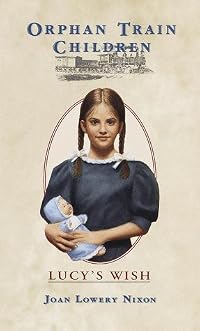
Lucy's Wish tells the fictional story of a young orphan girl in 1866. Her mother dies of cholera and Lucy is evicted from their apartment. She tries to find work to support herself, but her most meaningful accomplishment is playing with a young "simple" boy (he is probably autistic). After losing her job working in a butcher's shop, Lucy hears about a new program sending orphans to the West (modern-day Midwestern America) to be placed with families who want children. Lucy's only dream is to find a loving family complete with a younger sister.
Lucy is placed with the Snapes family in rural Missouri, and she quickly forms a bond with her new sister, Emma, who is also "simple". Within a short period of time, Lucy realizes that the Snapes show more family has fulfilled her wish: she has parents again and a sister who loves her, and Lucy herself learns to love her new sister and parents.
This short novel tries to portray the daily struggles of poor immigrants in the 1860's. Ms. Nixon paints a vivid picture of life for a young waif in New York City and her journey (both physical and emotional) on an orphan train. In addition to the narrative, she provides background information about orphan trains and New York City life for those who are not familiar with this particular episode of American history. I was among that number until I came across a non-fiction account of orphan trains earlier this year. Ms. Nixon is accurate in her account of the circumstances that led to orphan trains, and her omniscient narrator mostly succeeds in relating the emotions a young girl making such a journey would have felt.
Probably because of the intended audience of this book, Ms. Nixon does not reflect on the social justice issues raised by orphan trains: only white children were put on orphan trains, and religious distinctions were maintained with the adoptive families. She hints at the possibility of abuse occurring with adoptive families, and she distinctly mentions that children were sometimes returned or rejected by the adoptive families. In spite of these limitations, this book effectively portrays a time in America when people, even young children, were forced to fend for themselves because social safety nets had not been implemented by federal and state governments. This book would be perfect for an elementary school class learning about American history, social justice, family dynamics, children with special needs, or life conditions during the Industrial Revolution. show less
Lucy is placed with the Snapes family in rural Missouri, and she quickly forms a bond with her new sister, Emma, who is also "simple". Within a short period of time, Lucy realizes that the Snapes show more family has fulfilled her wish: she has parents again and a sister who loves her, and Lucy herself learns to love her new sister and parents.
This short novel tries to portray the daily struggles of poor immigrants in the 1860's. Ms. Nixon paints a vivid picture of life for a young waif in New York City and her journey (both physical and emotional) on an orphan train. In addition to the narrative, she provides background information about orphan trains and New York City life for those who are not familiar with this particular episode of American history. I was among that number until I came across a non-fiction account of orphan trains earlier this year. Ms. Nixon is accurate in her account of the circumstances that led to orphan trains, and her omniscient narrator mostly succeeds in relating the emotions a young girl making such a journey would have felt.
Probably because of the intended audience of this book, Ms. Nixon does not reflect on the social justice issues raised by orphan trains: only white children were put on orphan trains, and religious distinctions were maintained with the adoptive families. She hints at the possibility of abuse occurring with adoptive families, and she distinctly mentions that children were sometimes returned or rejected by the adoptive families. In spite of these limitations, this book effectively portrays a time in America when people, even young children, were forced to fend for themselves because social safety nets had not been implemented by federal and state governments. This book would be perfect for an elementary school class learning about American history, social justice, family dynamics, children with special needs, or life conditions during the Industrial Revolution. show less
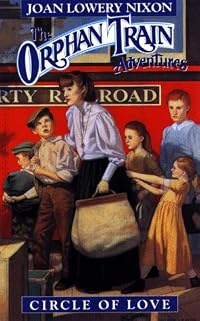
Orphan Train Children: Lucy’s Wish, by Joan Lowery Nixon, is a fictional narrative written for young readers in fourth or fifth grade. At the start of this chapter book, Nixon places her protagonist Lucy, who was orphaned after her father died in an accident and her mother contracted Cholera, in the heart of New York City during the 1860s. After being expelled from an orphanage for spilling a pitcher of milk and chipping some China, Lucy turns to the Children’s Aid Society for help, and she is placed on an Orphan Train along with 30 other children in order to find them adopted families out west.
Nixon’s story is grounded in historical fact, even though the specific circumstances of Lucy’s life are not. One of the most show more interesting and helpful parts of the book is at the end of the book after the glossary. Nixon includes “The Story of the Orphan Trains,” a section of nonfiction text filled with photographs, advertisements, and statistics of orphan trains and their riders. One table was particularly interesting is on page 110, and is a chart from The Children’s Aid Society’s 1910 bulletin that gives the state-by-state breakdown of where the society placed children by way of orphan train. The Children’s Aid Society still exists today.
One thing the book highlights is that the system of placing children in homes by way of orphan train was not perfect, but it was responding to the need of these orphaned children. Many lives were changed for the better because of it. I recommend this book for young readers. show less
Nixon’s story is grounded in historical fact, even though the specific circumstances of Lucy’s life are not. One of the most show more interesting and helpful parts of the book is at the end of the book after the glossary. Nixon includes “The Story of the Orphan Trains,” a section of nonfiction text filled with photographs, advertisements, and statistics of orphan trains and their riders. One table was particularly interesting is on page 110, and is a chart from The Children’s Aid Society’s 1910 bulletin that gives the state-by-state breakdown of where the society placed children by way of orphan train. The Children’s Aid Society still exists today.
One thing the book highlights is that the system of placing children in homes by way of orphan train was not perfect, but it was responding to the need of these orphaned children. Many lives were changed for the better because of it. I recommend this book for young readers. show less
Lucy lost her father when she was a little girl and just lost her mom couple week ago. She has no where to go and no one to take care of her. She asked to work for a small grocery store where her mom used to shop. She remembered her mother telling her to be good to Henry, an illness boy of the owner. However, one day she did not feel well and broke things, the owner chased her away. She met Joey, a street friend, who suggested her go to the Children Aid society to find a family for herself. Lucy wishes the family will take her in has a baby sister for her and loves her. She was welcomed by the Snapes' family and she does not have a baby sister. However, she had Emma, and illness daughter of her new parents.
3010909
Ratings
Members
- Recently Added By
Author Information

149+ Works 11,609 Members
Joan Lowery Nixon was born in Los Angeles, California. She attended the University of Southern California where she received a B.A. in journalism and later an education certificate from California State. She has written over 100 mystery books for young adults. She is known for her Orphan Train Adventure Series and other titles including A Family show more Apart, The Seance and Other Side of the Dark. Her works have earned her the honor of being the only writer to win four Edgar Allen Poe awards and in addition, two Spurs from Western Writers of America. She was a past President of the Mystery Writers of America. She died from complications of pancreatic cancer on June 28, 2003, in Houston, Texas. She was 76. (Bowker Author Biography) show less
Awards and Honors
Series

Classifications
Statistics
- Members
- 149
- Popularity
- 219,048
- Reviews
- 4
- Rating
- (4.00)
- Languages
- English
- Media
- Paper, Ebook
- ISBNs
- 7
- ASINs
- 1