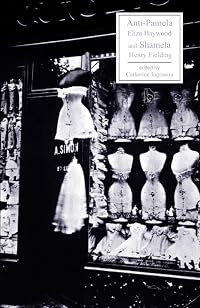
Anti-Pamela AND Shamela
by Eliza Haywood, Henry Fielding
On This Page
Description
Published together for the first time, Eliza Haywood's Anti-Pamela and Henry Fielding's An Apology for the Life of Mrs. Shamela Andrews are the two most important responses to Samuel Richardson's novel Pamela. Anti-Pamela comments on Richardson's representations of work, virtue, and gender, while also questioning the generic expectations of the novel that Pamela establishes, and it provides a vivid portrayal of the material realities of life for a woman in eighteenth-century London. show more Fielding's Shamela punctures both the figure Richardson established for himself as an author and Pamela's preoccupation with virtue. This Broadview edition also includes a rich selection of historical materials, including writings from the period on sexuality, women's work, Pamela and the print trade, and education and conduct. show lessTags
Recommendations


























Member Reviews
This book is so, so, so, SO much better than Pamela!
In all seriousness, Richardson's Pamela pissed me off on so many levels, and so when I read about the reaction to that book from others - not here in the 21st century but back in the 18th century - I was gratified to see that people back then got pissed off over it.
It's nice to know that even back then, in a time where women had few if any rights, Pamela rustled a lot of jimmies, inspiring the two stories that make up this book.
The Shamela story is much more licentious than Anti-Pamela, but both stories basically depict Pamela as a gold-digger while Mr. B is a dopey but good-hearted guy. Which is not much better than the original Pamela, but at least these two stories are more show more entertaining as they're meant to be satire.
3.5/5 stars.
I could not give it a higher rating because the Pamela in both stories, especially the Shamela one, comes across as a cunt and I wish that the author had taken a more balanced view of her in his satire. show less
In all seriousness, Richardson's Pamela pissed me off on so many levels, and so when I read about the reaction to that book from others - not here in the 21st century but back in the 18th century - I was gratified to see that people back then got pissed off over it.
It's nice to know that even back then, in a time where women had few if any rights, Pamela rustled a lot of jimmies, inspiring the two stories that make up this book.
The Shamela story is much more licentious than Anti-Pamela, but both stories basically depict Pamela as a gold-digger while Mr. B is a dopey but good-hearted guy. Which is not much better than the original Pamela, but at least these two stories are more show more entertaining as they're meant to be satire.
3.5/5 stars.
I could not give it a higher rating because the Pamela in both stories, especially the Shamela one, comes across as a cunt and I wish that the author had taken a more balanced view of her in his satire. show less
Didn't quite finished Anti-Pamela as I skimmed through the last 1/3. I enjoyed Shamela more than Anti-Pamela from an entertainment point of view, but Anti-Pamela is definitely more interesting in terms of what it says about female sexuality. Fielding seems to focus completely on class and what he deems as hypocrisy in the original Pamela. Both parodies are more fun to read, however, than the original.
Two satirical responses to Samuel Richardson's Pamela, or Virtue Rewarded, the story of a pure young servant girl and her desperate attempts to guard both her honor and her place against the advances of her rakish master.
The Anti-Pamela, by Eliza Haywood, is a parallel story about another servant girl, Syrena, whose alleged purity is only a sham intended to either entice an aristocrat to marry her or to otherwise provide for her as a mistress or as the result of blackmail. Syrena and her mother work together, and sometimes at odds, to pull the wool over the eyes of Syrena's employers--it's basically the story of a mother-daughter con artist team, and is funny even when one hasn't read Pamela.
Henry Fielding's Shamela is an outright show more parody of Richardson's book. Fielding's edge is to illustrate the main character's ulterior motives while also taking a stab at Richardson's writing style, etc. This one is shorter, and I enjoyed it a little less than Anti-Pamela.
The Broadview edition (I think it's the only modern edition of Anti-Pamela that's been published yet) also includes some incredibly useful historical notes and explanatory footnotes with regard to the language used. show less
The Anti-Pamela, by Eliza Haywood, is a parallel story about another servant girl, Syrena, whose alleged purity is only a sham intended to either entice an aristocrat to marry her or to otherwise provide for her as a mistress or as the result of blackmail. Syrena and her mother work together, and sometimes at odds, to pull the wool over the eyes of Syrena's employers--it's basically the story of a mother-daughter con artist team, and is funny even when one hasn't read Pamela.
Henry Fielding's Shamela is an outright show more parody of Richardson's book. Fielding's edge is to illustrate the main character's ulterior motives while also taking a stab at Richardson's writing style, etc. This one is shorter, and I enjoyed it a little less than Anti-Pamela.
The Broadview edition (I think it's the only modern edition of Anti-Pamela that's been published yet) also includes some incredibly useful historical notes and explanatory footnotes with regard to the language used. show less
Ratings
Members
- Recently Added By
Author Information

61+ Works 1,220 Members

263+ Works 15,928 Members
Henry Fielding, 1707 - 1754 A succcessful playwright in his twenties, Henry Fielding turned to the study of law and then to journalism, fiction, and a judgeship after his Historical Register, a political satire on the Walpole government, contributed to the censorship of plays that put him out of business. As an impoverished member of the upper show more classes, he knew the country squires and the town nobility; as a successful young playwright, the London jet set; as a judge at the center of London, the city's thieves, swindlers, petty officials, shopkeepers, and vagabonds. As a political journalist (editor-author of The Champion, 1739-1741; The True Patriot, 1745-1746; The Jacobite's Journal, 1747-1748; The Covent-Garden Journal, 1752), he participated in argument and intrigue over everything from London elections to national policy. He knowledgeably attacked and defended a range of politicians, from ward heelers to the Prince of Wales. When Fielding undertook writing prose fiction to ridicule the simple morality of Pamela by Samuel Richardson, he first wrote the hilarious burlesque Shamela (1741). However, he soon found himself considering all the forces working on humans, and in Joseph Andrews (1742) (centering on his invented brother of Pamela), he played with the patterns of Homer, the Bible, and Cervantes to create what he called "a comic epic poem in prose." His preface describing this new art form is one of the major documents in literary criticism of the novel. Jonathan Wild, a fictional rogue biography of a year later, plays heavily with ironic techniques that leave unsettled Fielding's great and recurring theme: the difficulty of uniting goodness, or an outflowing love of others, with prudence in a world where corrupted institutions support divisive pride rather than harmony and self-fulfillment. In his masterpiece Tom Jones (1749), Fielding not only faces this issue persuasively but also shows for the first time the possibility of bringing a whole world into an artistic unity, as his model Homer had done in verse. Fielding develops a coherent and centered sequence of events-something Congreve had done casually on a small scale in Incognita 60 years before. In addition he also relates the plot organically to character and theme, by which he gives us a vision of the archetypal good person (Tom) on a journey toward understanding. Every act by every character in the book reflects the special and typical psychology of that character and the proper moral response. In Tom Jones, Fielding affirms the existence of an order under the surface of chaos. In his last novel, Amelia (1751), which realistically examines the misery of London, he can find nothing reliable except the prudent good heart, and that only if its possessor escapes into the country. Fielding based the title character on his second wife, with whom he was deeply in love. However, ill himself, still saddened by the deaths of his intensely loved first wife and daughter, and depressed by a London magistrate's endless toil against corruption, Fielding saw little hope for goodness in that novel or in his informal Journal of a Voyage to Lisbon (1755). Shortly after traveling to Lisbon for his health, Fielding died at the age of 47, having proved to his contemporaries and successors that the lowly novel was capable of the richest achievements of art. (Bowker Author Biography) show less
All Editions
Work Relationships
Contains
Was inspired by
Common Knowledge
- Canonical title
- Anti-Pamela AND Shamela
- Original publication date
- 1741
Classifications
Statistics
- Members
- 115
- Popularity
- 283,655
- Reviews
- 3
- Rating
- (3.83)
- Languages
- English
- Media
- Paper
- ISBNs
- 2
- ASINs
- 1