On This Page
Description
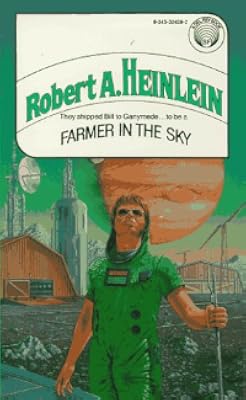
A youth and his father emigrate from the mechanical and organized world on overpopulated Earth to become colonists on Ganymede, the third moon of Jupiter.Tags
Recommendations
















Member Reviews
Homesteading in the 17th, 18th and 19th centuries in what would become the United States of America was often dangerous. When you ventured into unknown territory, there were things you could not take for granted, so a small incident could become a total fucking disaster.
That's pretty much what happens in this novel, which was written in 1950 and is set in the future of an overcrowded Earth where farming has been farmed out (heh) to moons. Living on the moon has its risks though and this is a decent example of early sci fi and off-planet colonization.
That's pretty much what happens in this novel, which was written in 1950 and is set in the future of an overcrowded Earth where farming has been farmed out (heh) to moons. Living on the moon has its risks though and this is a decent example of early sci fi and off-planet colonization.
I quite enjoyed this one, but I can certainly understand how a teenage reader today could find it difficult to relate. It's not just the science and technology that we have already commented upon, but the values and attitudes are also from the 50s. Even when Heinlein introduces differences (see for example the casual relationship Bill has with his father) those differences are defined against 50s' customs (as is to be expected, of course), and in more than 60 years we have changed a lot.
This is a book about terraforming and about pioneers founding a colony on one of Jupiter's moons. Their plight and the hard work and harshness they endure reminds us a lot of the pioneers who colonized the west of the US, which obviously is the show more inspiration here. There are enough differences and science fictional flavor to capture the imagination of the target audience. There is also a lot of emphasis placed on scouting, which is part of the wholesome message of this old-fashioned YA story, but perhaps that is still relevant to at least some teens today, since the scouting movement is still going strong.
Anyway, once more the outlook is hopeful: with hard work and effort you can achieve your dreams and improve your lot, but here there is more harshness and tragedy than in any of the previous books. Perhaps it caught me in the right mood, but I particularly enjoyed the last part of the book and I have to admit I even shed a couple of tears.
I also appreciated how the personality of the main character was drawn. He is a nice kid and has a lot of good qualities, but he is far from perfect. He sometimes acts like an ass... I mean, like a teenager, he sometimes has a big mouth and thinks he knows much more than he really does.
There are some long expository talks about how ecology works, and about other scientific matters, but I missed an explanation of how exactly the "heat trap" that allowed people to live on Ganymede worked. I found it curious how Heinlein seemed to regard food shortages as an important future problem as the population grows, while he doesn't seem to be worried about energy shortages. Clearly he expected that we would find out how to use nuclear fusion, while he did not expect the improvements in crop productivity. (We still have food problems, though, and they can get bad if we don't keep improving productivity). There was a awkward conversation which showed clearly that Heinlein did not understand relativity at all when he wrote this. You could be charitable and say that it was the teacher character the one who didn't understand it, but I'm sure it was Heinlein.
And what the hell was that about thealien artifacts ? It seemed to come out of nowhere.
All in all, a satisfying if old-fashioned SF story. show less
This is a book about terraforming and about pioneers founding a colony on one of Jupiter's moons. Their plight and the hard work and harshness they endure reminds us a lot of the pioneers who colonized the west of the US, which obviously is the show more inspiration here. There are enough differences and science fictional flavor to capture the imagination of the target audience. There is also a lot of emphasis placed on scouting, which is part of the wholesome message of this old-fashioned YA story, but perhaps that is still relevant to at least some teens today, since the scouting movement is still going strong.
Anyway, once more the outlook is hopeful: with hard work and effort you can achieve your dreams and improve your lot, but here there is more harshness and tragedy than in any of the previous books. Perhaps it caught me in the right mood, but I particularly enjoyed the last part of the book and I have to admit I even shed a couple of tears.
I also appreciated how the personality of the main character was drawn. He is a nice kid and has a lot of good qualities, but he is far from perfect. He sometimes acts like an ass... I mean, like a teenager, he sometimes has a big mouth and thinks he knows much more than he really does.
There are some long expository talks about how ecology works, and about other scientific matters, but I missed an explanation of how exactly the "heat trap" that allowed people to live on Ganymede worked. I found it curious how Heinlein seemed to regard food shortages as an important future problem as the population grows, while he doesn't seem to be worried about energy shortages. Clearly he expected that we would find out how to use nuclear fusion, while he did not expect the improvements in crop productivity. (We still have food problems, though, and they can get bad if we don't keep improving productivity). There was a awkward conversation which showed clearly that Heinlein did not understand relativity at all when he wrote this. You could be charitable and say that it was the teacher character the one who didn't understand it, but I'm sure it was Heinlein.
And what the hell was that about the
All in all, a satisfying if old-fashioned SF story. show less
I "read" an audiobook edition - if you could pick anyone in literature to give a swirly to, Heinlein's Bill would be the guy.
This protagonist and his narrative voice would be any voice actor's challenge because he is such a self-absorbed yet unself-aware, unlikeable guy that he grates on your every nerve.
plus the slang and curses and turns of phrase Heinlein creates to give the world its 50's on the moon flavor are enough to make you want to throttle the poor main character kid every time he opens his mouth or even thinks a thought .
all that aside, this story is still great speculative fiction, much of it put forward for young readers in such a way as to challenge myths of western expansion and manifest destiny while at the same time show more telling a story with some coming of age, tension & adventure. It's also an ode to engineers in a way which i always enjoy .
Perfect ? no . Perfectly entertaining & worth the read, yes ! show less
This protagonist and his narrative voice would be any voice actor's challenge because he is such a self-absorbed yet unself-aware, unlikeable guy that he grates on your every nerve.
plus the slang and curses and turns of phrase Heinlein creates to give the world its 50's on the moon flavor are enough to make you want to throttle the poor main character kid every time he opens his mouth or even thinks a thought .
all that aside, this story is still great speculative fiction, much of it put forward for young readers in such a way as to challenge myths of western expansion and manifest destiny while at the same time show more telling a story with some coming of age, tension & adventure. It's also an ode to engineers in a way which i always enjoy .
Perfect ? no . Perfectly entertaining & worth the read, yes ! show less
Um livro ágil e equilibrado sobre imigrantes que vão a colonizar Ganímedes, em Júpiter, abordando sua viagem, seus problemas, e a difícil missão de prosperar como fazendeiros. Não deixa de ser curioso o quanto esses humanos do futuro são tipicamente estado unidenses da década de 50, com todo o lado macho garoto escoteiro, patriarca engenheiro, dona de casa atrapalhada e vizinhos guerreiros, "sobreviventes". Mas creio que a escrita cativante e os episódios mundanos, mas futuristas, e as considerações sobre agricultura superam esse lado retrô, em um bom livro, com essa ressalva.
Vencedor do prêmio Hugo 1951 (retro-Hugo 2001).
Vencedor do prêmio Hugo 1951 (retro-Hugo 2001).
Bill Lerner and his father George decide to emigrate to Jupiter's largest moon, Ganymede, to begin a new life as farmers along with George's new wife Molly and her young daughter, Peggy. During their journey aboard the interplanetary colony ship Mayflower, the kids decide to form new branches of the Boy Scouts and Girl Scouts and Bill becomes a hero when he uses his old Scout uniform to plug a hull breach in his shared quarters compliments of a fist-sized meteor.
The pacing slows once they reach Ganymede and begin to build their new lives. George takes up a part time job as an engineer, his profession back on Earth, while Bill sets out to terraform his family's allotted land and build their new home. Along the way, the Lerner's receive show more help from their neighboring farmers and the Ganymede Boy Scouts.
Then, disaster strikes...
Compared to Heinlein's other juvenile space adventures—such as Have Space Suit, Will Travel, Citizen of the Galaxy, or Starman Jones—Farmer in the Sky lacks suspense, tension, and developed characters beyond the protagonist. Instead, it is a first-person POV chronicling of emigration from Earth to Ganymede with several dramatic events scattered throughout. For example, I was disappointed when a certain supporting character's death happened "off camera" and was glossed over in the final chapters. However, this might be to due to the fact that the book was intended for younger audiences during a time when writers trod lightly when dealing with sensitive topics.
As usual with Heinlein, his attention to even the minutest scientific and practical details—however fictionalized—offers the reader a sense of verisimilitude and plausibility. There is a fair balance between moving the story forward and describing the processes and pitfalls involved in taming the inhospitable surface of Ganymede. show less
The pacing slows once they reach Ganymede and begin to build their new lives. George takes up a part time job as an engineer, his profession back on Earth, while Bill sets out to terraform his family's allotted land and build their new home. Along the way, the Lerner's receive show more help from their neighboring farmers and the Ganymede Boy Scouts.
Then, disaster strikes...
Compared to Heinlein's other juvenile space adventures—such as Have Space Suit, Will Travel, Citizen of the Galaxy, or Starman Jones—Farmer in the Sky lacks suspense, tension, and developed characters beyond the protagonist. Instead, it is a first-person POV chronicling of emigration from Earth to Ganymede with several dramatic events scattered throughout. For example, I was disappointed when a certain supporting character's death happened "off camera" and was glossed over in the final chapters. However, this might be to due to the fact that the book was intended for younger audiences during a time when writers trod lightly when dealing with sensitive topics.
As usual with Heinlein, his attention to even the minutest scientific and practical details—however fictionalized—offers the reader a sense of verisimilitude and plausibility. There is a fair balance between moving the story forward and describing the processes and pitfalls involved in taming the inhospitable surface of Ganymede. show less
Better. Lots of science in this fiction, and science conjecture, BUT...
I can overlook the overly heavy Boy Scout thread, given that the story was written for Boys Life magazine; I can shake my head, but still get past the odd yokelisms Heinlein inconsistently saddled his characters with ("victuals", "varmints", seriously?) but the twist at the end (and I'm not spoiling it here) is such a head scratcher that the book gets knocked down from four to three stars. Perhaps I'm expecting too much from a grandmaster, and one of the big three?
I can overlook the overly heavy Boy Scout thread, given that the story was written for Boys Life magazine; I can shake my head, but still get past the odd yokelisms Heinlein inconsistently saddled his characters with ("victuals", "varmints", seriously?) but the twist at the end (and I'm not spoiling it here) is such a head scratcher that the book gets knocked down from four to three stars. Perhaps I'm expecting too much from a grandmaster, and one of the big three?
One of my favorites. Heinlein is a master of speculative science fiction and based on when he wrote this story its amazing how intuitive this man was about the possible future.
Western expansion pioneers in space.
Western expansion pioneers in space.
Members
- Recently Added By
Lists

Best Science Fiction Novels
816 works; 430 members

Best Young Adult
413 works; 102 members

Space Colonization
100 works; 26 members

Top Five Books of 2015
811 works; 241 members

Top Five Books of 2016
795 works; 229 members

Speculative Fiction to Read
706 works; 32 members

Elevenses
316 works; 87 members

Favorite Childhood Books
1,651 works; 519 members

Books Read in 2026
2,148 works; 70 members
Author Information

459+ Works 174,687 Members
Robert Anson Heinlein was born on July 7, 1907 in Butler, Mo. The son of Rex Ivar and Bam Lyle Heinlein, Robert Heinlein had two older brothers, one younger brother, and three younger sisters. Moving to Kansas City, Mo., at a young age, Heinlein graduated from Central High School in 1924 and attended one year of college at Kansas City Community show more College. Following in his older brother's footsteps, Heinlein entered the Navel Academy in 1925. After contracting pulmonary tuberculosis, of which he was later cured, Heinlein retired from the Navy and married Leslyn MacDonald. Heinlein was said to have held jobs in real estate and photography, before he began working as a staff writer for Upton Sinclair's EPIC News in 1938. Still needing money desperately, Heinlein entered a writing contest sponsored by the science fiction magazine Thrilling Wonder Stories. Heinlein wrote and submitted the story "Life-Line," which went on to win the contest. This guaranteed Heinlein a future in writing. Using his real name and the pen names Caleb Saunders, Anson MacDonald, Lyle Monroe, John Riverside, and Simon York, Heinlein wrote numerous novels including For Us the Living, Methuselah's Children, and Starship Troopers, which was adapted into a big-budget film for Tri-Star Pictures in 1997. The Science Fiction Writers of America named Heinlein its first Grand Master in 1974, presented 1975. Officers and past presidents of the Association select a living writer for lifetime achievement. Also, the Science Fiction and Fantasy Hall of Fame inducted Heinlein in 1998. Heinlein died in 1988 from emphysema and other related health problems. Heinlein's remains were scattered from the stern of a Navy warship off the coast of California. (Bowker Author Biography) show less
Some Editions
Awards and Honors
Series

Belongs to Publisher Series
Work Relationships
Is contained in
Has as a study
Common Knowledge
- Original publication date
- 1950-01-01
- People/Characters
- Bill Lermer; Mr. Kinski; Slats Keifer
- Important places
- Ganymede
- Dedication
- For Sandy
- First words
- Our troop had been up in the High Sierras that day and we were late getting back.
- Last words
- (Click to show. Warning: May contain spoilers.)'I am where I belong. And I'm going to stay!'
- Blurbers
- Derleth, August
- Original language
- English
Classifications
Statistics
- Members
- 2,233
- Popularity
- 9,088
- Reviews
- 30
- Rating
- (3.61)
- Languages
- 10 — Czech, Dutch, English, French, German, Hebrew, Italian, Russian, Spanish, Swedish
- Media
- Paper, Audiobook, Ebook
- ISBNs
- 28
- ASINs
- 34