How to Make Super Pop-ups
by Joan Irvine
On This Page
Description
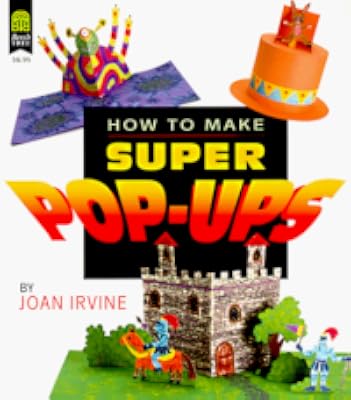
Provides instructions for making a variety of paper pop-ups, including animals, boats, robots, and enormous pop-ups for the stage.Tags
Recommendations










Member Reviews
“How to Make Super Pop-Ups” by Joan Irvine is a “How to Craft” book for children. This book may provide hours of entertainment on rainy days as well as teach other valuable skills. One of things that I enjoyed about this book is that, with a minimal amount of material expense, the reader can learn to follow simple written directions to create clever pop-up books. I felt the book was designed for children in 4th grade and up, since the book reads something like a recipe book. The reader has to follow simple directions to create the products that are displayed in the book. With some guidance from an adult, children can practice their manual dexterity with folding, cutting, and manipulating paper. The illustrations are very helpful show more and aide the reader in following the specific directions. However, I would have added a section of scaled pop-up patterns since some readers are not artists, in this way the end product will more likely look similar to the model that is displayed in the book. There is no fun in spending money, time, and effort on a project that yields a poorly designed end product. I would defiantly recommend this book to any children who enjoy origami, since readers are creating art projects by manipulating paper.
Ages 4th grade and Up show less
Ages 4th grade and Up show less
Based on a relatively quick glance at the book, it seems to be very useful. Lots of projects, advice, basic definitions and explanations, concluding with four basic, "very useful," pop-up techniques.
Library Thing Part E How To Craft
Irvine, Joan, and Linda Hendry. How to Make Super Pop-ups. New York: Morrow Junior, 1992. Print.
This title has an attractive front cover. It displays 5 pop ups in pastel colors set inside a red border. The five creations step out slightly from their panel on to the red border. This gives them some movement and a 3D effect. The title is in red against a 2 and ½” white background at the top of the cover; it catches the eye after scanning a whole three shelves of crafts books. The size is pleasing to hold and wide enough to lay out on a table and allow a group of four to follow directions and create four pop ups. There is a clear and easy to use table of contents. It is divided into four sections or show more four parts, with each part and heading in bold print. Thus making it easier for children to peruse the contents and find the item under the appropriate part. Each part is a different learned technique for pop-ups, with five to eight products under each technique that the reader can master. Under the introduction section there are paragraphs that discuss: Materials, Symbols and Definitions, Tips for Folding and Scoring, Tips for Cutting, and Tips for Measuring; all with friendly to read text and sentences spaced adequately. Most of the directions are on two panels side by side with each step set in its own borderless frame. The steps are numbered and an illustration for that step is drawn with care and detail right below the directions. Symbols such as: pencil, fold line, cut line, color pencil, glue, ruler are placed right on the folded drawn paper (illustration)so as to reinforce where that action is to take place and to reflect what the written directions are indicating at that step. There are thirty projects presented in this title such as animals, boats, robots, skeletons and even giant pop-ups for stage or displays. The intended audience would be elementary to middle school and the curriculum connection would be language arts, social studies, science, and math hands on projects that would enhance a report or reflect a short story read or summarize social studies and science concepts in a book with a symbolic pop-up. I like this book and would readily order several copies for the school library. Teachers and students would want equal access to Joan Irvines’s Super pop-ups. show less
Irvine, Joan, and Linda Hendry. How to Make Super Pop-ups. New York: Morrow Junior, 1992. Print.
This title has an attractive front cover. It displays 5 pop ups in pastel colors set inside a red border. The five creations step out slightly from their panel on to the red border. This gives them some movement and a 3D effect. The title is in red against a 2 and ½” white background at the top of the cover; it catches the eye after scanning a whole three shelves of crafts books. The size is pleasing to hold and wide enough to lay out on a table and allow a group of four to follow directions and create four pop ups. There is a clear and easy to use table of contents. It is divided into four sections or show more four parts, with each part and heading in bold print. Thus making it easier for children to peruse the contents and find the item under the appropriate part. Each part is a different learned technique for pop-ups, with five to eight products under each technique that the reader can master. Under the introduction section there are paragraphs that discuss: Materials, Symbols and Definitions, Tips for Folding and Scoring, Tips for Cutting, and Tips for Measuring; all with friendly to read text and sentences spaced adequately. Most of the directions are on two panels side by side with each step set in its own borderless frame. The steps are numbered and an illustration for that step is drawn with care and detail right below the directions. Symbols such as: pencil, fold line, cut line, color pencil, glue, ruler are placed right on the folded drawn paper (illustration)so as to reinforce where that action is to take place and to reflect what the written directions are indicating at that step. There are thirty projects presented in this title such as animals, boats, robots, skeletons and even giant pop-ups for stage or displays. The intended audience would be elementary to middle school and the curriculum connection would be language arts, social studies, science, and math hands on projects that would enhance a report or reflect a short story read or summarize social studies and science concepts in a book with a symbolic pop-up. I like this book and would readily order several copies for the school library. Teachers and students would want equal access to Joan Irvines’s Super pop-ups. show less
Part E Nonfiction-Crafts/How to
Irvine, J. (1992). How to make super pop-ups. New York: Morrow Junior Books.
Learn how to make pop-up cards with this book. From basic pop-ups to sliding strips and turning circles, each type of card is described in step-by-step directions. Each step of the directions is accompanied by a sketch of what the process should look like. The symbols and definitions at the beginning of the book, as well as the various tips for cutting, folding, scoring, and measuring, make it easy to follow and understand the steps to making a great pop-up card. Turn home-made cards into exciting works of art. Ages 7-12.
Irvine, J. (1992). How to make super pop-ups. New York: Morrow Junior Books.
Learn how to make pop-up cards with this book. From basic pop-ups to sliding strips and turning circles, each type of card is described in step-by-step directions. Each step of the directions is accompanied by a sketch of what the process should look like. The symbols and definitions at the beginning of the book, as well as the various tips for cutting, folding, scoring, and measuring, make it easy to follow and understand the steps to making a great pop-up card. Turn home-made cards into exciting works of art. Ages 7-12.
Ratings
Members
- Recently Added By
Author Information
11 Works 406 Members
Awards and Honors
Awards
Common Knowledge
- Canonical title
- How to Make Super Pop-ups
- Original publication date
- 1992
- Dedication
- This book is dedicated to my husband, Steve, /
who was incredibly supportive and helpful in /
the writing of How to Make Super Pop-ups. - First words
- Would you like to make a flying bird or perhaps an amazing lizard?
- Last words
- (Click to show. Warning: May contain spoilers.)Sliding Strip:...(8) Cut the end of the strip to make it shorter if necessary, Your figure should now move easily up and down the large slot of your paper.
Classifications
- Genre
- Nonfiction
- DDC/MDS
- 745.592 — Arts & recreation Drawing & decorative arts Decorations & Handicrafts / Calligraphy Handicrafts Making specific objects Toys, models, miniatures, related objects
- LCC
- TT870 .I78 — Technology Handicrafts. Arts and crafts Handicrafts. Arts and crafts Home arts. Homecrafts
- BISAC
Statistics
- Members
- 118
- Popularity
- 275,343
- Reviews
- 4
- Rating
- (4.25)
- Languages
- English
- Media
- Paper, Ebook
- ISBNs
- 7
- UPCs
- 1