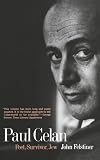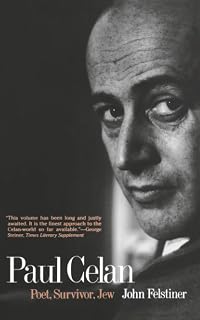
Paul Celan: Poet, Survivor, Jew (Yale Nota Bene)
by John Felstiner
On This Page
Description
Paul Celan, Europe's most compelling postwar poet, was a German-speaking, East European Jew. His writing exposes and illumines the wounds that Nazi destructiveness left on language. John Felstiner's sensitive and accessible book is the first critical biography of Celan in any language. It offers new translations of well-known and little-known poems-including a chapter on Celan's famous "Deathfugue"-plus his speeches, prose fiction, and letters. The book also presents hitherto unpublished show more photos of the poet and his circle.Drawing on interviews with Celan's family and friends and his personal library in Normandy and Paris, as well as voluminous German commentary, Felstiner tells the poet's gripping story: his birth in 1920 in Romania, the overnight loss of his parents in a Nazi deportation, his experience of forced labor and Soviet occupation during the war, and then his difficult exile in Paris. The life's work of Paul Celan emerges through readings of his poems within their personal and historical matrix. At the same time, Felstiner finds fresh insights by opening up the very process of translating Celan's poems.To present this poetry and the strain of Jewishness it displays, Felstiner uncovers Celan's sources in the Bible and Judaic mysticism, his affinities with Kafka, Heine, Hölderlin, Rilke, and Nelly Sachs, his fascination with Heidegger and Buber, his piercing translations of Shakespeare, Dickinson, Mandelshtam, Apollinaire. First and last, Felstiner explores the achievement of a poet surviving in his mother tongue, the German language that had passed, Celan said, "through the thousand darknesses of deathbringing speech." show lessTags
Recommendations








Member Reviews
To my great regret I came to the poetry (and the life story behind so much of it) of Paul Celan somewhat late in life, unpardonably late, even. But from the moment I did I knew that this was not just the Poet of the Holocaust - he was an unparalled poetic genius in the second half of he last century. This is a personal and totally biased opinion, so go read the poems, surely they speak for themselves. Yes they do.
But in this book we have contextualization, translations almost dissected (mostly in the German to English angle) and biographical notes along the way.
Paul Celan was himself a polyglot and a prolific translator. Born in a Romania that has changed borders to a jewish family that did not escape the fate of most others in Eastern show more Europe, eventually a French citizen, one of the great poets and shapers of the German language of all times.
His legacy is tremendous. His suicide perhaps a powerful statement of guilt or alienation - perhaps something entirely different that need not be dwelt on to enjoy the work.
Though "enjoy" seems to me to be an entirely personal approach.
He leads us to a labyrinth. To the depths of human cruelty. But he can see that all human passions have great surviving power.
Maybe not just after witnessing and enduring their extremes can one hope to reconcile itself with the humanity and the passions within.
The book is extraordinarily well-researched and written in a style I'd call 'academic but unassuming'. It will leave you with a longing to read more from Celan. That alone would justify its writing, apart from all its many merits. show less
But in this book we have contextualization, translations almost dissected (mostly in the German to English angle) and biographical notes along the way.
Paul Celan was himself a polyglot and a prolific translator. Born in a Romania that has changed borders to a jewish family that did not escape the fate of most others in Eastern show more Europe, eventually a French citizen, one of the great poets and shapers of the German language of all times.
His legacy is tremendous. His suicide perhaps a powerful statement of guilt or alienation - perhaps something entirely different that need not be dwelt on to enjoy the work.
Though "enjoy" seems to me to be an entirely personal approach.
He leads us to a labyrinth. To the depths of human cruelty. But he can see that all human passions have great surviving power.
Maybe not just after witnessing and enduring their extremes can one hope to reconcile itself with the humanity and the passions within.
The book is extraordinarily well-researched and written in a style I'd call 'academic but unassuming'. It will leave you with a longing to read more from Celan. That alone would justify its writing, apart from all its many merits. show less
Ratings
Members
- Recently Added By
Published Reviews
ThingScore 100
John Felstiner’s book is of inestimable value to anyone wanting to read Celan with understanding. It provides a sort of triple deal, giving a rudimentary narrative of the life, and combining this with translations and brilliant readings of maybe four or five dozen poems, the two acceptance speeches of 1958 (the City of Bremen Literature Prize) and 1960 (the Georg Büchner Prize), and the show more 1959 prose piece ‘Conversation in the Mountains’. When Felstiner ends: ‘From first to last his poems stand’ – a crucial verb in Celan – and follows that with four pages of lines from Celan’s poems, with their dates, from 1938 to 1970, it is like getting a dramatis personae; and when the reader feels, at each line or fragment, a pang of recognition, orientation and emotion, it is a tribute to what Felstiner has achieved in mediating and explicating these urgent and often enigmatic writings.
[...] More striking, and more valuable than his translations, are the readings (of the necessary microscopic acuity) to which Felstiner subjects Celan’s poems. It is here that Felstiner’s book becomes incomparably, almost unimaginably – and finally suspiciously, even counter-productively – richer than reading someone’s English versions of the poems, or even the originals unassisted. show less
[...] More striking, and more valuable than his translations, are the readings (of the necessary microscopic acuity) to which Felstiner subjects Celan’s poems. It is here that Felstiner’s book becomes incomparably, almost unimaginably – and finally suspiciously, even counter-productively – richer than reading someone’s English versions of the poems, or even the originals unassisted. show less
added by aileverte
Author Information

8+ Works 316 Members
John Felstiner teaches at Stanford University. (Bowker Author Biography)
Some Editions
Awards and Honors
Common Knowledge
- Original publication date
- 1995
- People/Characters
- Paul Celan
- Dedication
- For Alek and Sarah
and
for the victims of "that which happened," 1933-1945 - Blurbers
- Wiesel, Elie; Levertov, Denise; Hollander, John; Hartman, Geoffrey
Classifications
- Genres
- Biography & Memoir, Literature Studies and Criticism, Fiction and Literature
- DDC/MDS
- 831.914 — Literature & rhetoric German & related literatures German poetry 1900- 1900-1990 1945-1990
- LCC
- PT2605 .E4 .Z599 — Language and Literature German, Dutch and Scandinavian literatures German literature Individual authors or works 1860/70-1960
- BISAC
Statistics
- Members
- 201
- Popularity
- 163,748
- Reviews
- 1
- Rating
- (4.23)
- Languages
- English, German, Greek, Spanish
- Media
- Paper, Ebook
- ISBNs
- 11
- ASINs
- 2