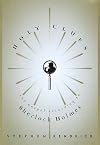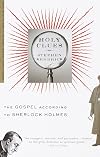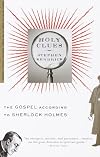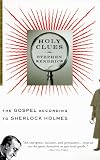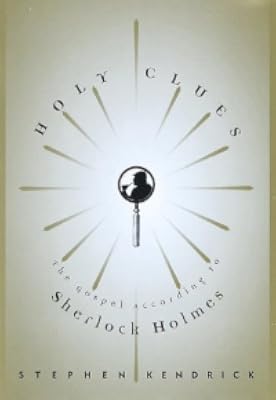
Holy Clues : The Gospel According to Sherlock Holmes
by Stephen Kendrick, Arthur Conan Doyle
On This Page
Description
If God is the greatest mystery of them all, then why not, in pursuit of God, consult the greatest detective of them all? In this imaginative and surprisingly profound book, Stephen Kendrick reveals Sherlock Holmes as spiritual guide. Drawing on the teachings of Christianity, Buddhism, and Judaism--as well as a host of thinkers as varied as Albert Einstein, Gandhi, and Vincent van Gogh--Kendrick explores the stories of Sherlock Holmes and finds remarkably prescient religious insights. He show more shows us the link between careful observation of clues and the Buddhist concept of "Bare Attention." He illuminates the parallel between the great sleuth's pursuit of justice and God's actions on the scene of the first murder, when Cain slew Abel. And in the detective's open, engaged mind, Kendrick finds a model for uniting the principles of science with a sincere spiritual quest. The result is a book of inspiration for the modern, skeptical searcher--and an entertaining work that sheds new light on the methods of the world's greatest detective. show lessTags
Recommendations












Member Reviews
Investigating Life's Mysteries with Sherlock Holmes. Review: This book is very hard to categorize. It is most easily described as a series of informal lectures on the religious viewpoints inherant in the published Sherlock Holmes stories. The individual essays are lively and interesting without feeling at all "Preachy" to one who has heard far too many sermons in the past. It is obvious that the author has thought extensively about the material and has concluded that there are strong religious elements in the tales.
The fact that the author is a Universalist minister with postgraduate degrees in Divinity and Writing indicates the main viewpoint of his writing. Rationalism and scientific examination of the universe provide a strong basis show more for religion that can de-emphasize Revelation as a source for faith. The strongly rational point of view of the Canonical writings fits well into this viewpoint and provides ample materials for religious analysis. The author makes a good case for the religious content of the tales and provides a number of insights into the thinking behind them and the assumptions buried therein. It also manages to be a warm and humane book by an author whose own nature gives his words a special glow.
This book is an intriguing analysis of the Canon. It is thought-provoking and well written by an enthusiastic Holmesian. If you enjoy such materials and enjoy speculating on philosophy and religion, this book belongs in your library.
Reviewed by: Philip K. Jones, 2003 show less
The fact that the author is a Universalist minister with postgraduate degrees in Divinity and Writing indicates the main viewpoint of his writing. Rationalism and scientific examination of the universe provide a strong basis show more for religion that can de-emphasize Revelation as a source for faith. The strongly rational point of view of the Canonical writings fits well into this viewpoint and provides ample materials for religious analysis. The author makes a good case for the religious content of the tales and provides a number of insights into the thinking behind them and the assumptions buried therein. It also manages to be a warm and humane book by an author whose own nature gives his words a special glow.
This book is an intriguing analysis of the Canon. It is thought-provoking and well written by an enthusiastic Holmesian. If you enjoy such materials and enjoy speculating on philosophy and religion, this book belongs in your library.
Reviewed by: Philip K. Jones, 2003 show less
Investigating Life's Mysteries with Sherlock Holmes. Review: This book is very hard to categorize. It is most easily described as a series of informal lectures on the religious viewpoints inherant in the published Sherlock Holmes stories. The individual essays are lively and interesting without feeling at all "Preachy" to one who has heard far too many sermons in the past. It is obvious that the author has thought extensively about the material and has concluded that there are strong religious elements in the tales.
The fact that the author is a Universalist minister with postgraduate degrees in Divinity and Writing indicates the main viewpoint of his writing. Rationalism and scientific examination of the universe provide a strong basis show more for religion that can de-emphasize Revelation as a source for faith. The strongly rational point of view of the Canonical writings fits well into this viewpoint and provides ample materials for religious analysis. The author makes a good case for the religious content of the tales and provides a number of insights into the thinking behind them and the assumptions buried therein. It also manages to be a warm and humane book by an author whose own nature gives his words a special glow.
This book is an intriguing analysis of the Canon. It is thought-provoking and well written by an enthusiastic Holmesian. If you enjoy such materials and enjoy speculating on philosophy and religion, this book belongs in your library.
Reviewed by: Philip K. Jones, 2003 show less
The fact that the author is a Universalist minister with postgraduate degrees in Divinity and Writing indicates the main viewpoint of his writing. Rationalism and scientific examination of the universe provide a strong basis show more for religion that can de-emphasize Revelation as a source for faith. The strongly rational point of view of the Canonical writings fits well into this viewpoint and provides ample materials for religious analysis. The author makes a good case for the religious content of the tales and provides a number of insights into the thinking behind them and the assumptions buried therein. It also manages to be a warm and humane book by an author whose own nature gives his words a special glow.
This book is an intriguing analysis of the Canon. It is thought-provoking and well written by an enthusiastic Holmesian. If you enjoy such materials and enjoy speculating on philosophy and religion, this book belongs in your library.
Reviewed by: Philip K. Jones, 2003 show less
Ratings
Members
- Recently Added By
Author Information

5+ Works 416 Members
Stephen Kendrick is a speaker, screenwriter, and producer whose film credits include Flywheel, Facing the Giants, Fireproof, and Courageous. Stephen co-authored the New York Times bestsellers The Love Dare and The Resolution for Men. He is a graduate of Kennesaw State University and attended seminary before being ordained into ministry. He is an show more associate pastor of preaching and prayer at Sherwood Church and serves on the board of the Fatherhood CoMission. Stephen and his wife, Jill, have six children. show less

3,998+ Works 169,511 Members
The most famous fictional detective in the world is Arthur Conan Doyle's Sherlock Holmes. However, Doyle was, at best, ambivalent about his immensely successful literary creation and, at worst, resentful that his more "serious" fiction was relatively ignored. Born in Edinburgh, Doyle studied medicine from 1876 to 1881 and received his M.D. in show more 1885. He worked as a military physician in South Africa during the Boer War and was knighted in 1902 for his exceptional service. Doyle was drawn to writing at an early age. Although he attempted to enter private practice in Southsea, Portsmouth, in 1882, he soon turned to writing in his spare time; it eventually became his profession. As a Liberal Unionist, Doyle ran, unsuccessfully, for Parliament in 1903. During his later years, Doyle became an avowed spiritualist. Doyle sold his first story, "The Mystery of the Sasassa Valley," to Chambers' Journal in 1879. When Doyle published the novel, A Study in Scarlet in 1887, Sherlock Holmes was introduced to an avid public. Doyle is reputed to have used one of his medical professors, Dr. Joseph Bell, as a model for Holmes's character. Eventually, Doyle wrote three additional Holmes novels and five collections of Holmes short stories. A brilliant, though somewhat eccentric, detective, Holmes employs scientific methods of observation and deduction to solve the mysteries that he investigates. Although an "amateur" private detective, he is frequently called upon by Scotland Yard for assistance. Holmes's assistant, the faithful Dr. Watson, provides a striking contrast to Holmes's brilliant intellect and, in Doyle's day at least, serves as a character with whom the reader can readily identify. Having tired of Holmes's popularity, Doyle even tried to kill the great detective in "The Final Problem" but was forced by an outraged public to resurrect him in 1903. Although Holmes remained Doyle's most popular literary creation, Doyle wrote prolifically in other genres, including historical adventure, science fiction, and supernatural fiction. Despite Doyle's sometimes careless writing, he was a superb storyteller. His great skill as a popular author lay in his technique of involving readers in his highly entertaining adventures. (Bowker Author Biography) show less

Arthur Conan Doyle has a Legacy Library. Legacy libraries are the personal libraries of famous readers, entered by LibraryThing members from the Legacy Libraries group.
Common Knowledge
- People/Characters
- Sherlock Holmes
Classifications
Statistics
- Members
- 114
- Popularity
- 284,604
- Reviews
- 2
- Rating
- (3.83)
- Languages
- English
- Media
- Paper, Ebook
- ISBNs
- 3
- ASINs
- 4