Atalanta's Race: A Greek Myth
by Shirley Climo
On This Page
Description
Retells the myth of the Greek princess, rejected by her father, raised by bears, won in marriage in a race by Melanion, and then changed into a lioness by an angry Aphrodite.Tags
Recommendations







Member Reviews
The Greek myth of Atalanta often appears in elementary-school readers and literary anthologies for older children. Since it has a strong, athletic, and defiant young girl as the main character, it seems to be regarded as some sort of proto-feminist piece.
In most versions of the story, a female child is born to King Iasus of Arcadia. Disappointed—even enraged—that his wife didn’t produce a son, he orders that the baby be abandoned on the side of a mountain. A she-bear finds and suckles the infant, who is later discovered by a group of hunters. They take her into their care and teach her how to track, trap, and spear animals.
Atalanta quickly demonstrates extraordinary athletic ability, particularly as a runner. When she gains wide show more renown for winning races, she’s called to the king’s court and discovers her true identity. She’s soon pressured to marry, for now her father (whose queen is dead) wants a grandson. Atalanta has no interest in love or marriage and only agrees if she can set the terms of a union: any suitor worth his salt must be able to beat her in a running race. Losing competitors are to be put to death.
Athletes and warriors willing to take the risk come from near and far. None succeeds, until Melanion (sometimes called Hippomenes) is aided in doing so by the goddess Aphrodite, who is angered by the proud girl’s spurning of love. The goddess supplies Melanion with three golden apples, which the young man tosses at various points in the race, distracting Atalanta, and allowing him to claim victory.
This being a Greek myth, the happily-ever-after part cannot be relied on (though some modern tellers prefer to leave out what actually happens after the wedding.) Because Atalanta and Melanion never offer thanks to Aphrodite for her role in their union, the goddess vindictively turns them into lioness and lion. “Let them race and hunt forevermore!” she bitterly pronounces.
Hmm . . . Now for an assessment of Climo’s picture-book version.
Climo is a masterful storyteller who writes well. She provides valuable descriptive detail without irritating and distracting lyrical excess. She fills in the gaps of the original story and humanizes the characters, particularly King Iasus who’s rendered considerably more sympathetic. Most significantly perhaps, she provides Atalanta with a mother, who begs and pleads with the king to spare her beloved daughter.
In Climo’s version, a merciful guard is charged with taking the baby to the slopes of Mount Cyllene. He finds a cave that might protect the child—the very one inhabited by a she-bear and her cubs. In this interpretation of the myth, Atalanta is later found not by a group of hunters but by a single one, the kindly Ciron, who recalls hearing about this baby and the manner in which she’d been abandoned. (Although Ciron uses her given name, he tells her nothing of her royal lineage.) The hunter raises her in his woodman’s hut and cultivates her natural talents, observing: “She was steady of hand and so nimble that she could slip the honey from a hive without disturbing the bees.” She can also “run as fast as a stag” and “speed an arrow to a target almost as well as Artemis, the goddess of the hunt.”
As she approaches young adulthood, Atlanta becomes restless. She leaves Ciron’s side, travelling to Athens, Sparta, Corinth, and Olympia, where she engages in and wins many athletic competitions. Climo emphasizes that although the girl is an exceptional sportswoman, she’s barred from the Olympics due to her sex.
Summoned to Iasus’s court after she gains wide renown, Atalanta is told of her parentage. This is where Climo makes her greatest deviation from her source material: the author has Iasus apologize to his daughter, admit how very wrong he was, and beg her forgiveness. Hmm . . . I wonder if it isn’t better for young readers to understand how unlikely this would have been in deeply misogynistic Ancient Greece.
To her credit, Climo does not succumb to the temptation of omitting or softening Atalanta’s marriage terms. In her telling, the suitors must compete in a race where defeat means something more than humiliation—namely, the loss of one’s head. However, the author can’t resist the desire to fashion a love story. Her Atalanta is attracted to the handsome young warrior, Melanion, and repeatedly tries to discourage him from running against her (knowing he’ll surely end up dead). And when the heroine is not victorious, she takes it well in stride. “Losing the race was a small price to pay for finding love,” she muses.
Climo’s story’s conclusion is faithful to the source material. After Atalanta delivers a son, Parthenopaeus, an heir for King Iasus, it is ultimately Aphrodite who wins the day. Since the ungrateful couple never offered the goddess thanks for her significant role in their union—providing the apples— and since the two only care about the hunt, games, and races, then that is all they will have. . . . But is it really so bad to be allowed to run free in the wild as lions if those are the things the pair really value? This reader thinks not!
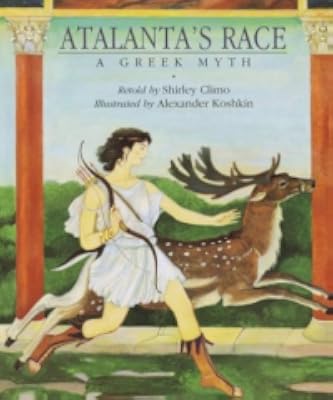
Before concluding, a few words about the art: Alexander Koshkin’s colourful, framed, Greek-style frieze-like illustrations wonderfully complement the text. All in all, I think this is a very fine retelling of the myth. The author humanizes the characters, fills in some of the narrative gaps, and highlights the talents of a gifted female athlete and her exclusion from the Olympics. (No wonder our heroine creates her own very high-stakes competition!) And Climo does all of this without deviating too much from the original fascinating myth.
Recommended. show less
In most versions of the story, a female child is born to King Iasus of Arcadia. Disappointed—even enraged—that his wife didn’t produce a son, he orders that the baby be abandoned on the side of a mountain. A she-bear finds and suckles the infant, who is later discovered by a group of hunters. They take her into their care and teach her how to track, trap, and spear animals.
Atalanta quickly demonstrates extraordinary athletic ability, particularly as a runner. When she gains wide show more renown for winning races, she’s called to the king’s court and discovers her true identity. She’s soon pressured to marry, for now her father (whose queen is dead) wants a grandson. Atalanta has no interest in love or marriage and only agrees if she can set the terms of a union: any suitor worth his salt must be able to beat her in a running race. Losing competitors are to be put to death.
Athletes and warriors willing to take the risk come from near and far. None succeeds, until Melanion (sometimes called Hippomenes) is aided in doing so by the goddess Aphrodite, who is angered by the proud girl’s spurning of love. The goddess supplies Melanion with three golden apples, which the young man tosses at various points in the race, distracting Atalanta, and allowing him to claim victory.
This being a Greek myth, the happily-ever-after part cannot be relied on (though some modern tellers prefer to leave out what actually happens after the wedding.) Because Atalanta and Melanion never offer thanks to Aphrodite for her role in their union, the goddess vindictively turns them into lioness and lion. “Let them race and hunt forevermore!” she bitterly pronounces.
Hmm . . . Now for an assessment of Climo’s picture-book version.
Climo is a masterful storyteller who writes well. She provides valuable descriptive detail without irritating and distracting lyrical excess. She fills in the gaps of the original story and humanizes the characters, particularly King Iasus who’s rendered considerably more sympathetic. Most significantly perhaps, she provides Atalanta with a mother, who begs and pleads with the king to spare her beloved daughter.
In Climo’s version, a merciful guard is charged with taking the baby to the slopes of Mount Cyllene. He finds a cave that might protect the child—the very one inhabited by a she-bear and her cubs. In this interpretation of the myth, Atalanta is later found not by a group of hunters but by a single one, the kindly Ciron, who recalls hearing about this baby and the manner in which she’d been abandoned. (Although Ciron uses her given name, he tells her nothing of her royal lineage.) The hunter raises her in his woodman’s hut and cultivates her natural talents, observing: “She was steady of hand and so nimble that she could slip the honey from a hive without disturbing the bees.” She can also “run as fast as a stag” and “speed an arrow to a target almost as well as Artemis, the goddess of the hunt.”
As she approaches young adulthood, Atlanta becomes restless. She leaves Ciron’s side, travelling to Athens, Sparta, Corinth, and Olympia, where she engages in and wins many athletic competitions. Climo emphasizes that although the girl is an exceptional sportswoman, she’s barred from the Olympics due to her sex.
Summoned to Iasus’s court after she gains wide renown, Atalanta is told of her parentage. This is where Climo makes her greatest deviation from her source material: the author has Iasus apologize to his daughter, admit how very wrong he was, and beg her forgiveness. Hmm . . . I wonder if it isn’t better for young readers to understand how unlikely this would have been in deeply misogynistic Ancient Greece.
To her credit, Climo does not succumb to the temptation of omitting or softening Atalanta’s marriage terms. In her telling, the suitors must compete in a race where defeat means something more than humiliation—namely, the loss of one’s head. However, the author can’t resist the desire to fashion a love story. Her Atalanta is attracted to the handsome young warrior, Melanion, and repeatedly tries to discourage him from running against her (knowing he’ll surely end up dead). And when the heroine is not victorious, she takes it well in stride. “Losing the race was a small price to pay for finding love,” she muses.
Climo’s story’s conclusion is faithful to the source material. After Atalanta delivers a son, Parthenopaeus, an heir for King Iasus, it is ultimately Aphrodite who wins the day. Since the ungrateful couple never offered the goddess thanks for her significant role in their union—providing the apples— and since the two only care about the hunt, games, and races, then that is all they will have. . . . But is it really so bad to be allowed to run free in the wild as lions if those are the things the pair really value? This reader thinks not!
Before concluding, a few words about the art: Alexander Koshkin’s colourful, framed, Greek-style frieze-like illustrations wonderfully complement the text. All in all, I think this is a very fine retelling of the myth. The author humanizes the characters, fills in some of the narrative gaps, and highlights the talents of a gifted female athlete and her exclusion from the Olympics. (No wonder our heroine creates her own very high-stakes competition!) And Climo does all of this without deviating too much from the original fascinating myth.
Recommended. show less
Apples are dangerous fruit, and when they enter a story, whether it be pagan or Judeo-Christian, you can be sure that that somebody is going to take a fall... And so it is in Shirley Climo's retelling of an ancient Greek myth about Atalanta - a princess abandoned at birth by the father who wanted a son, rescued by a wild bear, and raised by the hunter Ciron - whose skill as a sprinter par excellence can only be overcome with the crafty use of three of Aphrodite's golden apples.
The tale of Atalanta's fateful race with Melanion (Hippomenes in some versions), is the story of a young woman, a proud athlete with a competitive spirit, who does everything she can to avoid marriage, only to be overcome through the agency of the gods. This show more picture-book retelling has an almost fairy-tale like quality, and the scene in which the guard hides young Atalanta in a cave strongly reminded me of the huntsman who is tasked with killing Snow White. I found Alexander Koshkin's illustrations delightful, and would recommend this title to children (and their parents and teachers), who enjoy reading about ancient Greek mythology. show less
The tale of Atalanta's fateful race with Melanion (Hippomenes in some versions), is the story of a young woman, a proud athlete with a competitive spirit, who does everything she can to avoid marriage, only to be overcome through the agency of the gods. This show more picture-book retelling has an almost fairy-tale like quality, and the scene in which the guard hides young Atalanta in a cave strongly reminded me of the huntsman who is tasked with killing Snow White. I found Alexander Koshkin's illustrations delightful, and would recommend this title to children (and their parents and teachers), who enjoy reading about ancient Greek mythology. show less
From start to finish, I thought this book was complete insanity. I know it is a tale but from the king casting off his daughter, to a death race, to them transforming into lions I had no idea what to think of the book. I couldn’t I’m really understand the story the first time around due to how crazy everything was, but I think it was for the best. It kept my attention the entire time I was reading and I believe that’s what these books are all about.
"Atalanta's Race," was much different from your usual princess story. Instead of a prince finding love, a princess did, The princess' life wasn't always like a princess' life should be. Her father, the king, was disappointed she was a girl when she was born. He ordered his guards to bring her out to the mountains, if she died, that was the will of Zeus. Atalanta did not die. She was raised by lions until a hunter found her and raised her as his own. When she finally found love with the help of Aphrodite, her and her new husband were too worried about races and hunting, they never thanked her. She was upset and went to Rhea, the mother goddess. Rhea then changed the princess and her husband into lions because that's what they willed. show more Most myths or fairytales involving princesses have happy endings and live happily ever after. This story was different, because they were turned into lions, so they didn't exactly get their happily ever after. The illustrations used in this book helped the author depict the times of the Greek Gods and Goddesses. show less
This book is a version of a Greek myth that is well-written and nicely illustrated. The illustrations use classic Greek motifs and styles, fitting the book perfectly. I didn't have a very strong personal reaction to it, but I think it's a quality story that would be very useful in a mythology unit.
Atalanta is born in a Greek royal palace, but shortly after she is born she is taken up to a mountain because her father wanted a son. A hunter finds her and raises her as a hunter. Atalanta travels all over Greece showing how fast she can run. Once she gets to the palace, the king orders Atalanta to marry and she agrees to marry whoever can outrun her. One night, Aphrodite comes to one of the competitors, Melanion, in a dream and gives him three golden apples to use. While they are running, Melanion throws the apples onto the track. Atalanta gets distracted by the apples and Melanion runs ahead of her, eventually winning the race. Atalanta realizes that losing the race is not that bad because she found someone who loves her. This story show more is told in the way it would be told by the Greek people. A major theme of this story is love conquers all and you should do what is best for you, not what other people want you to do. show less
Atlanta's Race is a Greek Myth about a girl who is outcasted because of being a girl, raised by bears, and then raised by a hunter. She later discovers she was born to the king and queen and decides to say with her father. She is an active woman who can run and hunt just as well as any man. She proves that women can compete too. This myth is one of many about the olympics and this one in particular foreshadows women being allowed to compete in the olympics.
Genre Review: This is a good example of a myth. The author explains that this is a myth and the origins of it at the end of the book. For children, this is a good myth because it's told in simple enough language to be understood. This is a neat myth because it discusses the origins show more of the olympics- a very popular event today.
Point of View Critique: This story is told from the perspective of a narrator. I think the author chose to do this because it is a myth and it wouldn't make sense to have a character telling the story. Having a narrator tell the story makes the story more believable as myth.
Media: Painting show less
Genre Review: This is a good example of a myth. The author explains that this is a myth and the origins of it at the end of the book. For children, this is a good myth because it's told in simple enough language to be understood. This is a neat myth because it discusses the origins show more of the olympics- a very popular event today.
Point of View Critique: This story is told from the perspective of a narrator. I think the author chose to do this because it is a myth and it wouldn't make sense to have a character telling the story. Having a narrator tell the story makes the story more believable as myth.
Media: Painting show less
Members
- Recently Added By
Lists

A Child's Book Tour of Greece
37 works; 3 members
Author Information

23+ Works 4,868 Members
Shirley Climo was born in Cleveland, Ohio in 1928. She attended DePauw University until her mother died unexpectedly in 1949. She dropped out of college and took up her mother's work writing scripts for the weekly WGAR-Radio children's program Fairytale Theatre. During her lifetime, she wrote 24 books including The Korean Cinderella; Magic and show more Mischief: Tales from Cornwall; A Treasury of Princesses: Princess Tales from Around the World; A Treasury of Mermaids: Mermaid Tales from Around the World; and Someone Saw a Spider: Spider Facts and Folktales. She died on August 25, 2012 at the age of 83. (Bowker Author Biography) show less
All Editions
Common Knowledge
- Canonical title
- Atalanta's Race: A Greek Myth
- Important places
- Greece
Classifications
- Genre
- Children's Books
- DDC/MDS
- 398.21 — Society, government, & culture Customs, etiquette & folklore Folklore & Folktales Folk literature Fairy Tales
- LCC
- BL820 .A835 .C57 — Philosophy, Psychology and Religion Religions. Mythology. Rationalism Religions. Mythology. Rationalism History and principles of religions European. Occidental Classical (Etruscan, Greek, Roman)
- BISAC
Statistics
- Members
- 141
- Popularity
- 232,608
- Reviews
- 14
- Rating
- (3.65)
- Languages
- English
- Media
- Paper
- ISBNs
- 5
- UPCs
- 2
- ASINs
- 1