
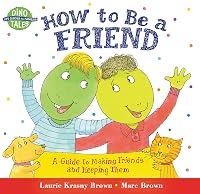
How to Be a Friend: A Guide to Making Friends and Keeping Them (Dino Life Guides for Families)
by Laurie Krasny Brown
Dino Life Guides for Families
On This Page
Description
Dinosaur characters illustrate the value of friends, how to make friends, and how to be and not to be a good friend.Tags
Recommendations





Member Reviews
This book was a mouthful! It provided plenty of good information on how to make a friend and how to keep a friend. It was a lot for me to read and I know it will be a lot for the children to understand. So if I were to read this book to my class, I would split it up for different days. I love how the author adds a page on "Talking Out An Argument," right after we view friends having an argument. During a read-aloud, I will have my students follow the steps. The little text bubbles are perfect for students to get an example on what the page is talking about.
I loved this book! I thought it was a really cute and different spin on an informational book. It provided information for readers to try out in order to be a good friend. The book provided facts about friendships, these facts which are important for readers to be aware of while forming friendships. For example, the book starts by saying, "Me Myself and I: There are times when it feels good to be by yourself, enjoying your own company" (Pg 1). I believe that the way this was written is very beneficial to readers. In a sense, it gives them a guideline to take into consideration when being social with peers. I also liked how the author chose to use illustrations and labelled/ captioned these illustrations - similarly to a comic strip. show more Through the exchange of information, readers are able to stay engaged and are able to put themselves in the characters' shoes. I also really love how the book pushes readers to think about changes they can make to be the best friend that they can. The main idea or message is that, friendships are not easy, but through effort and being understanding of those close to you, you cannot fail as a friend. show less
How to be a Friend, A Guide to Making Friends and Keeping Them
By Laurie & Marc Brown (2001)
I liked How to be a Friend, A Guide to Making Friends and Keeping Them by Laurie & Marc Brown for three reasons. First, I liked the illustrations throughout the book. I believe the characters are all dinosaurs of some type. So, by making the characters playful, cartoons the Brown’s do an excellent job reaching out to, and engaging their young readers. Second, I liked the use of speech bubbles. Speech bubbles are excellent tools to use to illustrate which character is speaking. In addition, speech bubbles introduce dialogue to students. When characters are talking readers get a better idea of what the character is like. Lastly, I liked pages 8 show more and 9. Specifically, these pages exemplify that friends can be different from each other in all kinds of ways; for example, a friend can be your mom, babysitter, or someone who speaks another language. By including this topic the Brown’s familiarize children with diversity. Overall, the “big idea” of How to be a Friend, A Guide to Making Friends and Keeping Them is to teach children how to be friends and that it is not always easy. I think this is a great book to read at the beginning of the school year to introduce students to the idea of making friends. show less
By Laurie & Marc Brown (2001)
I liked How to be a Friend, A Guide to Making Friends and Keeping Them by Laurie & Marc Brown for three reasons. First, I liked the illustrations throughout the book. I believe the characters are all dinosaurs of some type. So, by making the characters playful, cartoons the Brown’s do an excellent job reaching out to, and engaging their young readers. Second, I liked the use of speech bubbles. Speech bubbles are excellent tools to use to illustrate which character is speaking. In addition, speech bubbles introduce dialogue to students. When characters are talking readers get a better idea of what the character is like. Lastly, I liked pages 8 show more and 9. Specifically, these pages exemplify that friends can be different from each other in all kinds of ways; for example, a friend can be your mom, babysitter, or someone who speaks another language. By including this topic the Brown’s familiarize children with diversity. Overall, the “big idea” of How to be a Friend, A Guide to Making Friends and Keeping Them is to teach children how to be friends and that it is not always easy. I think this is a great book to read at the beginning of the school year to introduce students to the idea of making friends. show less
How to Be a Friend is a must have on every kindergarten and first grade class' bookshelf! This book, by Laurie Krasny Brown shares wonderful tips for making friends, which can be a major cause of stress for young children, in a fun way that's easy to understand. It's a great first day or week of school book to share at morning meeting, or at any point in the year for a quick, covert lesson on manners if that's still a struggle later in the year. One reason why I so highly recommend it is because it helps children take ownership of settling disagreements, starting friendships, and being a loyal friend. It's a great book for any teacher or parent looking to help improve their children's social skills.
I really enjoyed reading "How To Be A Friend". I think that this book should be for first through third grade. It seems a little to long and to complicated for kindergaten but to young for fourth, fifth, and sixth grade. The book teaches children how to handle many situations with friends. It explains how to make friends, how to share, and even how to settle arguments with friends. I think that this book has a lot of important points that children should learn. The number one friend rule is to treat others as you would want to be treated and this book does a wonderful job at explaining that to children.
This book would be good to read and discuss in kindergraden. It talks about different ways to be a good friend and talks about ways to make friends. I liked this book because it talks about bullies, which is a problem in schools. You could read this book and have kids write about there friends and fights that students have had with there friends.
Illustrations and text come together to form this children book about being a good friend to others. The book includes ways that the readers can treat others fairly, be a good friend, how to handle bullies, how to not be a good friend, and how to settle arguments. It also had multiple illustrations of situations that students could find themselves in on a daily basis.
This informational book could be used in a classroom for students to refer to when they are in a situation with another person, and they are unsure how to handle it. Many bully situations arise in school, because students are unsure about how to handle the situations presented to them. A resource in a classroom that allows students to go to when they are in a sticky show more situation would promote dialogue and stop a bad situation from becoming worse.
Informational picture book
Reading Level: 3.5 show less
This informational book could be used in a classroom for students to refer to when they are in a situation with another person, and they are unsure how to handle it. Many bully situations arise in school, because students are unsure about how to handle the situations presented to them. A resource in a classroom that allows students to go to when they are in a sticky show more situation would promote dialogue and stop a bad situation from becoming worse.
Informational picture book
Reading Level: 3.5 show less
Members
- Recently Added By
Author Information

22+ Works 3,709 Members
Series

Common Knowledge
- Original publication date
- 2001
Classifications
Statistics
- Members
- 1,109
- Popularity
- 22,824
- Reviews
- 17
- Rating
- (4.08)
- Languages
- English
- Media
- Paper
- ISBNs
- 8
- ASINs
- 1