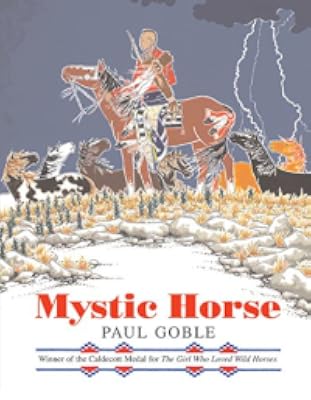
Mystic Horse
by Paul Goble
On This Page
Description
After caring for an old abandoned horse, a poor young Pawnee boy is rewarded by the horse's mystic powers.Tags
Recommendations




Member Recommendations
Member Reviews
What a beautiful story of the American Pawnee Indians. This folktale tells the story of a mystic horse, a horse that no one had hope in but a grandmother and her grandson. In this time, horses were imperative for not only survival but for a good quality of life. Unfortunately for these two, they did not own a horse and because of that they were the weakest, slowest, and poorest bunch of the entire tribe. When they were walking through the forest one day they came across a starving old horse. Instead of ignoring it for what it was, they saw the potential and beauty in this animal. They restored it back to health and it became the most beautiful, strongest, and fastest horse. The other members of the tribe were astonished and for once show more they were given the respect that they deserved and earned. This story is a remake of the long told story of "The Dun Horse." This remake resembles the original story for the most part but with a little twist of magic. Although this story is a folklore, it is still educational. They author did a great job at portraying how life was back then, the hardships they faced and their culture. This book would be an excellent interdisciplinary lesson for showing students how Indians lived. The author talks about the tribe hunting for meat, using the skin for clothing and tipis, and the significant roles that the horses played in their survival. show less
Mystic Horse tells the story of a Pawnee tribe hunting buffalo. On the outskirts of their tipi village live a poor old woman and her grandson. As the tribe moves from camp to camp looking for buffalo, the grandmother and grandson stay behind to pickup things that have been discarded. They have no horse and carry what they have on their backs.
One day the grandson finds an old, starving, sick horse. He cares for the horse and nurses him back to health as they travel behind the tribe. The boys make fun of him and his sickly horse, but he loves the animal and cares for him. When enemies are sited we learn of the magic of this mystic horse. He speaks to the boy and tells him how to defeat the enemy. The boy follows all directions, but one. show more As the story continues we learn a lesson of love and loss, remorse and forgiveness.
Paul Goble's beautiful illustrations help tell this lovely tale and shows the love the Pawnee people have for their horses. show less
One day the grandson finds an old, starving, sick horse. He cares for the horse and nurses him back to health as they travel behind the tribe. The boys make fun of him and his sickly horse, but he loves the animal and cares for him. When enemies are sited we learn of the magic of this mystic horse. He speaks to the boy and tells him how to defeat the enemy. The boy follows all directions, but one. show more As the story continues we learn a lesson of love and loss, remorse and forgiveness.
Paul Goble's beautiful illustrations help tell this lovely tale and shows the love the Pawnee people have for their horses. show less
I liked this folktale and Goble's version of it, but for me it lacks a bit of explanation that would really flesh out the story. Why does the creator forgive the boy for disobeying the horse, causing his death? Is it just because he is truly sorry and seems to genuinely mourn the horse? Why does he reward the boy with good fortune and many horses? The illustrations in this book are beautiful. It is a bit different from the other Goble books I have read, since the look of the Pawnee clothing, hairstyles, and symbols are quite different from those of the Sioux Indians who feature in many of Goble's illustrations. This book could be used in a curriculum about folktales and Native American culture.
Mystic Horse would be an independent read for fourth or fifth graders. The vocabulary and syntax is complicated and it is a decently long picture book. This book can be used to teach about the native american and Pawnee culture, the book show and describes the actions they do, the way the tribe works, the values of the tribe, and what they live in and wear. The book while doesn't say directly about the Pawnee culture, but through the description of the setting and the background of the story the student s can learn about the culture. The students could also learn about theme and the message the story teaches about not being greedy and being forgiven. The students would be able to identify the theme or themes in this story.
This is a Pawnee Indian legend about a young boy who wants to be a part of the tribe's buffalo hunt. He finds a sickly horse, cares for it, and it turns out to have magical powers. The boy goes too far and the horse dies. However, the boy's remorse brings about a nice ending and provides a moral for the story. There are a number of things in the story that illicit some interesting conversation from my students and the story always works for my class.
Vivid, fluid and capturing illustrations that draw you in and have you linger on the story. The illustrations capture the beauty of the time period, animals and landscapes.
A redemptive story to share with many.
Get more than one book, so that one may be on display.
A redemptive story to share with many.
Get more than one book, so that one may be on display.
A boy and grandmother from the Pawnee tribe are outcasts. They are a nomatic tribe who come across a skinny sick horse. The boy nurses it back to health in hopes that it will help carry their belongings. Before the boy and horse attack the enemy, the horse tells the boy to only cross enemy lines four times. The boy becomes greedy because his tribe is cheering for him and crosses enemy lines to attack one more time, a fifth time. Arrows shoot and strike his horse. His horse dies. Boy cries and asks for forgiveness. Then, one night the boy notices something moving in the brush below the cliff he was sitting on. It was his horse. It had come back to life.
Members
- Recently Added By
Author Information

52+ Works 9,312 Members
Paul Goble was born in Haslemere, Surrey, England on September 27, 1933. He was a sharpshooter in the British military from 1951 to 1953. In 1959, he received a National Diploma in Design, with honors, from the Central School of Arts and Crafts in London. While working in freelance industrial design and teaching at Ravensbourne College of Art and show more Design, he and his first wife Dorothy Lee wrote four picture books. In 1977, he decided to become a full-time author and illustrator and accepted a position as the artist-in-residence at Mount Rushmore National Memorial. He and Lee divorced in 1978. He was best known for his picture books inspired by Native American culture and lore including Buffalo Woman, Iktomi and the Boulder: A Plains Indian Story, and Crow Chief: A Plains Indian Story. He received the Caldecott Medal in 1979 for The Girl Who Loved Wild Horses. He died from Parkinson's disease on January 5, 2017 at the age of 83. (Bowker Author Biography) show less
Awards and Honors
Awards
Distinctions
Classifications
Statistics
- Members
- 94
- Popularity
- 341,125
- Reviews
- 8
- Rating
- (4.05)
- Languages
- English
- Media
- Paper
- ISBNs
- 2