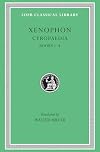
Cyropaedia, Books 1-4 [Ancient Greek]
by Xenophon
On This Page
Description
Cyropaedia by Xenophon (c. 430-c. 354 BCE) is a historical romance on the education of the sixth century BCE Persian king Cyrus the Elder that reflects Xenophon's ideas about rulers and government. Xenophon (ca. 430 to ca. 354 BCE) was a wealthy Athenian and friend of Socrates. He left Athens in 401 and joined an expedition including ten thousand Greeks led by the Persian governor Cyrus against the Persian king. After the defeat of Cyrus, it fell to Xenophon to lead the Greeks from the gates show more of Babylon back to the coast through inhospitable lands. Later he wrote the famous vivid account of this "March Up-Country" (Anabasis); but meanwhile he entered service under the Spartans against the Persian king, married happily, and joined the staff of the Spartan king, Agesilaus. But Athens was at war with Sparta in 394 and so exiled Xenophon. The Spartans gave him an estate near Elis where he lived for years writing and hunting and educating his sons. Reconciled to Sparta, Athens restored Xenophon to honour but he preferred to retire to Corinth. Xenophon's Anabasis is a true story of remarkable adventures. Hellenica, a history of Greek affairs from 411 to 362, begins as a continuation of Thucydides' account. There are four works on Socrates (collected in Volume IV of the Loeb Xenophon edition). In Memorabilia Xenophon adds to Plato's picture of Socrates from a different viewpoint. The Apology is an interesting complement to Plato's account of Socrates' defense at his trial. Xenophon's Symposium portrays a dinner party at which Socrates speaks of love; and Oeconomicus has him giving advice on household management and married life. Cyropaedia, a historical romance on the education of Cyrus (the Elder), reflects Xenophon's ideas about rulers and government; the Loeb edition is in two volumes. We also have his Hiero, a dialogue on government; Agesilaus, in praise of that king; Constitution of Lacedaemon (on the Spartan system); Ways and Means (on the finances of Athens); Manual for a Cavalry Commander; a good manual of Horsemanship; and a lively Hunting with Hounds. The Constitution of the Athenians, though clearly not by Xenophon, is an interesting document on politics at Athens. These eight books are collected in the last of the seven volumes of the Loeb Classical Library edition of Xenophon. show lessTags
Recommendations





Member Reviews
While this Loeb edition is the classic interlinear format -- my greek is rusty at best. The translation by Walter Miller is quite readable, and I flew through this first volume. The work is enjoyable simply as a classic tale of war. From other, more modern academic sources I have my doubts as to its value as history. That said, it is good for the general course of events, and provides an insight into the greek view of Cyrus and how he amassed his polyglot empire. For me, the two most striking portions of these books were first, the encounter with the Armenians, and second, his later discourse (which i fear to be more Xenophon than Cyrus) on the value of motivational speeches versus culture/training/long term indoctrination.
(2016 Review #10)
(2016 Review #10)
Plato writes in "Republic" that the principle of justice is the same for an individual as it is for a state. Therefore, the person who is eligible to govern a state must be a philosopher, i.e. lover of wisdom. Xenophon has found concrete expression of this ideal in the person of Cyrus, the founder of the Persian Empire, who embodied the essential characters of a philosopher-king, shepherd and guardian of the state.
Cyropaedia ("The Education of Cyrus") is a fascinating biography of Cyrus the Great. It integrates seamlessly into one narrative all the interesting aspects of biography, history, romance, war epic, political philosophy, leadership manual and military treatise, and yet, like many other Greco-Roman classics, is written in a show more simple, elegant, vivacious, humorous and captivating style. Cyropaedia has reportedly inspired Alexander the Great, Scipio Africanus, Julius Caesar, Cicero, Machiavelli and Thomas Jefferson among others. I suspect Abe Lincoln also got his leadership lessons (e.g. "Team of Rivals") from Xenophon.
He who rules himself well can rule the world.
(Read full review at Nemo's Library) show less
Cyropaedia ("The Education of Cyrus") is a fascinating biography of Cyrus the Great. It integrates seamlessly into one narrative all the interesting aspects of biography, history, romance, war epic, political philosophy, leadership manual and military treatise, and yet, like many other Greco-Roman classics, is written in a show more simple, elegant, vivacious, humorous and captivating style. Cyropaedia has reportedly inspired Alexander the Great, Scipio Africanus, Julius Caesar, Cicero, Machiavelli and Thomas Jefferson among others. I suspect Abe Lincoln also got his leadership lessons (e.g. "Team of Rivals") from Xenophon.
He who rules himself well can rule the world.
(Read full review at Nemo's Library) show less
This is a historical romance on the education of Cyrus the Elder and reflects Xenophon's ideas about rulers and government.
Ratings
Members
- Recently Added By
Author Information

718+ Works 10,519 Members
Xenophon's life and personality is better known to us, perhaps, than that of any other Greek who lived before Alexander the Great. Much of his considerable output of historical writing and essays is frankly or implicitly autobiographical. He reveals himself as one of those many Athenians and other Greeks who turned to autocratic political models, show more including admiration of Persia, after the excesses of the Athenian democracy led to disaster in the Peloponnesian War. He also reveals himself as much more than a literary man and a critic of his times. A gentleman adventurer and something of a professional soldier, he followed in turn the philosopher Socrates, the Persian prince Cyrus the Younger, and the Spartan king Agesilaus, all of whom he wrote about with an air of close personal knowledge. His works include the autobiographical Anabasis, an account of his service with a mercenary Greek army that marched from Mesopotamia to the Black Sea after the defeat and death of the younger Cyrus. It provides the most detailed single perspective on the military practices and military mentality of Xenophon's age. His Hellenica, by contrast, is an impersonal continuation to the end of the Peloponnesian War of the work of Thucydides and a patchy memoir that concentrates on Sparta's fortunes until the definitive end of its power in 362 b.c. Xenophon's other major works are the Cyropaedia and the rambling Socratic dialogues known as the Memorabilia. The Cyropaedia is a fictional idealization of the career of Cyrus the Great, the only great conqueror known to the Greeks before Alexander. Often regarded merely as a novel, it is a species of a priori historical reconstruction. A retrojection of the military science and political values of the day into a largely unknown Persia of the past, it is intended to explain Cyrus's success on rational principles. The Memorabilia and the Socratic Apology that comes down with them contain nothing of philosophical value but are thought by some scholars to offer a possible corrective to Plato's altogether too Platonic Socrates. Xenophon had a conventional and second-rate mind, but he is a valuable resource because of his mediocrity. He enables us to make contact with an ordinary intellect from a world that often seems dominated by geniuses. (Bowker Author Biography) show less
Series
Belongs to Publisher Series
Common Knowledge
- Canonical title
- Cyropaedia, Books 1-4 [Ancient Greek]
Classifications
- Genres
- Nonfiction, History
- DDC/MDS
- 913.3603 — History & geography Geography & travel Geography of and travel in ancient world Antiquities of ancient countries Europe north and west of Italian Peninsula to ca. 499
- LCC
- PA3612 .X4 — Language and Literature Greek language and literature. Latin language and literature Greek literature Translations
- BISAC
Statistics
- Members
- 112
- Popularity
- 288,909
- Reviews
- 3
- Rating
- (4.33)
- Languages
- English, Greek (Ancient), Italian
- Media
- Paper, Ebook
- ISBNs
- 7
- ASINs
- 2