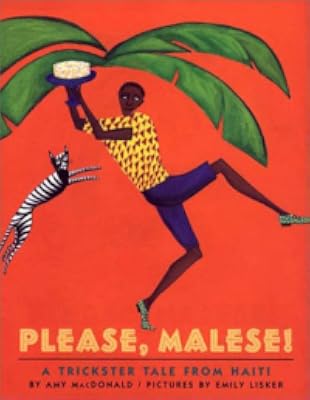
Please, Malese! A Trickster Tale from Haiti
by Amy MacDonald
On This Page
Description
Using his tricky ways, Malese takes advantage of his neighbors, until they catch on, after which he manages to pull an even bigger trick on them.Tags
Recommendations












Member Reviews
Relaxing in his hammock one day, Malese notices that his shoes are so worn, his toes are peeking out! How can he convince the village shoemakers to make him a new pair, when he has no money? With Malese, there's always a way, and soon two separate shoemakers find themselves the victim of this clever trickster. Likewise, when Malese decides to make rum cake, the rum sellers soon find themselves cheated out of some of their product. Eventually, the villagers get so fed up, they lock Malese in the local jail. Will he learn his lesson? Or will he play one more trick...?
Of course, the answer to this last question is never in doubt, Please, Malese! being a trickster tale! With a humorous narrative - based on the tale of "a shrewd peasant" show more collected in 1929 - and bold, colorful illustrations that accentuate the fun, this winsome retelling of a Haitian folktale is sure to please young readers, particularly those with a taste for traditional stories. show less
Of course, the answer to this last question is never in doubt, Please, Malese! being a trickster tale! With a humorous narrative - based on the tale of "a shrewd peasant" show more collected in 1929 - and bold, colorful illustrations that accentuate the fun, this winsome retelling of a Haitian folktale is sure to please young readers, particularly those with a taste for traditional stories. show less
Malese was a well known trickster, all his friends and neighbors were skeptical of his ways. One day he realized that he needed a new pair of shoes for his old ones were falling apart and his toes were not even covered. Being the trickster that he is, Malese went to a shoemaker and talked his way into one left shoe for inspection before buying then went to another for a right shoe. He continued his tricks through the market, the surrounding area, and even when he had been caught in his ways. This story is truly about a trickster who will stop at nothing to get what he wants.
I thought that this was such a cute little book! I enjoyed getting to read a folklore story from another country that was so full of small details that put you in show more the story. The pictures in this book were key to the connection of the culture. show less
I thought that this was such a cute little book! I enjoyed getting to read a folklore story from another country that was so full of small details that put you in show more the story. The pictures in this book were key to the connection of the culture. show less
This book takes an old folktale to a whole new level with a clever character who tricks his way from poverty to pleasure. The story is delivered traditionally while the illustrations present Haitian culture in a unique cheerful style that is well-suited for a multicultural children’s story.
Malese is a trickster, alright! He goes through life tricking other people to do things for him and give him things because he doesn't have the money to afford the lifestyle he enjoys. First, he tricks two shoemakers into making him a pair of shoes by asking each only for one, and then pretending not to like the work so that he doesn't have to pay. Then, he gets free rum for a rum cake by taking a bottle of water around the market, asking people to fill it, and then pouring half the bottle back when the sellers demand their money (thus, his mixture becomes more and more concentrated with wine even though he began with pure water.) Finally, he tricks someone into giving him a ride by convincing a friend that his animal needs help show more carrying the load. When the villagers get together and realize what Malese has been up to, they decide to lock him away. However, Malese even tricks them out of that one by acting as if he wants to be locked up. Thus, they end of begging him to leave early, and even agree to work on his house for him if he will just go home! In the end, Malese has gotten everything he wanted at the expense of others and has never been served right. show less
My husband and I read this tale to our daughter, and afterwards we were both left thinking, "huh?". I don't know that I have ever read a folktale where the trickster wins in the end and I don't think that I liked it. I suppose it was a lesson for the people being tricked to not be fooled by this type of person, but it is a round about lesson and I found it hard to benefit from this. The artowrk was culturally appealing and the aspects of the town and people reflected the culture as well. That was a characteristic of the book that would be appreciated.
Malesei tricks his neighbors in a variety of ways: One has to to do with mathematical limits: He fills a bottle halfway with water and then asks a rum merchant to fill it up, balks at the price and pours half his bottle back into the rum merchant's container. He repeatedly does this until his bottle is as close to being full of rum as he requires to bake a rum cake. To belabor this point: 0 rum -> 1/2 rum -> 3/4 rum -> ....
He points out to a man leading his donkey laden with baskets that it is unfair to make the donkey carry them and offers to sit on the donkey and carry the baskets. This is like a Chelm story in which the man carries his baskets on his back while sitting on his donkey to make the animal's load lighter.
He points out to a man leading his donkey laden with baskets that it is unfair to make the donkey carry them and offers to sit on the donkey and carry the baskets. This is like a Chelm story in which the man carries his baskets on his back while sitting on his donkey to make the animal's load lighter.
Please, Malese! takes an old folktale to a whole new level with a clever character who tricks his way from poverty to pleasure. The story is delivered traditionally while the illustrations present Haitian culture in a unique cheerful style that is well-suited for a multicultural children’s story.
Members
- Recently Added By
Author Information

18 Works 1,795 Members
All Editions
Awards and Honors
Awards
Common Knowledge
- Important places
- Haiti; Hispaniola
Classifications
Statistics
- Members
- 47
- Popularity
- 635,211
- Reviews
- 9
- Rating
- (3.94)
- Languages
- English
- Media
- Paper
- ISBNs
- 2