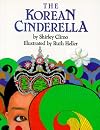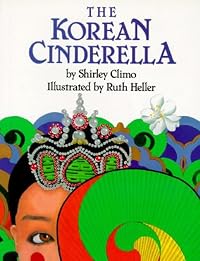
The Korean Cinderella
by Shirley Climo
On This Page
Description
In this version of Cinderella set in ancient Korea, Pear Blossom, a stepchild, eventually comes to be chosen by the magistrate to be his wife.Tags
Recommendations
Member Reviews
One of four international Cinderella variants that Shirley Climo has retold in picture-book form - the other three being The Egyptian Cinderella, The Persian Cinderella and The Irish Cinderlad - this Korean tale (actually a combination of three different Korean tales) follows the story of Pear Blossom, a beautiful young girl whose stepmother, Omoni, and stepsister, Peony, make her life miserable. Set three impossible tasks by Omoni, and threatened with a terrible fate if she does not perform them, Pear Blossom is aided in her distress by a frog, a flock of sparrows, and a great bull, eventually coming to the attention of a visiting magistrate...
As someone with a keen interest in comparative folklore, I am usually quite enthusiastic, show more when it comes to reading and identifying variants of the same tale type, across diverse cultures. It can often be quite illuminating to examine how different peoples have used the same storytelling elements, shifting the focus of the tale in order to make it more relevant to their own specific needs. That said, I have instinctively shied away, in the past, from Climo's four retellings, and others like it, not because I am uninterested in the stories themselves, but because it irritates me to see them described, in such an explicit way, as "Cinderella" stories. I know, of course, that a given tale type - in this case, the "persecuted heroine" tale, type 510A in the Aarne-Thompson folklore classification system - will often be described, colloquially, by whichever variant is most well known. Thus my own favorite telling of tale-type 310, Petrosinella, is described as a "Neopolitan Rapunzel." But in reality, this story is no more the "Korean Cinderella," than Cinderella is the "French Pear Blossom," and although I understand the need to market a book, and to attract readers - 'Like Cinderella? Then you might want to read this as well! - I think such parallels are best left to the description, or possibly to the sub-title.
Leaving this issue - and the fact that Climo did not provide an actual source for her story - aside, The Korean Cinderella does present an engaging tale, one that young fairytale lovers will enjoy. The accompanying illustrations by Ruth Heller, who also worked on another of Climo's Cinderella ventures (The Egyptian Cinderella), as well as her King of the Birds, are colorful and appealing, although I think her strength runs more to designs and motifs, than to faces, as her human figures just looked a little off to me. All in all, one I would recommend to those looking for variants of the persecuted heroine tale-type, although I would also advise that readers consider the limiting nature of the title that Climo chose. show less
As someone with a keen interest in comparative folklore, I am usually quite enthusiastic, show more when it comes to reading and identifying variants of the same tale type, across diverse cultures. It can often be quite illuminating to examine how different peoples have used the same storytelling elements, shifting the focus of the tale in order to make it more relevant to their own specific needs. That said, I have instinctively shied away, in the past, from Climo's four retellings, and others like it, not because I am uninterested in the stories themselves, but because it irritates me to see them described, in such an explicit way, as "Cinderella" stories. I know, of course, that a given tale type - in this case, the "persecuted heroine" tale, type 510A in the Aarne-Thompson folklore classification system - will often be described, colloquially, by whichever variant is most well known. Thus my own favorite telling of tale-type 310, Petrosinella, is described as a "Neopolitan Rapunzel." But in reality, this story is no more the "Korean Cinderella," than Cinderella is the "French Pear Blossom," and although I understand the need to market a book, and to attract readers - 'Like Cinderella? Then you might want to read this as well! - I think such parallels are best left to the description, or possibly to the sub-title.
Leaving this issue - and the fact that Climo did not provide an actual source for her story - aside, The Korean Cinderella does present an engaging tale, one that young fairytale lovers will enjoy. The accompanying illustrations by Ruth Heller, who also worked on another of Climo's Cinderella ventures (The Egyptian Cinderella), as well as her King of the Birds, are colorful and appealing, although I think her strength runs more to designs and motifs, than to faces, as her human figures just looked a little off to me. All in all, one I would recommend to those looking for variants of the persecuted heroine tale-type, although I would also advise that readers consider the limiting nature of the title that Climo chose. show less
I enjoyed, “The Korean Cinderella” for one main reason. I loved how I read a different culture’s perspective on the classic story of Cinderella. I’ve always thought that Disney’s portrayal of Cinderella was the only adaptation of the story. However, this is not true at all. “The Korean Cinderella” while similar to Disney’s version in some ways, was very much its own story full of rich Korean storytelling. Basically, the story is about a beautiful and kind girl named Pear Blossom, whose mother dies and then her father remarries a wicked woman with an equally wicked daughter. Pear Blossom’s father becomes ill shortly after he remarries, leaving her under the control of her evil stepmother who makes Pear Blossom a servant show more to her and her daughter. The tasks Pear Blossom’s step mother gives her are impossible, until a different mystical creature conveniently comes every time and helps her complete them. Every time Pear Blossom tells her stepmother what has happened during her chores, she accuses her of lying and punishes her severely. One day, the village Pear Blossom lived in was having a festival and she desperately wanted to go. Her stepmother said she could go, but she had to weed rice paddies in a huge field first. Just as Pear Blossom was about to give up a huge black ox appeared in a cloud of dust and ate the weeds “faster than the wind.” This allowed Pear Blossom to go to the festival, where she got a stone stuck in her sandal and had to take it off. As she was removing her shoe she saw a young, handsome noblemen approach her on a palanquin. She became nervous and ran away, forgetting to take her shoe with her. The nobleman called after her to stop running because he was taken with her beauty and ordered his servants to take him to the village. When Pear Blossom got back to the festival she ran into her stepmother who scolded her for being there. At this point, the nobleman came back with Pear Blossom’s shoe and asked her to marry him. From this summary you can see how different and incredibly rich in culture, “The Korean Cinderella” was. I absolutely loved getting to see a Korean perspective on what I (ignorantly) viewed as an “American” classic. The main idea in, “The Korean Cinderella” is to always remain kind and true to yourself, even in the face of cruelty and adversity. The story teaches that it is not always actions that make a person kind but, their reactions. Pear Blossom stayed upbeat and positive even when her stepmother and stepsister berated her, and never lowered herself to match their cruel antics. This enabled Pear Blossom to have her “happy ending” and also pays off in real life too. show less
The Korean Cinderella is a typical Cinderella story with an ugly stepmother and snotty stepsister. The harsh stepmother gives Pear Blossom impossible tasks to complete, but through the help of magical creatures she is able to complete each task with ease. The stepmother grants her permission to attend a village festival once the assigned chores are complete. While making her way to the village, she encounters the prince who is enamored by her beauty. In true Cinderella fashion, Pear Blossom loses her shoe, and the prince searches the village to find the girl with one shoe. He finds Pear Blossom and pledges his intentions for marriage. The following spring, the couple are married.
Personal Reflection: I love how this story incorporates show more Korean words and traditions. It is fairly predictable as it follows the traditional Cinderella story line, but it is still enjoyable. This story is a great introduction to teach children about other cultures.
Extension Ideas:
1. Have children form groups and look through the book to pick out Korean words and their meanings. Discuss in group setting.
2. Watch the movie Cinderella (or read the book if time is an issue) and have children write a paper describing similarities and differences in the two stories
3. Discuss Korea and some of its customs and traditions. Show children where Korea is on a map in relation to Oklahoma show less
Personal Reflection: I love how this story incorporates show more Korean words and traditions. It is fairly predictable as it follows the traditional Cinderella story line, but it is still enjoyable. This story is a great introduction to teach children about other cultures.
Extension Ideas:
1. Have children form groups and look through the book to pick out Korean words and their meanings. Discuss in group setting.
2. Watch the movie Cinderella (or read the book if time is an issue) and have children write a paper describing similarities and differences in the two stories
3. Discuss Korea and some of its customs and traditions. Show children where Korea is on a map in relation to Oklahoma show less
I had mixed feelings about this book after reading it. I liked that it is a Korean spin on a familiar story. The elements of the story stayed true to the Korean culture. The characters all wore traditional Korean clothing and activities such as traditional dancing were depicted. I especially liked the language of the book. The book used Korean words such as “Omani,” which means mother. The author also created a mystical tone to the traditional fantasy by using descriptive and beautiful poetry. “In spring white flowers frosted the tree, and PearBlossom wore a white ribbon on her long, black braid.” Another example is, “In the autumn, when leaves from the tree blew about the courtyard like scraps of sunshine, her mother dressed show more Pear Blossom in a yellow gown.” However, I became wary of sharing this book with children because of certain parts. Those parts would be when Pear Blossom's mother mistreated her. Sentences such as, “She made Pear Blossom crawl through the puddles, licking up the water” and “She did not give anything to eat, not that day or the next, not so much as a kernel of rice.” These sentences are normal in Korean culture, but for American students it may be problematic to share intense and harsh punishments as these with children. The main idea of “The Korean Cinderella” is that those who are good will prevail in the end. show less
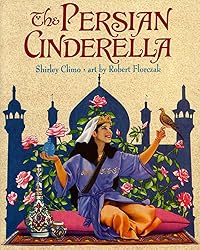
I did not find this book as enjoyable as The Persian Cinderella, but still found the book extremely informative. The book contained many of the elements of the original Cinderella story, but had a cultural twist that made it its own. The only reason why I did not find this story to be as enjoyable as the Persian version, was that I felt that the main character, Pear Blossom, was underdeveloped and did not have as much personality to her that made her stick out and really own her place in the book. I did not find myself rooting for her as I do with most of the Cinderella characters in these types of books. I did pity her and found her situation to be unfortunate, but her character did not really peak my interest. That being said, the show more book still was very informative and gave a lot of insight into Korean culture and how this classic story was told in different ways in Korea. One thing I really loved about how the book was written was that the author included many Korean words in the book with a translation to what it means: “Pear Blossom called the woman Omoni, or mother.” Finally, the illustrations in this book actually surpassed that of the Persian version of this story. There pages were there were no words, and yet the pictures really spoke volumes. The colors were vibrant and popped out of the page to really signify how exciting the festivals and Korean culture could be. In conclusion, the book was very effective for educational purposes, and while the story and plot was interesting and flowed well, I found the characters to be underdeveloped. show less
The Korean Cinderella by Shirley Climo takes reader to Korea telling the story of a girl named Pear Blossom. The premise is the same as the American Cinderella describing a young girl mistreated by her stepmother and sister. With the help of magical animals she gets her impossible task done. She looses a shoe and ends up with the prince/ magistrate. The vibrant illustrations were traditional and symbolic of Korean culture. I got a sense that her mother’s spirit was helping her along the way as well. This picture book could be used in high school when studying other countries and/or dealing with injustices. The moral of the story is a good one showing what goes around comes around. Grade 6 and up.
The author has done several books on the Cinderalla tale, and the one thing I remember most about this book was the colorful and clean art. Is paintings are bolder and darker than her 'Egyptian Cinderella', and the story is different enough to not feel like a rehash of Cinderella.
Members
- Recently Added By
Lists

Brightly Beaming Curriculum Books
281 works; 8 members

A Child's Book Tour of Korea
19 works; 2 members
Author Information

23+ Works 4,837 Members
Shirley Climo was born in Cleveland, Ohio in 1928. She attended DePauw University until her mother died unexpectedly in 1949. She dropped out of college and took up her mother's work writing scripts for the weekly WGAR-Radio children's program Fairytale Theatre. During her lifetime, she wrote 24 books including The Korean Cinderella; Magic and show more Mischief: Tales from Cornwall; A Treasury of Princesses: Princess Tales from Around the World; A Treasury of Mermaids: Mermaid Tales from Around the World; and Someone Saw a Spider: Spider Facts and Folktales. She died on August 25, 2012 at the age of 83. (Bowker Author Biography) show less
All Editions
Awards and Honors
Common Knowledge
- Canonical title
- The Korean Cinderella
- Original title
- The Korean Cinderella
- Original publication date
- 1993
- People/Characters
- Pear Blossom
- Important places
- Korea
- Original language
- English
Classifications
Statistics
- Members
- 874
- Popularity
- 30,918
- Reviews
- 49
- Rating
- (3.68)
- Languages
- English
- Media
- Paper
- ISBNs
- 8
- ASINs
- 2