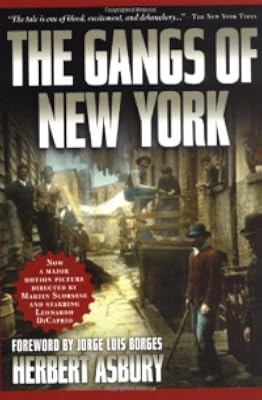
The Gangs of New York: An Informal History of the Underworld
by Herbert Asbury
On This Page
Description
First published in 1928, Herbert Asbury's "The Gangs of New York" is probably best remembered today as the source material for Martin Scorsese's 2002 film of the same name. According to the original publisher's announcement "this is a history of New York's underworld, from its beginnings in revolutionary times down to its virtual end as an organized force for evil during the first decade of the present century." "The Gangs of New York" is all of this and much more, a rogues' gallery of arch show more criminals who spread terror in little old New York when the Bowery flourished. Chinatown was lurid with feuds, and Five Points was a place to avoid both by day and night. An important contribution to American criminology at the end of the 19th century, this volume contains vivid accounts of gang methods, the draft riots, the tong wars, the Bowery, Hell's Kitchen, Tammany Hall's relation to the gangs, and an amazing glossary of underworld slang. show lessTags
Recommendations

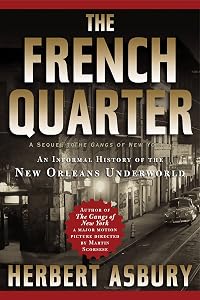





Member Recommendations
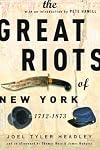
baobab The gangs of New York had a hand in most of the riots that Headley describes. In fact, Headley's book covers much of the same material as the first half of Asbury's book, the major difference being that Headley was writing a generation earlier.
Member Reviews
I concluded I would have to read Gangs of New York after hearing that it had stuck with Martin Scorsese for forty years until he was able to make the movie of the same name. With that much staying power it did not disappoint. The endless gangs and characters become a blur, and the amount of crime staggers the imagination. I often thought the Cagney era gangster names and lingo were fantasies of Hollywood, but they were nothing compared to the reality. From the Plug Uglies to the Whyos to the Baxter Street Dudes the gangs constantly morphed with each new wave of immigration. Little Augie, Goo Goo Knox and the Turtle were just a few in this cast of millions. The story of any one of them could carry a movie or a book devoted to them alone. show more A compelling read, but be warned the level of violence that was the reality makes the movie of this world look mild. show less
I love to read about the squalid splendor of old New York, of the Five Points, the Bowery, of its sexology and night life. Alas and alack, those topics left their cards but didn't stay in this account of gangland during a century ending about 1925. Concentrations here include street fighting, assassins, and turf wars, topics which are tangential at best to my reading interests. Further descent came from a chapter mostly devoted to the tools and techniques one might need to enter a bank vault and two longish chapters narrating the 1863 draft riots, an event which the author admits has almost no nexus with the gangs, save that many of the participants were members of gangs. The author occasionally deploys a tongue-in-cheek whimsy to good show more effect, but overall his style is competent but plodding. show less
A raucous history of the early 19th century underbelly of New York City, replete with accounts of brutal gang warfare and Boss Tweed-era Tammany Hall political machination. Dime-novel storytelling, not actual history. A mostly riveting, edge-of-your-seat account of lowlife Americana: lots of whisky, fisticuffs, brick-throwing, and bullets from the corrupt NYPD.
When reading a book written some time ago, it's important to remember that standards and tastes may have been different back then. Such is the case here. It's entirely possible (in this case, likely) that this book was considered eminently readable when it was published in 1927, but today's readers might find it somewhat more difficult.
Asbury presents us with a dizzying array of names of people (real names, pseudonyms, and nicknames) and places (modern and historical), barely pausing for breath, let alone meaningful distinction among them (I lost count of the number of gangsters described as "huge"). A map would have been nice, and a cast of characters even better.
Anecdotes are piled one on top of another, with little or no explanation show more as to why any of them are important or how any of them are connected. And each one is more sensationalistic than the last, making me wonder where Asbury got his information from. A bibliography is appended at the end of the book, but it's impossible to tell which stories he got from which sources (and, indeed, which came from "personal interviews" with criminals and police officers). So, as hard a time as I had just wading through the mass of details, I almost had an even harder time believing them. show less
Asbury presents us with a dizzying array of names of people (real names, pseudonyms, and nicknames) and places (modern and historical), barely pausing for breath, let alone meaningful distinction among them (I lost count of the number of gangsters described as "huge"). A map would have been nice, and a cast of characters even better.
Anecdotes are piled one on top of another, with little or no explanation show more as to why any of them are important or how any of them are connected. And each one is more sensationalistic than the last, making me wonder where Asbury got his information from. A bibliography is appended at the end of the book, but it's impossible to tell which stories he got from which sources (and, indeed, which came from "personal interviews" with criminals and police officers). So, as hard a time as I had just wading through the mass of details, I almost had an even harder time believing them. show less
Tough going at times, a bit dry occasionally. However, it has some truly fascinating stories in it about the incredible rise of New York into a civilized city. It's amazing how brutal life was at the turn of the century with violence raging nearly nonstop in some areas.
An enlightening look at the early history of New York City. The book bogs down in the categorizing of the gangs in the later years but still an eye-opening look at another time in the not so far away.
Really needs an overall narrative or sociological argument/insight to tie everything together. As it is, a series of repetitive anecdotes with very few having the sort of interesting detail to make them stand out.
Members
- Recently Added By
Author Information

17+ Works 2,914 Members
Herbert Asbury (1891-1963) was a prolific journalist and editor
Common Knowledge
- Original title
- The Gangs of New York: An Informal History of the Underworld
- Original publication date
- 1928
- People/Characters
- William Poole (Bill the Butcher); John Morrissey; Paul Kelly (Paolo Vaccarelli); Monk Eastman (Joseph Morris | William Delaney | Edward Delaney); Bill Devery; Kid Twist (Max Zweibach) (show all 14); Mary O'Malley; Tom Foley; Joe Brown (Joseph Castano); Owney Madden; Frankie Yale (Francesco Uale); Humpty Jackson; Joe Casseli; Al Capone
- Important places
- New York, New York, USA
- Important events
- American Civil War (1861 | 1865); New York City Draft Riots (1863-07-13 | 1863-07-16)
- Related movies
- Gangs of New York (2002 | IMDb)
- Dedication
- To Orell
- First words
- This book is not a sociological treatise, makes no pretense of offering solutions for the social, economic and criminological problems presente by the gangs.
- Last words
- (Click to show. Warning: May contain spoilers.)But it had been eight years since he had assumed active leadership of his gag, and on that day his father had proclaimed him dead.
- Original language
- English
Classifications
- Genres
- History, Nonfiction, General Nonfiction
- DDC/MDS
- 364.106097471 — Society, government, & culture Social problems and social services Crime Criminal offenses Organized Crime Standard subdivisions History, geographic treatment, biography
- LCC
- HV6439 .U7 .N4 — Social sciences Social pathology. Social and public welfare. Criminology Social pathology. Social and public welfare. Criminology Crimes and offenses
- BISAC
Statistics
- Members
- 1,699
- Popularity
- 13,138
- Reviews
- 15
- Rating
- (3.34)
- Languages
- 6 — English, French, German, Italian, Portuguese, Spanish
- Media
- Paper, Audiobook, Ebook
- ISBNs
- 28
- ASINs
- 17