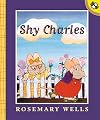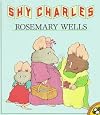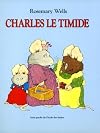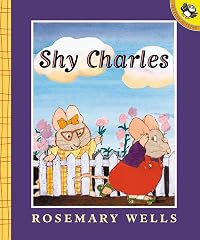
Shy Charles
by Rosemary Wells
On This Page
Description
Being painfully timid and shy does not keep a young mouse from rescuing his babysitter in an emergency situation, although after becoming a hero he still says zero.Tags
Recommendations



Member Reviews
Much to the disappointment of his parents, Charles Mouse doesn’t like to talk. He doesn’t say, “Thank you” or “Good-bye.” He avoids the phone and he’s perfectly happy playing all by himself. He sleeps through ballet class and isn’t any better at football. Will Charles ever learn to speak up for himself?
Written in rhyme, “Shy Charles” is an interesting look at a very shy, introverted child and his way of coping with the world. Like many parents, Charles’s mother and father do not seem to understand that his silence is because of his shyness; they worry that he has no manners [and they are, perhaps, a bit embarrassed]. They worry about how he will get along in the world if he cannot speak up for himself.
But Charles show more understands much more than his parents realize and when there’s an emergency with the babysitter, he knows exactly what to do. And he does it without hesitation.
Here, in Charles, young readers see that everyone is different and that that’s okay. Young readers who share Charles’s shyness see that there’s nothing wrong with being shy and quiet. And Charles accepts that his parents want him to be involved in things, so he willingly tries whatever they suggest, even ballet and football. But they can’t change his shyness.
Here, young readers see that parents aren’t perfect, they sometimes react badly, they sometimes make mistakes and speak harshly. And the way they speak to their child in this story is terribly upsetting . . . and difficult to defend. But there’s no doubt that they love Charles . . . in their own way, they’re trying to help him fit into the world. When Charles cries, it’s not clear if it’s because of the words his father has spoken or because he feels sad that his father is disappointed in him. There’s a lesson here for parents: perhaps they don’t quite understand their child, but harsh words won’t change anything and, like sticks and stones, they hurt.
Charmingly illustrated, this is a book for young readers and parents to read together and discuss. The message here is that what you say [and how you say it] is important and there’s absolutely nothing wrong with shyness or being different from others. Being yourself is perfectly fine . . . . show less
Written in rhyme, “Shy Charles” is an interesting look at a very shy, introverted child and his way of coping with the world. Like many parents, Charles’s mother and father do not seem to understand that his silence is because of his shyness; they worry that he has no manners [and they are, perhaps, a bit embarrassed]. They worry about how he will get along in the world if he cannot speak up for himself.
But Charles show more understands much more than his parents realize and when there’s an emergency with the babysitter, he knows exactly what to do. And he does it without hesitation.
Here, in Charles, young readers see that everyone is different and that that’s okay. Young readers who share Charles’s shyness see that there’s nothing wrong with being shy and quiet. And Charles accepts that his parents want him to be involved in things, so he willingly tries whatever they suggest, even ballet and football. But they can’t change his shyness.
Here, young readers see that parents aren’t perfect, they sometimes react badly, they sometimes make mistakes and speak harshly. And the way they speak to their child in this story is terribly upsetting . . . and difficult to defend. But there’s no doubt that they love Charles . . . in their own way, they’re trying to help him fit into the world. When Charles cries, it’s not clear if it’s because of the words his father has spoken or because he feels sad that his father is disappointed in him. There’s a lesson here for parents: perhaps they don’t quite understand their child, but harsh words won’t change anything and, like sticks and stones, they hurt.
Charmingly illustrated, this is a book for young readers and parents to read together and discuss. The message here is that what you say [and how you say it] is important and there’s absolutely nothing wrong with shyness or being different from others. Being yourself is perfectly fine . . . . show less
Shy Charles by Rosemary Wells equals PARENTAL FAILURE..no other way to put it.
All kids are different, and yeah---some are naturally quieter than others. Its a fact you have to deal with. Just because you don't like you're child being shy, doesn't mean you have the right to tell them "You're a jelly roll! You're just a cowardly custard. You're like a sandwich without the bread, not to mention the ham and mustard..." NO!!!!!! Bad Parenting, Bad Parenting, Bad Parenting! ..because kids totally want to hear their parents put them down instead of ENCOURAGING them like they're SUPPOSED to. Obviously, they're strategies didn't work, because it is ultimately Charles' decision to talk when he feels like it. Which he ends up doing, when it show more counts.
So far, I'm not really feeling Ms. Wells books. This is not a book that should be read to children by their parents. This book should be used for a lesson in: How NOT To Discipline or Raise Your Children.
...The only reason this book gets 2 stars, is because I like Charles. He's adorable.....his parents are far from adequate. >=( show less
All kids are different, and yeah---some are naturally quieter than others. Its a fact you have to deal with. Just because you don't like you're child being shy, doesn't mean you have the right to tell them "You're a jelly roll! You're just a cowardly custard. You're like a sandwich without the bread, not to mention the ham and mustard..." NO!!!!!! Bad Parenting, Bad Parenting, Bad Parenting! ..because kids totally want to hear their parents put them down instead of ENCOURAGING them like they're SUPPOSED to. Obviously, they're strategies didn't work, because it is ultimately Charles' decision to talk when he feels like it. Which he ends up doing, when it show more counts.
So far, I'm not really feeling Ms. Wells books. This is not a book that should be read to children by their parents. This book should be used for a lesson in: How NOT To Discipline or Raise Your Children.
...The only reason this book gets 2 stars, is because I like Charles. He's adorable.....his parents are far from adequate. >=( show less
Charles is a mouse of few words. He doesn't like to talk, and he's perfectly happy playing by himself. But his parents are not happy. "It's time he played football or joined the ballet", says Charles's father. So off Charles goes to ballet class, where he curls up and pretends to be asleep. Football proves even less successful. Will anything bring Charles out of his shell?
I liked the book a lot because it had a very well organized plot. It gave enough background information that it created more suspense at the climax. For example, Wells introduces throughout the story that Charles doesn’t like talking on the phone, so when his babysitter falls down the stairs, it creates a feeling of anxiety that he won’t know what to do in the situation. I also really liked the writing style used in the book. While it told a story, it was kind of like a poem too because it effectively used rhyme; ABCB pattern to be exact. For example, “How will you ever go to school or find a job or get married? Charles sat down and cried so hard…he had to be carried.: lastly, I enjoyed the illustrations because they enhanced show more the story by showing the emotions of Charles clearly in every situation. When the line quoted above was said to him, you could clearly see the sadness expressed on Charles’ face in the illustrations. The overall message of this book seems to be that shyness is okay but you still have to be able to step up when it counts. show less
My daughter and I love Shy Charles. She is very shy herself and she indentified with Charles. Granted, I never pushed her forward or forced stuff upon her the way Charles' mom did, but she loved knowing there are other shy kids out there. Granted, the parents aren't portrayed very favorably here, but then you just use it as a teaching moment. Quite frankly, she enjoyed the pics and the situations evoked by the words. But I used it as a teaching moment to say, really, it is okay to be shy and okay to not push yourself forward in situations you aren't comfortable in. She is 12 now, not nearly as shy but she still loves Shy Charles.
My daughter and I love Shy Charles. She is very shy herself and she indentified with Charles. Granted, I never pushed her forward or forced stuff upon her the way Charles' mom did, but she loved knowing there are other shy kids out there. Granted, the parents aren't portrayed very favorably here, but then you just use it as a teaching moment. Quite frankly, she enjoyed the pics and the situations evoked by the words. But I used it as a teaching moment to say, really, it is okay to be shy and okay to not push yourself forward in situations you aren't comfortable in. She is 12 now, not nearly as shy but she still loves Shy Charles.
Charles is shy, but he's cool in a crisis. (But shy again when thanked.)
Members
- Recently Added By
Author Information

264+ Works 36,049 Members
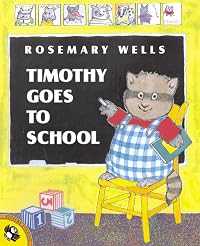
Rosemary Wells was born in New York City on January 29, 1943. She studied at the Museum School in Boston. Without her degree, she left school at the age of 19 to get married. She began her career in publishing, working as an art editor and designer first at Allyn and Bacon and later at Macmillan Publishing. She is an author and illustrator of over show more 60 books for children and young adults. Her first book was an illustrated edition of Gilbert and Sullivan's I Have a Song to Sing-O. Her other works include Martha's Birthday, The Fog Comes on Little Pig Feet, Unfortunately Harriet, Mary on Horseback, and Timothy Goes to School. She also created the characters of Max and Ruby, Noisy Nora, and Yoko, which are featured in some of her books. She has won numerous awards including a Children's Book Council Award for Noisy Nora in 1974, the Edgar Allan Poe award for two young adult books, Through the Looking Glass and When No One Was Looking, and the Boston Globe-Horn Book Award for Shy Charles. (Bowker Author Biography) show less
Awards and Honors
Common Knowledge
- People/Characters
- Shy Charles
Classifications
Statistics
- Members
- 581
- Popularity
- 50,762
- Reviews
- 20
- Rating
- (3.57)
- Languages
- English, French
- Media
- Paper
- ISBNs
- 24
- ASINs
- 3