On This Page
Description
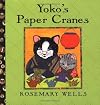
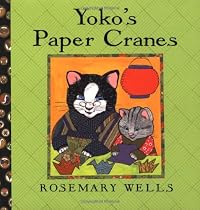
When Yoko moves from Japan to California, she decides to make and send origami swans to her grandmother for her birthday.Tags
Recommendations
Member Reviews
With beautiful imagery and a peaceful and thoughtful storyline, this book will show children the power of the emotional connection between a young girl and her heritage. Yoko’s family leaves Japan for the United States, but she keeps with her the knowledge of making paper cranes, and stays emotionally connected to her past by sending these cranes to her grandparents in Japan. This book is so sweet and powerful.
When Yoko was younger she lived in Japan near her grandmother and grandfather. Her grandmother taught her about the cranes in the garden and how they leave during winter but always return. She taught Yoko to fold an origami crane. Yoko grows older and moves to America. For her grandmother's birthday she makes three cranes and writes a card in Japanese saying, “Soon I will come back to Japan, just like the cranes.”
This beautifully illustrated book reflects Japanese origami and culture throughout. Many of the pictures and especially the clothes of Ojiisan and Obaasan (Japanese for grandfather and grandmother) look like collages of origami paper and gold leaf. I loved how the white space outside of the pictures also reflected the show more content of the story. Once it included small graphics of how to fold a paper crane and another time it showed the envelopes from letters that went back and forth between the continents
This would be a lovely story to incorporate for Grandparents Day. It shows how grandparents can teach us and also how we can show love back to them. A teacher could also have the students make some origami, although the crane may be too difficult depending on the age. To have the full effect, try to find patterned paper similar to what is in the book instead of the typical solid sheets. show less
This beautifully illustrated book reflects Japanese origami and culture throughout. Many of the pictures and especially the clothes of Ojiisan and Obaasan (Japanese for grandfather and grandmother) look like collages of origami paper and gold leaf. I loved how the white space outside of the pictures also reflected the show more content of the story. Once it included small graphics of how to fold a paper crane and another time it showed the envelopes from letters that went back and forth between the continents
This would be a lovely story to incorporate for Grandparents Day. It shows how grandparents can teach us and also how we can show love back to them. A teacher could also have the students make some origami, although the crane may be too difficult depending on the age. To have the full effect, try to find patterned paper similar to what is in the book instead of the typical solid sheets. show less
Yoko's Paper Cranes is a picture book about how Yoko's grandparents, Obaasan and Ojiisan, teach Yoko how to fold origami with beautiful paper. In Japan, the cranes fly away in winter and return in summer. When Yoko moves to the United States, she sends paper cranes to her grandparents as birthday gifts and tells them that she will return after the winter, just as the cranes do. It's a story about tradition, keeping in touch, and loves that spans oceans. I liked this book because children from many cultures can understand the bond between grandparent and grandchild yet the book gives insight into Japanese culture. Folding origami after reading the book to elementary children would be a good activity to bring the book to life.
"Yoko's Paper Cranes" is a touching story that was more effective at holding my interest than several of the books I have read. The major thing that kept my attention was the fact that the book was set in two countries on two continents. I found it interesting to see how the family maintained the same cultural identity in spite of the cultural demands and influences of their locales. The illustrations were also interesting in that they were constructed in the traditional Japanese style.
35 month - A short read but we really liked it. After making paper airplanes a few weeks ago with O she is very interested in folding paper. This was a great book that has sparked her interest to fold paper and use her imagination as to what it might become. I must learn to make paper cranes! The story touches on moving away from loved one, geography and appreciation for our loved ones.
This children's book is great for elementary students. It is a story about a cat name Yoko who recollects a story about her and grandmother. The story is about how her grandmother taught her how to fold origami paper cranes in the garden while she explained to her about how the cranes migrate during the winter but always return. In the present, Yoko is older and her family has moved from Japan to California. It is her grandmothers birthday and she decided to make three origami cranes for her grandmother with a card that says, “Soon I will come back to Japan, just like the cranes.”
This is a really touching storying that reminded me of my home and grandparents. This is a story I would use for Grandparents Day or a unit on family, show more culture, or compassion. This story would be good to use to teach elementary students how our grandparents can teach us a variety of things and that we can still show our love to them even if there are miles in-between. show less
This is a really touching storying that reminded me of my home and grandparents. This is a story I would use for Grandparents Day or a unit on family, show more culture, or compassion. This story would be good to use to teach elementary students how our grandparents can teach us a variety of things and that we can still show our love to them even if there are miles in-between. show less
Yoko is from Japan. She learned to make origami cranes from her grandparents. But Yoko moves to the States, and now has to rely on the mail to find out how her grandparents are doing. She decides to make them a present to remember their time together.
Members
- Recently Added By
Lists

FAB Pilot Books
15 works; 2 members
Author Information

264+ Works 36,049 Members
Rosemary Wells was born in New York City on January 29, 1943. She studied at the Museum School in Boston. Without her degree, she left school at the age of 19 to get married. She began her career in publishing, working as an art editor and designer first at Allyn and Bacon and later at Macmillan Publishing. She is an author and illustrator of over show more 60 books for children and young adults. Her first book was an illustrated edition of Gilbert and Sullivan's I Have a Song to Sing-O. Her other works include Martha's Birthday, The Fog Comes on Little Pig Feet, Unfortunately Harriet, Mary on Horseback, and Timothy Goes to School. She also created the characters of Max and Ruby, Noisy Nora, and Yoko, which are featured in some of her books. She has won numerous awards including a Children's Book Council Award for Noisy Nora in 1974, the Edgar Allan Poe award for two young adult books, Through the Looking Glass and When No One Was Looking, and the Boston Globe-Horn Book Award for Shy Charles. (Bowker Author Biography) show less
Awards and Honors
Series

Common Knowledge
- Original publication date
- 2001
- People/Characters
- Yoko [Rosemary Wells]; Obaasan; Ojiisan
- Important places
- Japan; America
- Dedication
- I wish to thank Johanna Hurley, my co-designer and Master Cutter of Japanese paper
- First words
- When Yoko was very small, she and her grandmother, Obaasan, fed the cranes in the pond at the end of the garden.
- Original language
- English
Classifications
Statistics
- Members
- 302
- Popularity
- 105,743
- Reviews
- 13
- Rating
- (3.88)
- Languages
- English
- Media
- Paper
- ISBNs
- 5
- UPCs
- 1
- ASINs
- 1