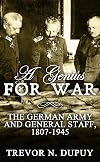
A genius for war: The German army and general staff, 1807-1945
by Trevor Nevitt Dupuy
On This Page
Description
"Presents the case that the key to German success in war lies not in some biological predisposition for battlefield success, not in adaptation to mindless regimentation, nor in fanatical devotion to leader or cause, but rather in the development and implementation of a unique, creative General Staff system which, by its very design and professionalism, was able to institutionalize excellence"--Jacket.Tags
Recommendations


































Member Reviews
Dupuy is a familiar name in the combat simulation and military history community. It was his analysis that first established that the German Army consistently outfought its opponents by about a factor of 1.3 to 1.5, a result now widely if sometimes reluctantly accepted by historians and military analysts. In this book, Dupuy presents his early theory (1977) to explain this phenomenon: The German General Staff was extraordinarily successful at institutionalizing military excellence.
Generals had had staffs before 1807, of course, but these minions were largely there to hold the general's coat and deliver messages for him -- the latter a responsibility of no small importance as armies grew in size. The success of Frederick the Great in show more holding off a powerful allied coalition in the late 18th century proved Frederick a military and political genius, but left Prussia with a problem: With no really defensible borders, one does not want to rely on the slim chance that one's kings will always be military geniuses.
This led two Prussian officers, Scharnhorst and Geneisenau, to work for a staff system that would institutionalize military excellence, overcoming any lack of genius in the top commander (presumably the king or another high noble). Their work gained impetus from the drubbing the Prussians got at the hands of Napoleon, who was undoubtedly just such a military genius. Ironically, as originally conceived by these rather liberal men, the sword they meant to construct was to be matched with an appropriate sheath -- control of the Army by a constitutional government. They got the sword; the sheath, not so much, with tragic consequences for the world.
The General Staff played a significant role in the success of Prussia in gathering the other German states into an empire, beginning with some spats with Denmark in which Austria, the other great German state, was a sometimes ally and sometimes foe. This was aided by Bismark, who was probably the greatest diplomat Germany has ever produced, and who managed to ensure that the budding young nation only had to fight one enemy at a time. The system gained further impetus from such technological advances as the needle rifle, adopted at about the time of the American Civil War. (The anecdote that Moltke the Elder, who led the staff at this time, regarded the American Civil War as unworthy of study because it was fought between armed mobs is almost certainly untrue; on the other hand, it is true that systematic study of the American Civil War was not part of the staff curriculum until shortly before the First World War.)
The General Staff really came into its own during the 1870 Franco-Prussian War, where the French got clobbered and William I had himself crowned Emperor of Germany in the Hall of Mirrors at Versailles. The Germans probably had slightly inferior equipment, but their troops were a bit better trained and, Dupuy claims, the real advantange was their excellent staff system.
World War I did not turn out well for the Germans, of course, but it was not for lack of military excellence. Moltke the Younger tinkered with the Schlieffen Plan and lost the Battle of the Marne, but Dupuy attributes this to military genius on the part of Foch, the French commander, less than lack of competence in Moltke; Moltke was a very competent officer, just not a Napoleon -- or a Foch. And, after all, the battle didn't win the war for the French. It merely kept the Germans from winning the war right then and there. Dupuy notes that the Germans continued to fight better than the Alies throughout the war; they were simply overwhelmed by numbers.
Same for World War II. Dupuy takes pains to make it clear he loathes the Nazis and despises the Wehrmacht for serving Hitler so well; he then talks at great length about how incredibly good the German Army was. Of course, the Allies from the first war had tried to gut the German Army by limiting its size to a pittance, denying it modern equipment, abolishing the General Staff, and requiring long enlistment so no reserves could be built up. This meant that, once Hitler outbluffed the former Allies in a performance that would not be again matched until Iran in 2015*, the Germans would rapidly equip themselves with the most modern arms (having few obsolete ones to discard), create a new General Staff out of the Troop Office (where it had been hiding all along -- abolishing the General Staff was an utterly silly and unenforceable demand), and have a corps of officers and officer candidates with many years' experience ready to step into higher billets.
At that, Hitler wanted the Army expanded faster than its officers liked; they managed to hold the line on requiring high standards for officers almost to the end of the war, but had to compromise on overall troop levels by creating an Army within the Army. The armored and mechanized forces were the "real" Army, which was small but mobile and very well trained; the vast numbers of men rapidly inducted and trained formed the rest of the Army, from which less was expected. But not much less; it's amazing how well the Germans did.
So was German military excellence really attributable to the General Staff? Not everyone has been convinced, since the book came out in 1977. Beevor insists that the Germans like soldiering a lot more than the Allies; there is some evidence of this. van Creveld thinks the Germans had far better unit cohesion, due to superior personnel policies; there is some evidence for this as well. Hastings thinks political indoctrination and resulting morale were more important that Dupuy gave them credit for; there's evidence for this as well. It cannot hurt that serving in the military was always a prestigious thing in modern Germany; Dupuy notes this but glosses over it with inadequate explanation. Contrast this with the view in other countries (such as the U.S., where in the 1920s officers in Washington, D.C., were ashamed to wear their uniforms to work) and it's hard to imagine it wasn't important.
Still, a lot of interesting history and though-provoking analysis. show less
Generals had had staffs before 1807, of course, but these minions were largely there to hold the general's coat and deliver messages for him -- the latter a responsibility of no small importance as armies grew in size. The success of Frederick the Great in show more holding off a powerful allied coalition in the late 18th century proved Frederick a military and political genius, but left Prussia with a problem: With no really defensible borders, one does not want to rely on the slim chance that one's kings will always be military geniuses.
This led two Prussian officers, Scharnhorst and Geneisenau, to work for a staff system that would institutionalize military excellence, overcoming any lack of genius in the top commander (presumably the king or another high noble). Their work gained impetus from the drubbing the Prussians got at the hands of Napoleon, who was undoubtedly just such a military genius. Ironically, as originally conceived by these rather liberal men, the sword they meant to construct was to be matched with an appropriate sheath -- control of the Army by a constitutional government. They got the sword; the sheath, not so much, with tragic consequences for the world.
The General Staff played a significant role in the success of Prussia in gathering the other German states into an empire, beginning with some spats with Denmark in which Austria, the other great German state, was a sometimes ally and sometimes foe. This was aided by Bismark, who was probably the greatest diplomat Germany has ever produced, and who managed to ensure that the budding young nation only had to fight one enemy at a time. The system gained further impetus from such technological advances as the needle rifle, adopted at about the time of the American Civil War. (The anecdote that Moltke the Elder, who led the staff at this time, regarded the American Civil War as unworthy of study because it was fought between armed mobs is almost certainly untrue; on the other hand, it is true that systematic study of the American Civil War was not part of the staff curriculum until shortly before the First World War.)
The General Staff really came into its own during the 1870 Franco-Prussian War, where the French got clobbered and William I had himself crowned Emperor of Germany in the Hall of Mirrors at Versailles. The Germans probably had slightly inferior equipment, but their troops were a bit better trained and, Dupuy claims, the real advantange was their excellent staff system.
World War I did not turn out well for the Germans, of course, but it was not for lack of military excellence. Moltke the Younger tinkered with the Schlieffen Plan and lost the Battle of the Marne, but Dupuy attributes this to military genius on the part of Foch, the French commander, less than lack of competence in Moltke; Moltke was a very competent officer, just not a Napoleon -- or a Foch. And, after all, the battle didn't win the war for the French. It merely kept the Germans from winning the war right then and there. Dupuy notes that the Germans continued to fight better than the Alies throughout the war; they were simply overwhelmed by numbers.
Same for World War II. Dupuy takes pains to make it clear he loathes the Nazis and despises the Wehrmacht for serving Hitler so well; he then talks at great length about how incredibly good the German Army was. Of course, the Allies from the first war had tried to gut the German Army by limiting its size to a pittance, denying it modern equipment, abolishing the General Staff, and requiring long enlistment so no reserves could be built up. This meant that, once Hitler outbluffed the former Allies in a performance that would not be again matched until Iran in 2015*, the Germans would rapidly equip themselves with the most modern arms (having few obsolete ones to discard), create a new General Staff out of the Troop Office (where it had been hiding all along -- abolishing the General Staff was an utterly silly and unenforceable demand), and have a corps of officers and officer candidates with many years' experience ready to step into higher billets.
At that, Hitler wanted the Army expanded faster than its officers liked; they managed to hold the line on requiring high standards for officers almost to the end of the war, but had to compromise on overall troop levels by creating an Army within the Army. The armored and mechanized forces were the "real" Army, which was small but mobile and very well trained; the vast numbers of men rapidly inducted and trained formed the rest of the Army, from which less was expected. But not much less; it's amazing how well the Germans did.
So was German military excellence really attributable to the General Staff? Not everyone has been convinced, since the book came out in 1977. Beevor insists that the Germans like soldiering a lot more than the Allies; there is some evidence of this. van Creveld thinks the Germans had far better unit cohesion, due to superior personnel policies; there is some evidence for this as well. Hastings thinks political indoctrination and resulting morale were more important that Dupuy gave them credit for; there's evidence for this as well. It cannot hurt that serving in the military was always a prestigious thing in modern Germany; Dupuy notes this but glosses over it with inadequate explanation. Contrast this with the view in other countries (such as the U.S., where in the 1920s officers in Washington, D.C., were ashamed to wear their uniforms to work) and it's hard to imagine it wasn't important.
Still, a lot of interesting history and though-provoking analysis. show less
Ratings
Members
- Recently Added By
Lists

All Things Germany
321 works; 4 members
Author Information

105 Works 3,279 Members
Common Knowledge
- Original publication date
- 1977
- People/Characters
- Karl von Clausewitz; Adolf Hitler
- Important places
- Germany
- Dedication*
- This book is affectionately dedicated to my son, Charles
- First words*
- The year 1944 was one of almost unending disaster for Germany , The greatest and most damaging physical and psychological impact on the German people and on their leadership was the result of the hammering that came from the ... (show all)air.
- Last words*
- (Click to show. Warning: May contain spoilers.)Yet in the light of the historical facts, and in the light of the Soviet reaction to at least some of those historical facts, it would be dangerous for the United States to continue blithely to ignore either the current Soviet example or that of the German General Staff, which for more than a century, on many a bloody field repeatedly demonstrated its special genius of war.
- Original language
- English
*Some information comes from Common Knowledge in other languages. Click "Edit" for more information.
Classifications
- Genres
- Nonfiction, History, General Nonfiction
- DDC/MDS
- 355.3 — Society, government, & culture Public administration & military science The Military - Land, Air & Sea / Warfare Organization and personnel of military forces
- LCC
- DD103 .D86 — History of Europe, Asia, Africa and Oceania Germany History of Germany History Military, naval, and political history. Foreign relations
Statistics
- Members
- 167
- Popularity
- 196,524
- Reviews
- 1
- Rating
- (3.83)
- Languages
- English, German
- Media
- Paper, Ebook
- ISBNs
- 7
- ASINs
- 3