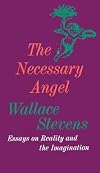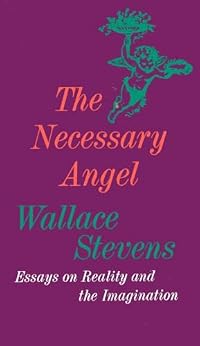
The Necessary Angel: Essays on Reality and the Imagination
by Wallace Stevens
On This Page
Description
In this collection of essays, consummate poet Wallace Stevens reflects upon his art. His aim is not to produce a work of criticism or philosophy, or a mere discussion of poetic technique. As he explains in his introduction, his ambition in these various pieces, published in different times and places, aimed higher than that, in the direction of disclosing "poetry itself, the naked poem, the imagination manifesting itself in its domination of words." Stevens proves himself as eloquent show more and scintillating in prose as in poetry, as he both analyzes and demonstrates the essential act of repossessing reality through the imagination. show lessTags
Recommendations








Member Reviews
This is one of those great books where almost every sentence is so essential to the overall argument that once you've stepped away from the actual business of reading, it's hard to express in any quick or easy way what you've just been immersed in.* This probably means, of course, that I'll have to keep going back to it from time to time—and the thickness of the essays makes sense, give the fact that Stevens was, after all, a poet.
*(Note that this quality also makes it difficult to provide a quantitative rating, which is in no way a bad thing.)
*(Note that this quality also makes it difficult to provide a quantitative rating, which is in no way a bad thing.)
Talking of poetry is a kind of poetry, and Wallace Stevens does his best to assert that. Being a man known for his dense and wildly imaginative poetry, his prose is no different. In the seven essays collected here, he winds a path through reality, imagination, poetry, philosophy, and religion. Along the way, we get a momentary glimmer of his views on the Bible, communism, and the state of literature and art in his day. How any man could be this linguistically and philosophically limber and still work as the vice president of an insurance company is beyond me. The casual reader must be warned, though, that this book, although slim, is jam-packed and will take a steady mind to get through.
Wallace Stevens was an American Modernist Poet who died in 1955. He spent most of his life working as an executive for an insurance company. Knowing this it is perhaps not a surprise that one of the major themes in his poems and essays was harnessing both imagination and realism in his work.
The collection of essays that make up The Necessary Angel was published in 1951 and that was why I became interested to read them. I had come across one or two of his poems in various anthologies of American poetry, but could not remember anything about them. This is the only collection of essays published during Stevens' lifetime and its subject matter unsurprisingly is poetry and what he is looking to find in both his own poems and those of his show more contemporaries. The first essay The Noble Rider and the Sound of Words spends much ink in defining what he means by imagination and reality. Imagination is an essential requirement for a poet and in Stevens opinion the best poetry shows an interdependence of the imagination and reality as equals. Imagination is the power that enables us [the reader) to perceive the normal in the abnormal. He uses a quote from the modernist painter Georges Braque to clarify his point in an essay that critiques one of Marrion Moore's poems.
"The senses deform the mind reforms"
The quote from Braque may well serve as a way of looking at Braque's cubist paintings. but perhaps it is a bit more difficult to apply this to words on a page, but I can see what he is getting at.
These essays somewhat academic in tone can spring to life on occasions take this for example:
"Men feel that the imagination is the next greatest power to faith: the reigning prince. Consequently their interest in the imagination and its work is to be regarded not as a phase of humanism but as a vital self-assertion in a world in which nothing but the self remains, if that remains."
The most approachable essay for me in this collection is one where he compared the art of painting to that of writing and reading poetry. Perhaps I should let one of Steven's own poems anthologised in The Faber Book of Modern Verse speak for him/itself.
NOT IDEAS ABOUT THE THING BUT THE THING ITSELF
At the earliest ending of winter,
In March, a scrawny cry from outside
Seemed like a sound in his mind.
He knew that he heard it,
A bird's cry at daylight or before,
In the early March wind.
The sun was rising at six,
No longer a battered panache above snow.....
It would have been outside.
It was not from the vast ventriloquism
Of sleeps faded paper-mâché....
The sun was coming from outside.
That scrawny cry - it was
A chorister whose c preceded the choir.
It was part of the colossal sun,
Surrounded by its choral rings,
Still far away. It was like
A new knowledge of reality.
I would never have come across this collection of essays had I not been fixated in reading books published in 1951. They are for me; not essential in any stretch of the imagination, but I did find enough of interest to keep me reading. 3 stars. show less
The collection of essays that make up The Necessary Angel was published in 1951 and that was why I became interested to read them. I had come across one or two of his poems in various anthologies of American poetry, but could not remember anything about them. This is the only collection of essays published during Stevens' lifetime and its subject matter unsurprisingly is poetry and what he is looking to find in both his own poems and those of his show more contemporaries. The first essay The Noble Rider and the Sound of Words spends much ink in defining what he means by imagination and reality. Imagination is an essential requirement for a poet and in Stevens opinion the best poetry shows an interdependence of the imagination and reality as equals. Imagination is the power that enables us [the reader) to perceive the normal in the abnormal. He uses a quote from the modernist painter Georges Braque to clarify his point in an essay that critiques one of Marrion Moore's poems.
"The senses deform the mind reforms"
The quote from Braque may well serve as a way of looking at Braque's cubist paintings. but perhaps it is a bit more difficult to apply this to words on a page, but I can see what he is getting at.
These essays somewhat academic in tone can spring to life on occasions take this for example:
"Men feel that the imagination is the next greatest power to faith: the reigning prince. Consequently their interest in the imagination and its work is to be regarded not as a phase of humanism but as a vital self-assertion in a world in which nothing but the self remains, if that remains."
The most approachable essay for me in this collection is one where he compared the art of painting to that of writing and reading poetry. Perhaps I should let one of Steven's own poems anthologised in The Faber Book of Modern Verse speak for him/itself.
NOT IDEAS ABOUT THE THING BUT THE THING ITSELF
At the earliest ending of winter,
In March, a scrawny cry from outside
Seemed like a sound in his mind.
He knew that he heard it,
A bird's cry at daylight or before,
In the early March wind.
The sun was rising at six,
No longer a battered panache above snow.....
It would have been outside.
It was not from the vast ventriloquism
Of sleeps faded paper-mâché....
The sun was coming from outside.
That scrawny cry - it was
A chorister whose c preceded the choir.
It was part of the colossal sun,
Surrounded by its choral rings,
Still far away. It was like
A new knowledge of reality.
I would never have come across this collection of essays had I not been fixated in reading books published in 1951. They are for me; not essential in any stretch of the imagination, but I did find enough of interest to keep me reading. 3 stars. show less
This selection of essays represents Stevens's thought about the craft and meaning of poetry. Based primarily on talks that he gave over a period of years the essays are informative while also being difficult and problematical at times. In their difficulty they mirror much of his poetry.
Stevens controverts the notion that the imagination is a counterpoint to reality and instead insists that the two are in essential interplay:
Stevens controverts the notion that the imagination is a counterpoint to reality and instead insists that the two are in essential interplay:
Not an easy read; this poet's prose is leaden compared to his verse, but it is worth the work for the brilliant ideas embedded in the rhetoric.
A rich essay on the power of imagination, with many relevant observations both for the poet and the philosopher.
Ratings
Members
- Recently Added By
Lists

Harold Bloom - The Western Canon: D. The Chaotic Age
833 works; 24 members

Modernism
140 works; 8 members
Author Information

107+ Works 6,393 Members
Series
Belongs to Publisher Series
Common Knowledge
- Canonical title
- The Necessary Angel: Essays on Reality and the Imagination
- Original publication date
- 1942
- Epigraph
- ... I am the necessary angel of earth,Since, in my sight, you see the earth again. - The Auroras of Autumn
- First words
- One function of the poet at any time is to discover by his own thought and feeling what seems to him to be poetry at that time.
Classifications
Statistics
- Members
- 538
- Popularity
- 55,121
- Reviews
- 6
- Rating
- (3.82)
- Languages
- English, French, Italian
- Media
- Paper, Ebook
- ISBNs
- 5
- ASINs
- 8