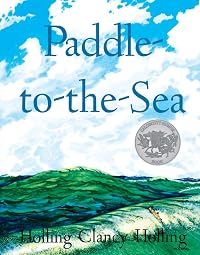
Paddle-to-the-Sea
by Holling C. Holling
On This Page
Description
A young Indian boy from Nipigon country in the Canadian wilderness carves a twelve-inch canoe with a kneeling Indian figure and frees it to undertake a journey to the Atlantic Ocean in his place. He must stay home and help his father but yearns to learn about the world beyond his life in the village. Four years later this tiny vessel reaches its destination, ending a journey fraught with danger, excitement, and beauty.Taking the listener through the Great Lakes to the Atlantic Ocean, Holling show more Clancy Holling gives us a treasure chest of geography and natural science wrapped in an unforgettably beautiful story. This timeless award-winning book has been a favorite of families for over sixty years. show lessTags
Recommendations









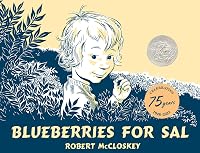
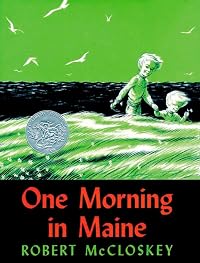


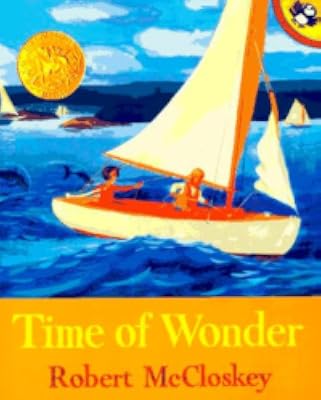





Member Recommendations
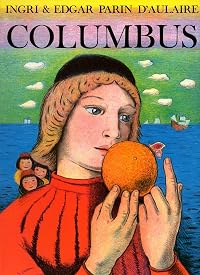
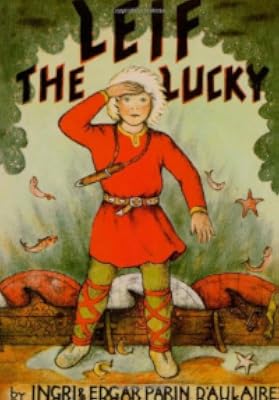
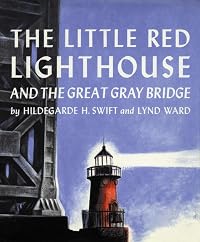
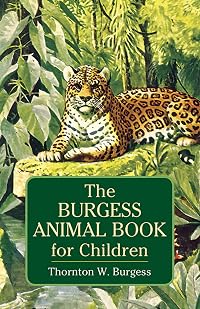
Sandydog1 Both are long Hollings childrens book, of epic voyages and interesting characters.
Member Reviews
In twenty-seven brief "chapters" - each of which consists of a single page of text, decorated with black and white illustrations, and paired with a full-page color painting - Holling Clancy Holling sets out the story of "Paddle-to-the-Sea," a miniature wooden canoe carved by a young Indian boy in Nipigon country, Canada, and then sent out on a long journey toward the sea. As the canoe travels on its way, it journeys through all five of the Great Lakes, with detours and unexpected stops along the way, passing through many hands, and experiencing many years of adventure before eventually finding its way out the St. Lawrence River, and eventually, into the open sea.
An unexpectedly moving book, Paddle-to-the-Sea is both educational and show more engrossing, taking young readers on a geographic tour of the Great Lakes region of North America, from the rural Canadian wilderness north of Lake Superior, through all the various interconnected waterways - Lakes Superior, Michigan, Huron, Eerie, Ontario, and the rivers which connect them - and finally to the sea, while also presenting the many human activities, from farming to heavy industry, that surround these important bodies of water. Chosen as a Caldecott Honor Book in 1942, it has a great deal of visual appeal, particularly the full-color, full-page paintings. One especially nice detail is the comparison of the shape of each lake to some figure or object - I never noticed that Lake Superior looks like a wolf's head, Lake Michigan like a squash, or Lake Huron like a trapper with his pack upon his back!
I was a little afraid, going in, that the depiction of the Indian boy who created Paddle-to-the-Sea would be egregiously racist (as is so often the case, with vintage children's books including Native American themes), but although there is certainly an element of the "mystically spiritual Indian guide" in his depiction (and some rather choppy statements, that could be interpreted as stereotypical "Indian" speech), I think there is also just a healthy does of curious and creative boyhood in him. Fanciful though it may be, I found myself thinking, while reading this story, that the release of Paddle-to-the-Sea, and his subsequent journey, could be interpreted as a metaphor for our words and actions - how they go out into the world, and affect the people around us; and how, if crafted with care, they might do great things, and connect us to people far away.
It's that sense of connection, that Paddle-to-the-Sea brings, between disparate peoples in far-flung places, that most moved me in Holling's book, and led to my four-star rating. This is an advanced picture-book, so I would only recommend it to upper elementary school students and above, who are capable of reading more extended texts. I would also only recommend it with the caveat that the depiction of the Indian boy, although not egregiously offensive in my estimation, might still feel condescending to some, and be problematic for them. With that caveat understood, I'd say this makes a lovely introduction to the geography of the Great Lakes region, some fifty years ago, and still, to a great extend, today. show less
An unexpectedly moving book, Paddle-to-the-Sea is both educational and show more engrossing, taking young readers on a geographic tour of the Great Lakes region of North America, from the rural Canadian wilderness north of Lake Superior, through all the various interconnected waterways - Lakes Superior, Michigan, Huron, Eerie, Ontario, and the rivers which connect them - and finally to the sea, while also presenting the many human activities, from farming to heavy industry, that surround these important bodies of water. Chosen as a Caldecott Honor Book in 1942, it has a great deal of visual appeal, particularly the full-color, full-page paintings. One especially nice detail is the comparison of the shape of each lake to some figure or object - I never noticed that Lake Superior looks like a wolf's head, Lake Michigan like a squash, or Lake Huron like a trapper with his pack upon his back!
I was a little afraid, going in, that the depiction of the Indian boy who created Paddle-to-the-Sea would be egregiously racist (as is so often the case, with vintage children's books including Native American themes), but although there is certainly an element of the "mystically spiritual Indian guide" in his depiction (and some rather choppy statements, that could be interpreted as stereotypical "Indian" speech), I think there is also just a healthy does of curious and creative boyhood in him. Fanciful though it may be, I found myself thinking, while reading this story, that the release of Paddle-to-the-Sea, and his subsequent journey, could be interpreted as a metaphor for our words and actions - how they go out into the world, and affect the people around us; and how, if crafted with care, they might do great things, and connect us to people far away.
It's that sense of connection, that Paddle-to-the-Sea brings, between disparate peoples in far-flung places, that most moved me in Holling's book, and led to my four-star rating. This is an advanced picture-book, so I would only recommend it to upper elementary school students and above, who are capable of reading more extended texts. I would also only recommend it with the caveat that the depiction of the Indian boy, although not egregiously offensive in my estimation, might still feel condescending to some, and be problematic for them. With that caveat understood, I'd say this makes a lovely introduction to the geography of the Great Lakes region, some fifty years ago, and still, to a great extend, today. show less
Perhaps the living-est of living books. Not only is the story engaging and charming, each page is full of information about the Great Lakes, the cities that line their shores, and the commerce that is so vital to many of those cities, not to mention the natural world that is also present here. None of it is boring (at least not to nerdy parents, but my 5yo also seemed engaged in each page).
I wouldn’t try to finish it in one sitting, there’s so much to look at and enjoy on each page that 2-3 chapters (pages) at a time is good.
I wouldn’t try to finish it in one sitting, there’s so much to look at and enjoy on each page that 2-3 chapters (pages) at a time is good.
I found this book the day before Bay Books, an independent bookseller, closed its doors in Concord, California. Perhaps I should say that the book found me. Why would I buy a children's book? It must have been the local book dragon whispering in my ear, for I am grateful for this great find.
The author takes us on a trip that starts in the great northern wastes of Canada, and we follow the carved toy through the wilderness and down in to the Great Lakes of the States. Along the way, we find out what the inside of a sawmill looked like and how Lake Superior resembles a wolf's head. Yes, a wolf's head.
If the kids want to have more read to them, tell them to go to sleep so you can read the book yourself in peace and quiet. It was sad to show more see yet another local bookstore leave us, but it brought me great happiness with my last purchase.
Book Season = Autumn show less
The author takes us on a trip that starts in the great northern wastes of Canada, and we follow the carved toy through the wilderness and down in to the Great Lakes of the States. Along the way, we find out what the inside of a sawmill looked like and how Lake Superior resembles a wolf's head. Yes, a wolf's head.
If the kids want to have more read to them, tell them to go to sleep so you can read the book yourself in peace and quiet. It was sad to show more see yet another local bookstore leave us, but it brought me great happiness with my last purchase.
Book Season = Autumn show less
A young Indian boy carves a little canoe with a figure inside and names him Paddle-to-the-Sea. Paddle's journey, in text and pictures, through the Great Lakes to the Atlantic Ocean provides an excellent geographic and historical picture of the region.
A carved Native American figurine-Paddle-to-the-Sea--makes his voyage from an Indian village through the Great Lakes to the Atlantic Ocean. Beautiful illustrations and great geography. A true living textbook.
49 months - I really enjoyed reading this with my daughter. I was expecting it to be about a real person paddling the Great Lakes but this idea is much more creative. A great geography lesson and lots of other learning too. Great vocabulary about nature. It would be fantastic to have a newer version of this book with more vivid colors in the illustrations. The art style is very much Group of Seven-esque. A good story to introduce my little dual citizen to natural connection and resources the two countries share.
An incredible journey of a figure in a toy canoe finding it's way to the ocean. A lot of American geography, history and nature components are beautifully illustrated.
Members
- Recently Added By
Published Reviews
ThingScore 50
A young American Indian boy (no tribe indicated) carves a small canoe with a seated figure to paddle it and sends the two off on a journey from Lake Superior to the Atlantic Ocean. … This is the story of Paddle-to-the-Sea's many adventures over the four years it takes him to reach the sea. No information on American Indians in contained in the story.
added by CourtyardSchool
Lists

Caldecott Honor Books
296 works; 22 members

Favorite Childhood Books
1,651 works; 519 members

Top-Rated Children's Books
87 works; 16 members

Elevenses
316 works; 88 members
Ambleside Books
459 works; 18 members

Sonlight Books
1,487 works; 25 members
Honey For a Child's Heart
1,152 works; 25 members

Brightly Beaming Curriculum Books
281 works; 7 members

Toy Stories: Living Dolls, Bears and Other Toys
129 works; 7 members

Tour of Michigan
2 works; 1 member

Northern Exposure's Chris in the Morning Reading List
31 works; 1 member

CCE 1000 Good Books List
1,033 works; 12 members

Romalda Spalding's Writing Road To Reading
213 works; 3 members

Books Set in Canada
57 works; 10 members

Before Austen Comes Aesop
318 works; 9 members

Beautiful Feet Books
304 works; 7 members

Recommended Reading List
219 works; 1 member
Favorite Picture Books
479 works; 160 members

Books We Loved As Children
603 works; 253 members
Author Information

21+ Works 13,181 Members
Awards and Honors
Awards
Work Relationships
Has the adaptation
Common Knowledge
- Canonical title
- Paddle-to-the-Sea
- Original publication date
- 1941
- Important places
- Canada; Lake Nipigon, Ontario, Canada; St. Lawrence River; Lake Superior; Thunder Bay, Ontario, Canada; Sault Ste. Marie, Ontario, Canada
- Related movies
- Paddle to the Sea (1966 | IMDb)
- Dedication
- John Henry Chapman with whose father I have paddled under, over, and through many a Great Lake wave.
- First words
- The Canadian wilderness was white with snow.
- Last words
- (Click to show. Warning: May contain spoilers.)' You, Little Traveler! You made the journey, the Long Journey. You now know the things I have yet to know. You, Little Traveler! You were given a name, a true name in my father's lodge. Good Medicine, Little Traveler! You are truly a Paddle Person, a Paddle-to-the-Sea!'
Classifications
Statistics
- Members
- 4,106
- Popularity
- 3,777
- Reviews
- 30
- Rating
- (4.38)
- Languages
- English
- Media
- Paper, Audiobook, Ebook
- ISBNs
- 24
- UPCs
- 4
- ASINs
- 24