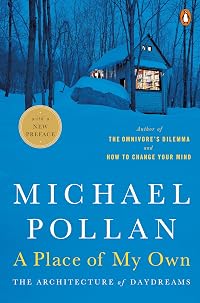
A Place of My Own: The Architecture of Daydreams
by Michael Pollan
On This Page
Description
A captivating personal inquiry into the art of architecture, the craft of building, and the meaning of modern work"A room of one's own: Is there anybody who hasn't at one time or another wished for such a place, hasn't turned those soft words over until they'd assumed a habitable shape?"
When Michael Pollan decided to plant a garden, the result was the acclaimed bestseller Second Nature. In A Place of My Own, he turns his sharp insight to the craft of building, as he recounts the process of show more designing and constructing a small one-room structure on his rural Connecticut property—a place in which he hoped to read, write, and daydream, built with his own two unhandy hands.
Invoking the titans of architecture, literature, and philosophy, from Vitruvius to Thoreau, from the Chinese masters of feng shui to the revolutionary Frank Lloyd Wright, Pollan brilliantly chronicles a realm of blueprints, joints, and trusses as he peers into the ephemeral nature of "houseness" itself. From the spark of an idea to the search for a perfect site to the raising of a ridgepole, Pollan revels in the infinitely detailed, complex process of creating a finished structure. At once superbly written, informative, and enormously entertaining, A Place of My Own is for anyone who has ever wondered how the walls around us take shape—and how we might shape them ourselves.
Praise for A Place of My Own
"A glorious piece of prose . . . Pollan leads readers on his adventure with humor and grace."—Chicago Tribune
"[Pollan] alternates between describing the building process and introducing informative asides on various aspects of construction. These explanations are deftly and economically supplied. Pollan's beginner status serves him well, for he asks the kind of obvious questions about building that most readers will want answered." —The New York Review of Books
"By shrewdly combining just the right mix of personal reflection, architectural background, and nuts-and-bolts detail, Michael Pollan enables us to see, feel, and understand what goes into the building of a house. The result is a captivating and informative adventure."—John Berendt, author of Midnight in the Garden of Good and Evil
"An utterly terrific book . . . an inspired meditation on the complex relationship between space, the human body and the human spirit."—Francine du Plessix Gray
"A tour de force . . . [Pollan] writes gracefully and humanely. He is a true carpenter-craftsman of prose."—Phillip Lopate. show less
Tags
Recommendations

























Member Reviews
I first came across the work of Michael Pollan while a student at the Farm School, in the Fall of 2008. “The Omnivore’s Dilemma” was one of our assigned readings, and I remember reading this text late into the night up in my little loft in the dormitory. Pollan goes about his journalism with an often-comical amateurism (I regularly find myself laughing as I read his prose). And yet, with his Zen “beginner’s mind” and poetic attention to detail, as well as viscously restrained editing (all of his books span a tightly curated quiver of topics, and are never more than a few hundred pages in length), Pollan always manages to get to the depth at which true meaning can be created and explored.
While reading Tedd Benson’s show more “Timberframe” I kept coming across quotes from a mysterious Pollan text: “A Place of My Own.” “But isn’t Pollan a food writer?” I thought to myself. My second book I read from Pollan was his recent text on psychedelics, “How to Change Your Mind.” I think of him as the foodie Berkeley type (I happen to have run into him last time I was at the Berkeley farmer’s market); what was he doing writing about architecture?
It turns out that Pollan’s second book, published in 1997, reveals an entirely different man (or at least a man in an entirely different context) then we find him in today. Apparently Pollan, his wife, and son, spent quite some time (more than a decade) living in Northwestern Connecticut. Being a ruddy New Englander myself, this rather raises my regard of him (until I think remember that he, for some reason, still resides in Berkeley—even while supposedly teaching at Harvard).
For a couple of years now, I’ve been daydreaming about building a sauna. Two winters ago I read a book on sauna construction. I live on land that is “in the family,” so to say, so I have enough trust in my tenure to consider building something. The place also is an open timber frame spanning three generations; so Pollan’s concept of “a place of my own” sounds extremely appealing.
During this time of coronavirus, I feel both a strong sense of nostalgia, as well as a sense of somehow being outside of my life. Given this coincidence of sentiments, I’ve been gravitating towards books like this one, books that bring us into ourselves while bringing us in contact with the tangible, the commonplace.
This is a book about Pollan going through the two-and-a-half-year-long process of building himself a writer’s cabin.
From the beginning, Pollan goes about this in a very different way than I would. Pollan says the only thing his father ever built was a cedar closet, during the construction of which, he happened to nail his toolbox back behind the paneling. In contrast, my father timber-framed the house I grew up in, and I’ve spent much of my life in contact with one form or another of craft.
So to come around to the first surprise: Pollan hired an architect to come up with a plan for his cabin! Although I intended to become an architect for some stretch of time in childhood (I still retain the graph-paper blueprints I made of glass dome houses), I’ve had effectively zero contact with them in my adult life. We recently constructed a substantial porch on my current home, and our contractor drew up the blueprint, not an architect. I can appreciate the importance of design process (I would consider myself a permaculturist), and I can see the ways that working with an architect enabled Pollan to achieve something he wouldn’t have been able to on his own.
The next surprise: he hires a contractor to work with him! This also ends up being a wise decision for Pollan, as his contractor serves as a mentor.
In the new foreword, composed in 2010, Pollan describes his journalism as muddling through the relationship between nature and culture. This is an intersection close to my heart. In this book, Pollan has somehow been able to explore the exceedingly obtuse history of architecture and private space in a text that is both tactile and accessible. With writing this good, I feel as though I could almost read anything Pollan decides to write about. He is likely the best non-fiction writer of which I’m aware.
By no means is this book dated. In many ways, it speaks to more fundamental truths than his writing on food and psychedelics. If you’re looking for a meditative reflection on space, the built environment, and the way that this all relates to our humanity and sensory experience, this book will delight. show less
While reading Tedd Benson’s show more “Timberframe” I kept coming across quotes from a mysterious Pollan text: “A Place of My Own.” “But isn’t Pollan a food writer?” I thought to myself. My second book I read from Pollan was his recent text on psychedelics, “How to Change Your Mind.” I think of him as the foodie Berkeley type (I happen to have run into him last time I was at the Berkeley farmer’s market); what was he doing writing about architecture?
It turns out that Pollan’s second book, published in 1997, reveals an entirely different man (or at least a man in an entirely different context) then we find him in today. Apparently Pollan, his wife, and son, spent quite some time (more than a decade) living in Northwestern Connecticut. Being a ruddy New Englander myself, this rather raises my regard of him (until I think remember that he, for some reason, still resides in Berkeley—even while supposedly teaching at Harvard).
For a couple of years now, I’ve been daydreaming about building a sauna. Two winters ago I read a book on sauna construction. I live on land that is “in the family,” so to say, so I have enough trust in my tenure to consider building something. The place also is an open timber frame spanning three generations; so Pollan’s concept of “a place of my own” sounds extremely appealing.
During this time of coronavirus, I feel both a strong sense of nostalgia, as well as a sense of somehow being outside of my life. Given this coincidence of sentiments, I’ve been gravitating towards books like this one, books that bring us into ourselves while bringing us in contact with the tangible, the commonplace.
This is a book about Pollan going through the two-and-a-half-year-long process of building himself a writer’s cabin.
From the beginning, Pollan goes about this in a very different way than I would. Pollan says the only thing his father ever built was a cedar closet, during the construction of which, he happened to nail his toolbox back behind the paneling. In contrast, my father timber-framed the house I grew up in, and I’ve spent much of my life in contact with one form or another of craft.
So to come around to the first surprise: Pollan hired an architect to come up with a plan for his cabin! Although I intended to become an architect for some stretch of time in childhood (I still retain the graph-paper blueprints I made of glass dome houses), I’ve had effectively zero contact with them in my adult life. We recently constructed a substantial porch on my current home, and our contractor drew up the blueprint, not an architect. I can appreciate the importance of design process (I would consider myself a permaculturist), and I can see the ways that working with an architect enabled Pollan to achieve something he wouldn’t have been able to on his own.
The next surprise: he hires a contractor to work with him! This also ends up being a wise decision for Pollan, as his contractor serves as a mentor.
In the new foreword, composed in 2010, Pollan describes his journalism as muddling through the relationship between nature and culture. This is an intersection close to my heart. In this book, Pollan has somehow been able to explore the exceedingly obtuse history of architecture and private space in a text that is both tactile and accessible. With writing this good, I feel as though I could almost read anything Pollan decides to write about. He is likely the best non-fiction writer of which I’m aware.
By no means is this book dated. In many ways, it speaks to more fundamental truths than his writing on food and psychedelics. If you’re looking for a meditative reflection on space, the built environment, and the way that this all relates to our humanity and sensory experience, this book will delight. show less
Michael Pollan’s second book is chronicled in this, his search for a writing refuge. What’s it about? Getting up from the desk and doing physical labor, architecture, history, design, writing, family, woodworking, honesty, weather, accomplishments, philosophy, craft and writing-the-second-book. For a start.
This is a leisurely read, a slow one, to be savored. Extensive chapter endnotes and a bibliography of the many books mentioned are part of the backmatter, and much appreciated for those of us who want to explore more.
The story begins with the pending arrival of a first baby: the recently remodeled home Judith and Michael Pollan share will be too small to accommodate his writing area, her art studio and a nursery. They had a good show more experience with the architect (even though the delays and finances of remodeling are topics he ‘still won’t discuss’) so he’s engaged to draw up plans for a writing shed.
He recalls the discussions in detail, the back-and-forth of getting to a design that works on the site, that works in a practical way, and that pleases aesthetically. The architect’s character is drawn so well that I feel I know him. The same happens later with the builder, and the battles between those two are constant.
This might seem like a straightforward story – idea, design, build it – but in the telling of the tale, Pollan takes us on a journey through history. He’s a self-described researcher (I could relate to this immediately), someone who turns to books or articles when presented with a question. So he reads in that meandering way one does, getting lost in research and discovery, one volume mentioning another thinker or designer, then that person’s work must be investigated. Pollan shares all of this. An example of how he thinks:
Daydreaming does not enjoy tremendous prestige in our culture, which tends to regard it as unproductive thought. Writers perhaps appreciate its importance better than most, since a fair amount of what they call work consists of little more than daydreaming edited. Yet anyone who reads for pleasure should prize it too, for what is reading a good book but a daydream at second hand? Unlike any other form of thought, daydreaming is its own reward. For regardless of the result (if any), the very process of daydreaming is pleasurable. And, I would guess, is probably a psychological necessity. For isn’t it in our daydreams that we acquire some sense of what we are about?
If I found the first part of the book slow-going, it was because I didn’t accept his rhythm. Once I figured it out and settled in, I thoroughly enjoyed the ride. It’s not an action story, and if that’s what you want, then stay away from this book.
On the other hand, if you like to wonder, ponder and imagine, then this is for you. show less
This is a leisurely read, a slow one, to be savored. Extensive chapter endnotes and a bibliography of the many books mentioned are part of the backmatter, and much appreciated for those of us who want to explore more.
The story begins with the pending arrival of a first baby: the recently remodeled home Judith and Michael Pollan share will be too small to accommodate his writing area, her art studio and a nursery. They had a good show more experience with the architect (even though the delays and finances of remodeling are topics he ‘still won’t discuss’) so he’s engaged to draw up plans for a writing shed.
He recalls the discussions in detail, the back-and-forth of getting to a design that works on the site, that works in a practical way, and that pleases aesthetically. The architect’s character is drawn so well that I feel I know him. The same happens later with the builder, and the battles between those two are constant.
This might seem like a straightforward story – idea, design, build it – but in the telling of the tale, Pollan takes us on a journey through history. He’s a self-described researcher (I could relate to this immediately), someone who turns to books or articles when presented with a question. So he reads in that meandering way one does, getting lost in research and discovery, one volume mentioning another thinker or designer, then that person’s work must be investigated. Pollan shares all of this. An example of how he thinks:
Daydreaming does not enjoy tremendous prestige in our culture, which tends to regard it as unproductive thought. Writers perhaps appreciate its importance better than most, since a fair amount of what they call work consists of little more than daydreaming edited. Yet anyone who reads for pleasure should prize it too, for what is reading a good book but a daydream at second hand? Unlike any other form of thought, daydreaming is its own reward. For regardless of the result (if any), the very process of daydreaming is pleasurable. And, I would guess, is probably a psychological necessity. For isn’t it in our daydreams that we acquire some sense of what we are about?
If I found the first part of the book slow-going, it was because I didn’t accept his rhythm. Once I figured it out and settled in, I thoroughly enjoyed the ride. It’s not an action story, and if that’s what you want, then stay away from this book.
On the other hand, if you like to wonder, ponder and imagine, then this is for you. show less
One of the joys about LT is finding a great read that you would never discover on your own. Stasia (alcottacre) recommended this one so I tracked down a copy which was sent to me from the deep archives of our library. Michael Pollan is an author and essayist who decided that he needed to try a break from his cerebral existence and do some “manual labor.” His chosen project is to build a “writing hut” which will enhance the view from his house and where he can have a quiet place to work away from his home. He has the architect who helped with the remodel of his main house to draw up a plan and hires a “jack of all trades” young man to help with the construction and teach him the skills he will need to complete the job. This show more book is not only the story of the project but a discussion of the history of architecture, musings on many aspects of life and a lively view of the personalities of the people who help him. And that only scratches the surface of what this book discusses. I found it a total delight and highly recommend it to anyone who is interested in architecture, building construction, and/or people. show less
A charming, modest account of author Michael Pollan building a tiny writing hut on his New England property. Like Second Nature before it, A Place of My Own: The Architecture of Daydreams spirals out into greater themes of humanity's place in the natural world (this time with a focus on architectural history) then, each time he is about to stretch too far into the abstract, Pollan returns with a little self-deprecating humour and/or some gentle ribbing of a modern school of architecture thought.
Sweet and thoughtful, but not quite as well honed as his later work, this extended essay is good inspiration for anyone trying to flesh out a personal space (as, currently, I am, in a new 390 ft^2 studio apartment).
3.5/5, rounded down because show more it's supposed to rain this weekend and I wanted to go camping; otherwise 4/5. show less
Sweet and thoughtful, but not quite as well honed as his later work, this extended essay is good inspiration for anyone trying to flesh out a personal space (as, currently, I am, in a new 390 ft^2 studio apartment).
3.5/5, rounded down because show more it's supposed to rain this weekend and I wanted to go camping; otherwise 4/5. show less
A charming, modest account of author Michael Pollan building a tiny writing hut on his New England property. Like Second Nature before it, A Place of My Own: The Architecture of Daydreams spirals out into greater themes of humanity's place in the natural world (this time with a focus on architectural history) then, each time he is about to stretch too far into the abstract, Pollan returns with a little self-deprecating humour and/or some gentle ribbing of a modern school of architecture thought.
Sweet and thoughtful, but not quite as well honed as his later work, this extended essay is good inspiration for anyone trying to flesh out a personal space (as, currently, I am, in a new 390 ft^2 studio apartment).
3.5/5, rounded down because show more it's supposed to rain this weekend and I wanted to go camping; otherwise 4/5. show less
Sweet and thoughtful, but not quite as well honed as his later work, this extended essay is good inspiration for anyone trying to flesh out a personal space (as, currently, I am, in a new 390 ft^2 studio apartment).
3.5/5, rounded down because show more it's supposed to rain this weekend and I wanted to go camping; otherwise 4/5. show less
Pollan approaches even architecture, construction, and woodworking with the soul of a writer. As he learns to use a chainsaw, frame a building, and shingle a roof, he can't help but wax poetic about the romance and philosophy of windows and trim. A Place of My Own is a unique blend of building history, architectural theory, and the poetry of spaces as a writer delves into the world of each in his quest to design and build his own freestanding workspace. Pollan plods at times through dense theory, but generally his humorous anecdotes on construction, his history lessons, and his literary asides blend effortlessly to form an engaging commentary on the design and creation of personal spaces.
Anyone who has liked Tracy Kidder's House will love this one too. Instead of a house, though, Pollan is building his own garden retreat. Why he needs a place of his own besides the house he already owns with his wife remains unclear. Somewhere down there I imagine he feared the encroachment of his first child. Thus, while his wife is pregnant with their first child, Pollan is pregnant with his plan for his shed.
If there has ever been a person over-thinking everything, it must be Pollan. The mission to the moon cannot have been better analyzed and prepared than the construction of Pollan's garden shed. While reading this book, I felt profound sympathy for the poor architect who has to adapt and modify the plans countless times. In a show more limbo between friend and business partner, the architect works mostly pro bono Pollani. The intricacies of the Starbucks ordering system were developed for just such yuppie control freaks. At multiple times, I wanted to slap the author: It is only a shed. It isn't complicated and it doesn't require so much reflexion. Buying standard parts, Pollan could have saved himself a lot of trouble (but then he would have had more time to spend with his pregnant wife ...).
If you are a doer, a lets-go person, you will probably hate this book. If you enjoy planning and (over-)thinking about buildings, you will find a pleasant read, although at times the reading experience slows down to watching paint dry. Perhaps it is well that nobody watched Thoreau build his cabin in the woods. show less
If there has ever been a person over-thinking everything, it must be Pollan. The mission to the moon cannot have been better analyzed and prepared than the construction of Pollan's garden shed. While reading this book, I felt profound sympathy for the poor architect who has to adapt and modify the plans countless times. In a show more limbo between friend and business partner, the architect works mostly pro bono Pollani. The intricacies of the Starbucks ordering system were developed for just such yuppie control freaks. At multiple times, I wanted to slap the author: It is only a shed. It isn't complicated and it doesn't require so much reflexion. Buying standard parts, Pollan could have saved himself a lot of trouble (but then he would have had more time to spend with his pregnant wife ...).
If you are a doer, a lets-go person, you will probably hate this book. If you enjoy planning and (over-)thinking about buildings, you will find a pleasant read, although at times the reading experience slows down to watching paint dry. Perhaps it is well that nobody watched Thoreau build his cabin in the woods. show less
Members
- Recently Added By
Lists

Books & Films Referenced by Cal Newport's Deep Work
43 works; 1 member

Short Nonfiction Collections
51 works; 4 members

Best Architecture Books
87 works; 14 members
Author Information

33+ Works 42,727 Members
Michael Pollan is a contributing writer for "The New York Times Magazine" as well as a contributing editor at "Harper's" magazine. He is the author of two prize-winning books: "Second Nature: A Gardener's Education" and "A Place of My Own: The Education of an Amateur Builder." Pollan lives in Connecticut with his wife and son. (Publisher Provided) show more Michael Pollan was born in 1955 and raised on Long Island, NY. He received his B.A. in English from Bennington College in 1977 and his Masters, also in English, from Columbia University, in 1981. He is the author of Cooked: A Natural History of Transformation, as well as 5 New York Times bestselling books: Food Rules: An Eater's Manual, In Defense of Food: An Eater's Manifesto, The Omnivore's Dilemma: A Natural History of Four Meals. The Botany of Desire: A Plant's-Eye View of the World and Ho wto Change Your Mind: What the New Science of Psychedelics Teaches Us about Consciousness, Dying, Addiction, Depression, and Transcendence. (Bowker Author Biography) show less
Common Knowledge
- Original title
- A Place of My Own: The Education of an Amateur Builder
- Alternate titles
- A Place of My Own: The Architecture of Daydreams
- Original publication date
- 1997
- Original language
- English
Classifications
- Genres
- Art & Design, Nonfiction, Biography & Memoir, General Nonfiction
- DDC/MDS
- 690.837 — Applied science & technology Buildings Construction of buildings Residential and related buildings Specific kinds of conventional housing Separate houses, detached; cottages
- LCC
- TH4890 .P65 — Technology Building construction Building construction Buildings: Construction with reference to use
- BISAC
Statistics
- Members
- 1,265
- Popularity
- 19,377
- Reviews
- 19
- Rating
- (3.78)
- Languages
- English, Turkish
- Media
- Paper, Audiobook, Ebook
- ISBNs
- 18
- ASINs
- 10