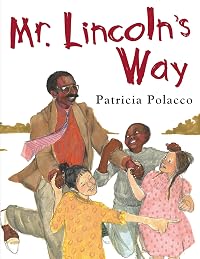
Mr. Lincoln's Way
by Patricia Polacco
On This Page
Description
When Mr. Lincoln, "the coolest principal in the whole world," discovers that Eugene, the school bully, knows a lot about birds, he uses this interest to help Eugene overcome his intolerance.Tags
Recommendations

Member Reviews
The prolific Patricia Polacco, whose Thank You, Mr. Falker was a picture-book tribute to the special teacher who helped her to learn to read, here turns her attention to the tale of an extraordinary principle, with predictably outstanding results. Mr. Lincoln was the heart and soul of his elementary school. He had tea parties with the kindergarten class, and took the sixth-graders on nature walks. He "was the coolest principle in the whole world." To everyone, that is, except Eugene Esterhause, a trouble-making student nicknamed "Mean Gene" because of his propensity for bullying the other children, and "sassing" the teachers. Seeing in this recalcitrant, disrespectful and thoughtlessly racist young boy a troubled and unhappy soul, Mr. show more Lincoln sought a way to reach out to Eugene, eventually finding it in his love of birds...
Mr. Lincoln's Way is another poignant picture-book triumph from Patricia Polacco, whose perceptive understanding of the world of childhood is matched only by her expressive and deeply satisfying artwork. I particularly appreciated the connection she drew between familial instability and bullying, and between parental example and the development of racist thinking. The story of how Mr. Lincoln reached Eugene, and taught him to respect and cherish difference, is especially inspiring for being true (as are so many of Polacco's tales), and I found the little afterword, in which we learn what good use Eugene made of Mr. Lincoln's example, in eventually becoming a teacher himself, very moving. The endpapers even show a grown-up Eugene with his diverse students, his "little birds." Well done, Patricia Polacco! show less
Mr. Lincoln's Way is another poignant picture-book triumph from Patricia Polacco, whose perceptive understanding of the world of childhood is matched only by her expressive and deeply satisfying artwork. I particularly appreciated the connection she drew between familial instability and bullying, and between parental example and the development of racist thinking. The story of how Mr. Lincoln reached Eugene, and taught him to respect and cherish difference, is especially inspiring for being true (as are so many of Polacco's tales), and I found the little afterword, in which we learn what good use Eugene made of Mr. Lincoln's example, in eventually becoming a teacher himself, very moving. The endpapers even show a grown-up Eugene with his diverse students, his "little birds." Well done, Patricia Polacco! show less
I believe this book would a very powerful tool to use in almost any age level classroom. This book introduces the idea of race at a young age. Mr. Lincoln is an African American principal at a school where he is loved by everyone. There is one child named Eugene that is having a hard time at school with his behavior. Mr. Lincoln finds a way to channel this negative behavior into something positive with a bird atrium. Eugene and Mr. Lincoln start to spend a lot of time together and grow a relationship. Eugene's father isn't a fan of this so they start to separate. One day, Eugene is heard making negative racial comments. This is when Mr. Lincoln takes Eugene aside and describes that he loves all the birds no matter how they look and that show more is how we should love everyone. It is a very powerful tool to teach students about race and how it effects everyone around them. show less
This is a story about Eugene, a boy that bullies kids at his school because of their difference. Mr. Lincoln, the principal, realizes that Eugene is not bad; he is just following things he hears at home. In his own special way Mr. Lincoln finds a way to help Louis and to show him that differences are what make us special.
I love the way the author uses birds to cover such a controversial subject as racism. The illustrations use bold and bright colors to bring out the differences in the students and the birds.
This book can be used in a Science class to discuss birds, or when discussing bullying and racism.
I love the way the author uses birds to cover such a controversial subject as racism. The illustrations use bold and bright colors to bring out the differences in the students and the birds.
This book can be used in a Science class to discuss birds, or when discussing bullying and racism.
The realistic fiction is about a bully who is nicknamed “Mean Gene”. He picks on other students and his behavior is very difficult for the teachers to deal with him. Mr. Lincoln, his principal tries to figure out a way to reach him. He discovers that Eugene enjoys birds. Mr. Lincoln uses this knowledge to guide Eugene. The teachers began to see improvements in Eugene’s reading and behavior until he has a meltdown one day. He calls two Hispanic children names. Mr. Lincoln discovers that Eugene’s father is racist. Mr. Lincoln carefully talks with Eugene about how the birds are different colors and that the world would not be as interesting if they were all the same. He uses the analogy of the birds as students to reveal that he is show more not to treat other students badly.
This was a moving book. It deals with racism and bullies so artfully. The illustrations were realistic. The story may help teachers and students to view bullies and racism from a different perspective. A teacher may not give up on a student who so desperately needs their guidance. A student may not feel threatened by a story whereas a direct confrontation may not be as effective.
As an extension activity of this book, I would have the students write their reactions to the story and tell of their experiences with someone not treating them kindly. The students could also draw a picture of what happened. I would let them share their stories to the class. show less
This was a moving book. It deals with racism and bullies so artfully. The illustrations were realistic. The story may help teachers and students to view bullies and racism from a different perspective. A teacher may not give up on a student who so desperately needs their guidance. A student may not feel threatened by a story whereas a direct confrontation may not be as effective.
As an extension activity of this book, I would have the students write their reactions to the story and tell of their experiences with someone not treating them kindly. The students could also draw a picture of what happened. I would let them share their stories to the class. show less
One of my favorite Patricia Polaccos, this book will make even the most difficult and stubborn kid reflective (even if only for a moment). The true story discusses a challenging student filled with hateful messages from his father and the principal who takes it upon himself to guide and nurture the young man. The book is rich with personal connections for students and can be integrated with science, social studies, or language arts. I pull this book out for class discussions when there has been bullying or when students are especially uncooperative- I wouldn't teach without it!
In this book, Polacco tackles both intolerance and bullying. Mr. Lincoln is the "coolest" principal: he is Santa at Christmas, lights the menorah at Chanukah, and wears a dashiki for Kwanza and a burnoose for Ramadan. The author chronicles his attempt to reclaim "Mean Gene," a child who sasses his teachers, picks on other children, and makes ethnic slurs. "`He's not a bad boy, really,' Mr. Lincoln said. `Only troubled.'" However, the distinction is not clarified. When the principal discovers that the boy is fond of birds, he capitalizes on this interest. He involves him in attracting the creatures to the school atrium while at the same time showing him that just as the differences in the birds render them beautiful, so do the show more differences in people. While the theme is an important and timely one, Polacco has allowed her message to overwhelm both plot and character development. The story emerges as didactic, laden with heavy-handed metaphor, and too simplistic a solution to a deep-rooted problem. The book may be useful to schools in need of a springboard for discussion of the topic and is graced with impressive watercolors, but it is not up to the author's usual literary standards.
After reading this book I would ask the students as a group to take a minute to think about the following questions:
• Who gave you your name?
• Do you know why it was chosen to be your name?
• What do you especially like about your name?
• Do you have any nicknames that you like to be called?
Students then pair up and take about five minutes per student to share their answers to the four
questions with their partner. When both students have shared with one another, the whole group
comes back together and each student introduces their partner and shares some highlights of what
they learned about their partner’s name.
Than I would follow up the discussion with one more question:
• Can you remember a time when someone called you the wrong name or said your name incorrectly?
How did that feel and what did you do? show less
After reading this book I would ask the students as a group to take a minute to think about the following questions:
• Who gave you your name?
• Do you know why it was chosen to be your name?
• What do you especially like about your name?
• Do you have any nicknames that you like to be called?
Students then pair up and take about five minutes per student to share their answers to the four
questions with their partner. When both students have shared with one another, the whole group
comes back together and each student introduces their partner and shares some highlights of what
they learned about their partner’s name.
Than I would follow up the discussion with one more question:
• Can you remember a time when someone called you the wrong name or said your name incorrectly?
How did that feel and what did you do? show less
This book was very inspirational and I really enjoyed reading it. Mr. Lincoln is the Principal of the school and he is admired by almost everyone. He dresses very stylish and always spends time trying to connect with the students. However, Eugene causes a lot of trouble for Mr. Lincoln. He is a bully and never wants to listen. Eugene loves birds and Mr. Lincoln bonds with him and tries to help him through his behavior problems. When Eugene gets in trouble, he is crying and confesses to Mr. Lincoln that his old man has "real bad names he calls everyone who is different from them." Mr. Lincoln feels sorrow for Eugene that he was raised to think and treat others like that. I loved the plot of this book and felt that the story line was very show more relatable and important. It was engaging and I did not get bored while reading. It had a climax and a resolution. It was easy to connect to because I feel that everyone knows of a bully from sometime when they went to school. I also liked how Mr. Lincoln helped Eugene become a better person and show him that the color of one's skin should not make a difference. Also, I felt that the characters were really well-developed. Mr. Lincoln was an inspiring person and he seemed to have a great heart. The author also did a great job giving personality to each character and making them different in their own way. Finally, the illustrations were drawn very well and it made the book, in my opinion. The were drawn abstractly, but were very warm and made me really look at each page carefully. They were bright and even though there was problems within the book, they made me find happiness. The main message of this book was that no one is better than someone else, especially because of skin color. No one should be judged or viewed differently because of the way they were born and that is a lesson that everyone should be taught. It is especially relatable because racism still happens everyday and it needs to end. show less
Members
- Recently Added By
Lists

Picture Books About Civil Rights
51 works; 4 members
Author Information

Patricia Polacco was born in Lansing, Michigan on July 11, 1944. She attended Oakland Tech High School in Oakland, California before heading off to the California College of Arts and Crafts in Oakland, then Laney Community College in Oakland. She then set off for Monash University, Mulgrave, Australia and the Royal Melbourne Institute of show more Technology, Melbourne, Australia where she received a Ph.D in Art History, Emphasis on Iconography. After college, she restored ancient pieces of art for museums. She didn't start writing children's books until she was 41 years old. She began writing down the stories that were in her head, and was then encouraged to join the Society of Children's Book Writers and Illustrators. There she learned how to put together a dummy and get a story into the form of a children's picture book. Her mother paid for a trip to New York, where the two visited 16 publishers in one week. She submitted everything she had to more than one house. By the time she returned home the following week, she had sold just about everything. Polacco has won the 1988 Sydney Taylor Book Award for The Keeping Quilt, and the 1989 International Reading Association Award for Rechenka's Eggs. She was inducted into the Author's Hall of Fame by the Santa Clara Reading Council in 1990, and received the Commonwealth Club of California's Recognition of Excellence that same year for Babushka's Doll, and again in 1992 for Chicken Sunday. She also won the Golden Kite Award for Illustration from the Society of Children's Book Writers and Illustrators for Chicken Sunday in 1992, as well as the Boston Area Educators for Social Responsibility Children's Literature and Social Responsibility Award. In 1993, she won the Jane Adams Peace Assoc. and Women's Intl. League for Peace and Freedom Honor award for Mrs. Katz and Tush for its effective contribution to peace and social justice. She has won Parent's Choice Honors for Some Birthday in 1991, the video Dream Keeper in 1997 and Thank You Mr. Falker in 1998. In 1996, she won the Jo Osborne Award for Humor in Children's Literature. Her titles The Art of Miss. Chew and The Blessing Cup made The New York Times Best Seller List. (Bowker Author Biography) show less
Awards and Honors
Awards
Notable Lists
Common Knowledge
- Original publication date
- 2001
- First words
- Mr. Lincoln was the coolest principal in the whole world, or so his students thought.
- Last words
- (Click to show. Warning: May contain spoilers.)"I'll make you proud of me, Mr. Lincoln. I promise"
- Publisher's editor
- Gauch, Patricia Lee
- Original language
- English
Classifications
Statistics
- Members
- 1,650
- Popularity
- 13,584
- Reviews
- 88
- Rating
- (4.51)
- Languages
- English
- Media
- Paper
- ISBNs
- 6