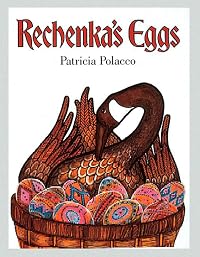
Rechenka's Eggs
by Patricia Polacco
On This Page
Description
An injured goose rescued by Babushka, having broken the painted eggs intended for the Easter Festival in Moscva, lays thirteen marvelously colored eggs to replace them, then leaves behind one final miracle in egg form before returning to her own kind.Tags
Recommendations












Member Reviews
Known far and wide for her gorgeous pysanky - Ukrainian Easter eggs, decorated with intricate patterns, and gorgeous colors - Babushka was preparing for the great Moscow Easter Festival, when she happened upon an injured goose near her house. Naming her new anserine friend Rechenka, Babushka brought the goose home, and nursed her back to health. Then, disaster struck, and it seemed as if all of Babushka's painstaking work over the past year, in creating her pysanky, had been in vain. Was her dream of once again triumphing at the Festival over? Or was there a miracle in store - a miracle in which Rechenka could play a part...?
Although I was a little put off by the geographic confusion here - pysanky are Ukrainian, and so (one presumes) show more is Babushka, although she lives in a dacha just outside Moscow (?) - I found Rechenka's Eggs a very engaging tale, otherwise. Babushka is an endearing heroine - her compassion, and ability to see the miraculous in the everyday events around her, are immensely appealing. Polacco's artwork did seem a little...off to me (a slightly different color scheme than usual, perhaps?), which made more sense, when I noted that this title was originally published in 1988, and is one of the author/artist's earliest books. I must just be used to her later style. All in all, although it won't ever rank amongst my favorite Patricia Polacco books, Rechenka's Eggs is still an appealing story for Easter time, and for anyone who appreciates those marvelous pysanky! show less
Although I was a little put off by the geographic confusion here - pysanky are Ukrainian, and so (one presumes) show more is Babushka, although she lives in a dacha just outside Moscow (?) - I found Rechenka's Eggs a very engaging tale, otherwise. Babushka is an endearing heroine - her compassion, and ability to see the miraculous in the everyday events around her, are immensely appealing. Polacco's artwork did seem a little...off to me (a slightly different color scheme than usual, perhaps?), which made more sense, when I noted that this title was originally published in 1988, and is one of the author/artist's earliest books. I must just be used to her later style. All in all, although it won't ever rank amongst my favorite Patricia Polacco books, Rechenka's Eggs is still an appealing story for Easter time, and for anyone who appreciates those marvelous pysanky! show less
I really enjoyed this book for several reasons. As a child, I loved reading this story with my father. We are part Ukrainian, and one of our culture’s traditions is painting eggs for Easter rather than dying eggs. This book incorporates the tradition of painting eggs, which is why I always loved reading the story. The language incorporates Russian terms within the story, such as “Babushka, dacha, kulich, and pashka.” I really enjoy the illustrations because they are extremely detailed and beautiful, which engages the reader. Through the illustrations, there are portrayals of Christian faith. For example, many of the paintings illustrated on Babushka’s walls are of saints worshiped in the Christian faith. The setting also centers show more on the time of Easter, which a very religious Christian holiday. I think it is important that multicultural aspects are represented in this story; this gives readers an opportunity to learn about new cultures or celebrate their own traditions. Throughout the story, there is a repetition of the word “miracle.” Babushka considers many events that happen to her and others are miracles. These miracles include caribou surviving the winter, the wounded goose Rechenka being sent to Babushka, the beautifully painted eggs laid by Rechenka, the caribou’s baby calves, and the baby chick hatched from Rechenka’s last egg. The character of Babushka is very believable and relatable to a reader’s own grandmother; she is very gentle, kind, and caring of all living things. I love the friendship that developed between Babushka and Rechenka; I believe this teaches a valuable lesson on friendship to young readers. The central message of the story is miracles happen everyday and friendship should always be cherished. show less
Every year Babushka creates beautiful hand painted traditional Ukrainian Easter eggs to show off at the fair, and every year hers are the most beautiful. When she finds an injured goose, she brings it home and nurses it back to health, and it becomes her dear companion. As it gets better though, it gains more energy and accidentally destroys her painted eggs! At first she is very upset, but she is astonished to discover that the goose has begun to lay painted eggs, and she uses them as her entry to the competition. By the time the fair comes around, she has enough to enter, and everyone is blown away by how beautiful they are. When she returns home, her goose is gone, but the last egg she laid is still there, and it hatches into a show more gosling for her to keep and raise so she won't be lonely.
AGES: 3-8
SOURCE: home bookshelf show less
AGES: 3-8
SOURCE: home bookshelf show less
Rechenka’s Eggs, by Patricia Polacco, is an authentic picture book featuring traditions and surprises. I truly enjoyed this book, because I could feel the importance of this tradition to the main character. Babushka, the old woman, paints eggs for the Easter festival in Moska. One day she rescues an injured goose. She nutures it back to health, however, the goose accidentally breaks all her precious painted eggs in the process of flying again. The next day, she awakens to find that the goose had a laid the most beautiful egg. The main theme of this story is about miracles. Because Babushka saved the goose, the goose returned a favor, which was only possible due to a miracle. The lovely illustrations of the eggs also give the book a show more dazzling appearance. I noticed that each egg in the illustrations is different, just like it says they should be in the story. I appreciate how Patricia Polacco is both the author and illustrator for this book, because she could follow through with this little detail that made all the difference in this adorable miracle of a book. show less
This has more of a fantasy twist to its story than the two stories I've read by Polacco before. It's audience is older, I believe, like that of "Thank you, Mr. Falker" but I don't think the storytelling is quite as detailed and we'll written as that one. It's still very good, it just doesn't stand as tall as Falker, in my opinion. I wasn't expecting that ending, not that I had any expectations at all. I couldn't predict how the story would end, but I think the one Polacco chose is perfect. Again, I see a lot of cultural elements she described in her autobiography in this story. I can't figure out from an artist's standpoint, however, why she left Babushka's face as a sketch while everything else was colored in.
Babushka is known for the intricately painted delicate eggs for which she wins awards at festivals. One day, she comes across an injured goose, takes her in and cares for her, and gives her the name Rechenka. As the goose regains its health, it begins to poke around the house and one day shatters all the eggs that Babushka was working on for the next festival. One by one, by some miracle, the goose lays eggs even more beautifully colored than those that were broken. When Babushka leaves for the festival, she says goodbye to Rechenka, knowing that it is time to migrate for the winter. When she comes home to an empty house, she is a little sad at the loss of a friendship, but soon discovers that Rechenka has left an egg, which hatches as show more a new friend for Babushka.
This book could be used to illustrate Russian culture or introduce art and the rare art forms of the past, like egg painting. It could also just be read for enjoyment, and conveys the message that animals and artwork are beautiful and should be appreciated. show less
This book could be used to illustrate Russian culture or introduce art and the rare art forms of the past, like egg painting. It could also just be read for enjoyment, and conveys the message that animals and artwork are beautiful and should be appreciated. show less
This story has all the qualities of a traditional folktale, with a new spin and a fantasy quality. A very good story, interesting characters, interesting story elements like the painted eggs, and rewards that are not financial all make for a very good story. The art is excellent.
A teacher could include this title in stories about Russia, Russian culture, folktales, or Easter traditions. Librarians can feature this book for Easter displays and international/world folktale displays or programs.
A teacher could include this title in stories about Russia, Russian culture, folktales, or Easter traditions. Librarians can feature this book for Easter displays and international/world folktale displays or programs.
Members
- Recently Added By
Lists

Honey For a Child's Heart
1,152 works; 25 members

Brightly Beaming Curriculum Books
281 works; 8 members

A Child's Book Tour of Ukraine
29 works; 2 members

Under The Chinaberry Tree
194 works; 1 member

Reading Rainbow
193 works; 9 members

Read Aloud Revival
108 works; 4 members

The Peaceful Preschool Curriculum
58 works; 1 member
Author Information

81+ Works 57,066 Members
Patricia Polacco was born in Lansing, Michigan on July 11, 1944. She attended Oakland Tech High School in Oakland, California before heading off to the California College of Arts and Crafts in Oakland, then Laney Community College in Oakland. She then set off for Monash University, Mulgrave, Australia and the Royal Melbourne Institute of show more Technology, Melbourne, Australia where she received a Ph.D in Art History, Emphasis on Iconography. After college, she restored ancient pieces of art for museums. She didn't start writing children's books until she was 41 years old. She began writing down the stories that were in her head, and was then encouraged to join the Society of Children's Book Writers and Illustrators. There she learned how to put together a dummy and get a story into the form of a children's picture book. Her mother paid for a trip to New York, where the two visited 16 publishers in one week. She submitted everything she had to more than one house. By the time she returned home the following week, she had sold just about everything. Polacco has won the 1988 Sydney Taylor Book Award for The Keeping Quilt, and the 1989 International Reading Association Award for Rechenka's Eggs. She was inducted into the Author's Hall of Fame by the Santa Clara Reading Council in 1990, and received the Commonwealth Club of California's Recognition of Excellence that same year for Babushka's Doll, and again in 1992 for Chicken Sunday. She also won the Golden Kite Award for Illustration from the Society of Children's Book Writers and Illustrators for Chicken Sunday in 1992, as well as the Boston Area Educators for Social Responsibility Children's Literature and Social Responsibility Award. In 1993, she won the Jane Adams Peace Assoc. and Women's Intl. League for Peace and Freedom Honor award for Mrs. Katz and Tush for its effective contribution to peace and social justice. She has won Parent's Choice Honors for Some Birthday in 1991, the video Dream Keeper in 1997 and Thank You Mr. Falker in 1998. In 1996, she won the Jo Osborne Award for Humor in Children's Literature. Her titles The Art of Miss. Chew and The Blessing Cup made The New York Times Best Seller List. (Bowker Author Biography) show less
Awards and Honors
Awards
Distinctions
Common Knowledge
- Canonical title
- Rechenka's Eggs
Classifications
Statistics
- Members
- 1,766
- Popularity
- 12,510
- Reviews
- 22
- Rating
- (4.04)
- Languages
- English, Norwegian
- Media
- Paper, Audiobook, Ebook
- ISBNs
- 17
- ASINs
- 9