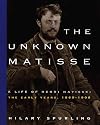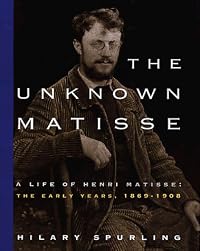
The Unknown Matisse: A Life of Henri Matisse: The Early Years, 1869-1908
by Hilary Spurling
A Life of Henri Matisse (Volume 1)
On This Page
Description
The art, youth, early maturity and life of artist Henri Matisse are thoroughly examined in this biography that also includes 24 pages of color reproductions. Henri Matisse is one of the masters of twentieth-century art and a household word to millions of people who find joy and meaning in his light-filled, colorful images-yet, despite all the books devoted to his work, the man himself has remained a mystery. Now, in the hands of the superb biographer Hilary Spurling, the unknown Matisse show more becomes visible at last. Matisse was born into a family of shopkeepers in 1869, in a gloomy textile town in the north of France. His environment was brightened only by the sumptuous fabrics produced by the local weavers-magnificent brocades and silks that offered Matisse his first vision of light and color, and which later became a familiar motif in his paintings. He did not find his artistic vocation until after leaving school, when he struggled for years with his father, who wanted him to take over the family seed-store. Escaping to Paris, where he was scorned by the French art establishment, Matisse lived for fifteen years in great poverty, an ordeal he shared with other young artists and with Camille Joblaud, the mother of his daughter, Marguerite. But Matisse never gave up. Painting by painting, he struggled toward the revelation that beckoned to him, learning about color, light, and form from such mentors as Signac, Pissarro, and the Australian painter John Peter Russell, who ruled his own art colony on an island off the coast of Brittany. In 1898, after a dramatic parting from Joblaud, Matisse met and married Amele Parayre, who became his staunchest ally. She and their two sons, Jean and Pierre, formed with Marguerite his indispensable intimate circle. From the first day of his wedding trip to Ajaccio in Corsica, Matisse realized that he had found his spiritual home: the south, with its heat, color, and clear light. For years he worked unceasingly toward the style by which we know him now. But in 1902, just as he was on the point of achieving his goals as a painter, he suddenly left Paris with his family for the hometown he detested, and returned to the somber, muted palette he had so recently discarded. Why did this happen? Art historians have called this regression Matisse's "dark period," but none have ever guessed the reason for it. What Hilary Spurling has uncovered is nothing less than the involvement of Matisse's in-laws, the Parayres, in a monumental scandal which threatened to topple the banking system and government of France. The authorities, reeling from the divisive Dreyfus case, smoothed over the so-called Humbert Affair, and did it so well that the story of this twenty-year scam, and the humiliation and ruin its climax brought down on the unsuspecting Matisse and his family, have been erased from memory until now. It took many months for Matisse to come to terms with this disgrace, and nearly as long to return to the bold course he had been pursuing before the interruption. What lay ahead were the summers in St-Tropez and Collioure; the outpouring of "Fauve" paintings; Matisse's experiments with sculpture; and the beginnings of acceptance by dealers and collectors, which, by 1908, put his life on a more secure footing. Hilary Spurling's discovery of the Humbert Affair and its effects on Matisse's health and work is an extraordinary revelation, but it is only one aspect of her achievement. She enters into Matisse's struggle for expression and his tenacious progress from his northern origins to the life-giving light of the Mediterranean with rare sensitivity. She brings to her task an astonishing breadth of knowledge about his family, about fin-de-siecle Paris, the conventional Salon painters who shut their doors on him, his artistic comrades, his early patrons, and his incipient rivalry with Picasso. In Hilary Spurling, Matisse has found a biographer with a detective's ability to unearth crucial facts, the narrative power of a novelist, and profound empathy for her subject. Oxford-educated journalist Spurling uncovers the involvement of Matisse's in-laws in a monumental financial scandal, describing how it affected his health and how it led to his "dark period". Her examination of Matisse's artistic and career progression is informed by an astonishing breadth of knowledge about his family, fin-de- siecle Paris, the conventional Salon painters who shut their doors on him, his artistic comrades, his early patrons, and his rivalry with Picasso. show lessTags
Recommendations



















Member Reviews
A good, comprehensive biography with the only nagging doubts caused by the traces of Spurling's suppressed hero-worship. By the end of this, the first of two volumes, you get the feeling Picasso is being set up a little too neatly as the arch-nemesis of the next book; she seems to have difficulty in overcoming what Gertude Stein coined the Matisseite/Picassoite divide, or even accepting those who found themselves on the other side.
Although I like his work (his later work, it turns out), and I've been to Nice and have seen where he lived and been to the Matisse Museum devoted to his work in Cimiez, it turns out I knew nothing about him. This book has fixed that, at least in part. Because it is only part of the story, taking you up to 1908, when he was 39 and just becoming successful. Since he lived to be 85, there is a second volume that needs to be read.
Reads like a thriller, with artists struggling, falling by the wayside, getting up again, dying. Exhausting to read but fascinating.
I think that Matisse’s paintings are wonderful because he enjoyed doing them and he put ideas and feelings into them. But I wonder about our experiences when we go an art gallery. Art goers come from different spheres of life. If I look at something and don't understand the deeper ideas within I can choose to shut up or I can comment at the level I can reach - nothing wrong with that. When I saw an exhibition of Matisse Cirque pictures I was bemused because I could see many of the forms but I could not understand Matisse's choice of subjects for each picture. I was a little disappointed that there was nothing there that appealed to me like his blue nudes. But as I listened and read about the pictures that I was looking at I discovered show more some interesting ideas and I felt that there was a journey through the sequenced pictures. Months later I saw an exhibition of Fauvist paintings which were hung in black walled rooms with strong lighting illuminating the work. The effect was stunning. There are no works from Matisse (that I can think of) that are The Great Masterpiece that everyone knows and can name (people can reply to this review as they wish) but in the history of art Matisse contributed to and experienced the creation of a number of interesting genres.
Before he became an artist Matisse spent a little more than a year in Paris. In those months the Eiffel Tower was built up from nothing to the great structure it is today. He then went sick and ended up in bed from some months with not much to do except learn to paint. His final pieces were also created from wheel chair or bed.
I am sure that colour was of prime importance to Matisse when he was a Fauvist. I am not so sure that colour was so important to him when he was cutting out shapes, it seems to be more the desire to suggest objects using flat shapes, and even there he was not trying to develop 3D images but simply create objects flatly.
The artist should not be concerned about measures, whether time, or acceptance. Instead, when working on his/her art, the artist should, with all of his/her capacity and will, enter the realm where these measurements don't apply; where all there is is the uniqueness, creativity, and vision of each artist. Of course, this is very difficult; the ego feeds on measurements of power, influence, wealth, success and so on. Once ridden of these concerns, the artist is ready to produce and express uniqueness, which is the contribution that adds to art, that enriches both: art and the artist. And if afterwards, when the critics/experts, gallery owners and the like, decide that the art produced doesn't "measure up," then there is reason for the artist to savour a degree of satisfaction, in that he/she expressed what undoubtedly is his/hers alone. This doesn't mean that the work will necessarily go unnoticed. On the contrary; it might be recognized as its very own kind, just like the great works that have been created, certainly, by the same process.
The book? Too much biography and not much on Matisses's art itself. show less
Before he became an artist Matisse spent a little more than a year in Paris. In those months the Eiffel Tower was built up from nothing to the great structure it is today. He then went sick and ended up in bed from some months with not much to do except learn to paint. His final pieces were also created from wheel chair or bed.
I am sure that colour was of prime importance to Matisse when he was a Fauvist. I am not so sure that colour was so important to him when he was cutting out shapes, it seems to be more the desire to suggest objects using flat shapes, and even there he was not trying to develop 3D images but simply create objects flatly.
The artist should not be concerned about measures, whether time, or acceptance. Instead, when working on his/her art, the artist should, with all of his/her capacity and will, enter the realm where these measurements don't apply; where all there is is the uniqueness, creativity, and vision of each artist. Of course, this is very difficult; the ego feeds on measurements of power, influence, wealth, success and so on. Once ridden of these concerns, the artist is ready to produce and express uniqueness, which is the contribution that adds to art, that enriches both: art and the artist. And if afterwards, when the critics/experts, gallery owners and the like, decide that the art produced doesn't "measure up," then there is reason for the artist to savour a degree of satisfaction, in that he/she expressed what undoubtedly is his/hers alone. This doesn't mean that the work will necessarily go unnoticed. On the contrary; it might be recognized as its very own kind, just like the great works that have been created, certainly, by the same process.
The book? Too much biography and not much on Matisses's art itself. show less
Ratings
Members
- Recently Added By
Author Information

Hilary Spurling was born in 1940 in Stockport England. She attended Somerville College in Oxford. She bacame the arts and theater critic for The Spectator during the 1960's. She was also the reviewer for The Observer and The Daily Telegraph. She has written several biographies including Pearl Buck in China and Matisse the Master: The Conquest of show more Colour 1909-1954, which won the 2005 Whitebread Book of the Year Award and the Los Angeles Book Prize for Biography in 2006. (Bowker Author Biography) show less
Some Editions
Awards and Honors
Awards
Distinctions
Series

Common Knowledge
- People/Characters
- Henri Matisse; Amélie Matisse; Marguerite Matisse Duthuit
- Original language
- English
Classifications
Statistics
- Members
- 369
- Popularity
- 84,702
- Reviews
- 4
- Rating
- (4.14)
- Languages
- 5 — English, French, Portuguese, Spanish, Swedish
- Media
- Paper, Ebook
- ISBNs
- 15
- ASINs
- 1