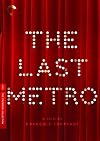
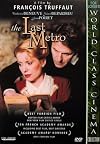
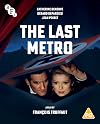
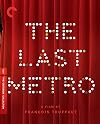
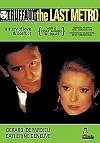
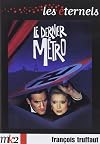
The Last Metro [1980 film]
by François Truffaut (Director/Screenwriter), Suzanne Schiffman (Screenwriter)
On This Page
Description
"A stylish and poignant film about Jewish director Lucas Steiner (Heinz Bennent), who is forced to hide in the basement of his theater during the Nazi occupation while his wife (Catherine Deneuve) stars in its latest production. Romantic tensions mount when she and her leading man (Gérard Depardieu) begin to fall in love with each other. At the same time, a pro-Nazi theater critic ensconces himself in the theater causing stress to the entire cast"--Container.Tags
Recommendations









Member Reviews
As much as I love The Most Beautiful Woman Who Ever Lived, Catherine Deneuve's presence doesn't elevate this movie to the so-so level. Disappointing.
Gérard Depardieu and Catherine Deneuve star as members of a French theater company living under the German occupation during World War II in François Truffaut’s gripping, humanist character study. Against all odds—a Jewish theater manager in hiding; a leading man who’s in the Resistance; increasingly restrictive Nazi oversight—the troupe believes the show must go on. Equal parts romance, historical tragedy, and even comedy, The Last Metro (Le dernier métro) is Truffaut’s ultimate tribute to art overcoming adversity.
(source: The Criterion Collection)
(source: The Criterion Collection)
Francois Truffaut directs with a light touch, and caps the film with a delightfully whimsical and meta tone that I wish had been applied to the whole movie. He follows in the tradition of Jean-Pierre Melville by adapting a popular genre as a serious allegory for the darkest period in French history: the Nazi Occupation. Just as Melville used the gangster film to examine notions of legality, legitimacy, authority and criminality in a period when the Resistance were outlaws and the police rounding up Jews for the death camps, so Truffaut takes the beloved putting-on-a-show warhorse, and uses it as a metaphor for the conditions of life in Occupied France: the need to act, adapt and continually discard roles. When Depardieu's character show more leaves to fight for the Resistance, he puns about exchanging his make-up (maquillage) for the maquis.
What Truffaut is most interested in, as in all his films, is the effect this need for constant dissembling has on individual identity and relationships. This romantic comedy plays like a mature update of 'Casablanca', stylised, open-ended, with Truffaut's moving camera wrenching spirit from the claustrophobic confines. show less
What Truffaut is most interested in, as in all his films, is the effect this need for constant dissembling has on individual identity and relationships. This romantic comedy plays like a mature update of 'Casablanca', stylised, open-ended, with Truffaut's moving camera wrenching spirit from the claustrophobic confines. show less
Jun 1, 2025English (UK)
1942. Parigi occupata dai nazisti. L'ultimo metrò è il mezzo che i parigini debbono prendere per tornare a casa in sicurezza dopo essere stati a teatro. Proprio di un teatro e di chi lo fa continuare ad esistere che il film si occupa. Marion Steiner è la prima attrice del Théâtre Montmatre che si è caricata sulle spalle l'impresa di fare andare avanti la compagnia dopo che il marito, il regista ebreo Lucas, è fuggito per evitare l'arresto. In realtà l'uomo è nascosto nella cantina dell'edificio e da lì, con l'aiuto della consorte, continua a dirigere. Lo spettacolo che si sta provando è di un autore danese e s'intitola "La scomparsa". Per il ruolo di primo attore viene ingaggiato il giovane e irruente Bernard Granger che show more proviene dal Grand Guignol. Bernard, all'insaputa dei colleghi, fa anche parte della rete clandestina della Resistenza. show less
May 22, 2017Italian
Paris, septembre 1942. Lucas Steiner, le directeur du théâtre Montmartre a dû fuir parce qu’il est juif. Sa femme Marion Steiner dirige le théâtre et engage Bernard Granger, transfuge du Grand Guignol, pour jouer à ses côtés dans ”la Disparue”, que met en scène Jean-Louis Cottins. Jusqu’au soir de la générale, la troupe subit les menaces du virulent critique de ”Je suis partout”, Daxiat, dont l’ambition est de diriger la Comédie- Française. Et si, par amour pour sa femme, Lucas Steiner avait fait semblant de fuir la France et était resté caché dans la cave de son théâtre pendant toute la guerre… (fonte: retro del dvd)
Nov 14, 2023Italian
Parigi, 1942: a causa del coprifuoco, l'ultimo metrò parte alle 20,30, ma il teatro, nonostante la paura, è frequentatissimo. Il proprietario e direttore del Teathre Montmartre è costretto, in quanto ebreo, a vivere nascosto nella cantina del suo teatro, da dove continua a lavorare e a dirigere all'insaputa degli stessi attori. Per tutti, a dirigere l'impresa è la moglie Marion. (fonte: Cdec)
Feb 18, 2020Italian
Members
- Recently Added By
Author Information

Francois Truffaut was one of the principal figures in the French New Wave movement of the 1950s and early 1960s. As a young critic for the avant-garde film magazine Les Cahiers du Cinema, he formulated the politique des auteurs---the idea that directors with a personal vision are the true authors of films, rather than conventional screenwriters or show more script-bound directors. An admirer of American films, Truffaut was much influenced by Alfred Hitchcock (see Vol. 1). In several of his own films, Truffaut, who had an unhappy childhood and youth, portrayed a fictionalized version of himself, a character called Antoine Doinel, to create personal cinema. The first of these films, which was also his first feature film, was The Four Hundred Blows (1959). It is still one of the most popular of his works. Other notable Truffaut films are Shoot the Piano Player (1960), the lyrical menage a trois Jules and Jim (1961), the Academy Award-winning Day for Night (1973), The Last Metro (1980), and The Woman Next Door (1981). (Bowker Author Biography) show less
All Editions
Awards and Honors
Awards
Series
Belongs to Publisher Series
Criterion Laserdiscs (158)
The Criterion Collection (462)
Work Relationships
Is an adaptation of
Common Knowledge
- Canonical title
- The Last Metro [1980 film]
- Related movies
- The Last Metro (1980 | IMDb)
Classifications
Statistics
- Members
- 73
- Popularity
- 430,912
- Reviews
- 8
- Rating
- (3.50)
- Languages
- English, French, Spanish
- ISBNs
- 5
- UPCs
- 5
- ASINs
- 15