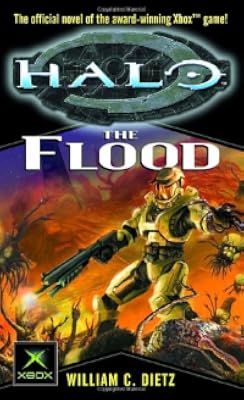
Halo: The Flood
by William C. Dietz
Halo Novels (Original Quadrilogy 2), Halo Universe (Original Quadrilogy Novels — Original Quadrilogy 2)
On This Page
Description
The bestselling adaptation of the iconic video game Halo: Combat Evolved featuring the Master Chief—part of the expanded universe based on the award-winning video game series!2552. Having barely escaped the final battle for Reach against the vast alien alliance known as the Covenant, the crew of the Pillar of Autumn, including Spartan John-117—the Master Chief—and his AI companion Cortana, is forced to make a desperate escape into slipspace. But their destination brings them to an show more ancient mystery and an even greater struggle. In this far-flung corner of the universe floats a magnificently massive, artificial ringworld. The crew's only hope of survival is to crash-land on its surface and take the battle opposing the Covenant to the ground.
But they soon discover that this enigmatic ringworld is much more than it seems. Built one hundred thousand years ago by a long-lost civilization known as the Forerunners, this "Halo" is worshipped by the Covenant—a sacred artifact they hope will complete their religious quest for supposed transcendence, and they will stop at nothing to control it. Engaging in fierce combat, Master Chief and Cortana will go deep into the Halo construct and uncover its dark secret and true purpose—even as a monstrous and far more vicious enemy than the Covenant emerges to threaten all sentient life on Halo and the galaxy beyond... show less
Tags
Recommendations
Member Reviews
I'm generally familiar with the game and the series, but I've never played it myself. That being said, I was able to enjoy this book since it filled me in on what happened in Halo: Combat Evolved, without playing it (my boyfriend plays all the Halo games but I don't have the ability to just yet). It wasn't great, the first book in the Halo series of novels was way better. I do appreciate being filled in, but I think the execution could have been a little better. There are only so many times you can say that Master Chief runs into a room, shoots everything in it, and moves into another room, rinse wash repeat, rinse wash repeat (especially with the library!). It isn't that Chief is just shooting things, it is that the actual combat show more section is very thin, its the same enemy over and over, and there is no description beyond any other potential combat sequence that can be found in any other book of a similar theme/topic. Some of these sections could have been wrapped up faster, and should have been ("The Spartan cleared the first room..."---detail how, what he faced..."and proceeded to slog through another X amount of rooms before reaching his destination." Boom, done, without the reader being forced to slog alongside him in the worst way).
Entertaining in some parts, non-essential for those who have played the game, rough pacing, but a good read for those of us trying to "read and watch along" with our significant others, without logging hundreds of hours or lacking the console/game to do so. I hope the next one is better. Oblivion and Fall of Reach were much more enjoyable than this one. show less
Entertaining in some parts, non-essential for those who have played the game, rough pacing, but a good read for those of us trying to "read and watch along" with our significant others, without logging hundreds of hours or lacking the console/game to do so. I hope the next one is better. Oblivion and Fall of Reach were much more enjoyable than this one. show less
I've heard mentioned many times this is the 'way of the future' - Video games spawning books and movies rather than the other way around. This book is a perfect example of how not to do it.
After reading [b:The Fall of Reach|60229|The Fall of Reach (Halo, #1)|Eric S. Nylund|http://photo.goodreads.com/books/1170538877s/60229.jpg|1881174] I had decent expectations for this one, and ended up pretty disappointed. The Fall Of Reach is an OK novel with elements of the game folded into it. The authour worked hard to make a storyline and plot that hung together and fleshed out what we knew from the game.
This book on the other hand is mostly vast swathes of extra descriptive game walk-thru. And trust me, while I really enjoy playing Halo, a first show more person shooter game walk thru is not gripping reading material.
I'm guessing the authour had zero lattitude to play with the story line. There are some original touches here or there, expanding on things from the game or adding bits not there at all. Those parts are actually pretty decent, and the only parts that read like a story. As for the rest of it, Master Chief and Cortana show more character in the game than they do here.
If you're a Halo fanatic and haven't read the book, then maybe there's something here for you, but otherwise try something else. show less
After reading [b:The Fall of Reach|60229|The Fall of Reach (Halo, #1)|Eric S. Nylund|http://photo.goodreads.com/books/1170538877s/60229.jpg|1881174] I had decent expectations for this one, and ended up pretty disappointed. The Fall Of Reach is an OK novel with elements of the game folded into it. The authour worked hard to make a storyline and plot that hung together and fleshed out what we knew from the game.
This book on the other hand is mostly vast swathes of extra descriptive game walk-thru. And trust me, while I really enjoy playing Halo, a first show more person shooter game walk thru is not gripping reading material.
Turn left, shoot three Grunts, go up stairs, use grenade on group of Elites on walkway, turn right, shoot Grunt...you get the picture.
I'm guessing the authour had zero lattitude to play with the story line. There are some original touches here or there, expanding on things from the game or adding bits not there at all. Those parts are actually pretty decent, and the only parts that read like a story. As for the rest of it, Master Chief and Cortana show more character in the game than they do here.
If you're a Halo fanatic and haven't read the book, then maybe there's something here for you, but otherwise try something else. show less
While it’s nice to have a novelisation of the first Halo game, this action packed adventure translates poorly into the written format. It might be fun to shoot countless aliens and space parasites from behind a controller, but it isn’t fun to read about someone else doing it paragraph after paragraph.
That said, the novel provides some neat character insight and helps emphasis how creepy the Flood is. However, this could’ve been achieved better through a series of short stories.
I don’t recommend reading this unless you’re a massive Halo fan. Play the game instead.
That said, the novel provides some neat character insight and helps emphasis how creepy the Flood is. However, this could’ve been achieved better through a series of short stories.
I don’t recommend reading this unless you’re a massive Halo fan. Play the game instead.
Like the first book I think this book is good but not great, it is the novelization of the first halo video game and I would say that is where most of the faults begin.
I have to start with bad on this one, it is strange to say this but this book is TOO much like the video game. It doesn't just go through the story in the same way but describes the combat in an obnoxious manner. Imagine a friend talking you through a game they recently played but instead of giving you a broad description of story and basic points of action, they describe every single minion they kill and every single step they took, it would drive you mad... that's what this book does. In the first book I complimented the combat for being well written and it is the show more exact opposite here, I hated reading the Master Chief sections. The only thing worth while in these sections were the small bits of Master Chiefs thoughts and struggles during his scenes, but even they are not worth it, you can only describe killing a grunt, elite, or jackal so many times before it starts to bore you to madness.
Which brings me the good, pretty much every thing else. There are so many good background characters that I wish they could've dominated the novel more. All of the ODST section were amazing, especially Lieutenant McKay. The combat scenes with the ODST are drastically better than Master Chief's, the combat is interesting, creative, and exciting. You get to know some of the soldiers (but the character development is still bare minimum) and you get some really funny military banter with the occasional badass soldier doing something that completely changes the battle. Then you have Captain Keyes' story, where it starts out really good then ends very weird and sad. But I can't forget what should be a buddy cop movie in the Halo universe with the fearful and intelligent grunt named Yayap and the self righteous and ambitious Elite Zuka 'Zamamee, how much money do I need to send to someone to make that.
There are more really good characters in this novel and Master Chief's story drags the book down so much to the point where if you want to read this book I would advise you to skip his sections and just read the other character's stories. Play the game for Chief but read the book for the background. show less
I have to start with bad on this one, it is strange to say this but this book is TOO much like the video game. It doesn't just go through the story in the same way but describes the combat in an obnoxious manner. Imagine a friend talking you through a game they recently played but instead of giving you a broad description of story and basic points of action, they describe every single minion they kill and every single step they took, it would drive you mad... that's what this book does. In the first book I complimented the combat for being well written and it is the show more exact opposite here, I hated reading the Master Chief sections. The only thing worth while in these sections were the small bits of Master Chiefs thoughts and struggles during his scenes, but even they are not worth it, you can only describe killing a grunt, elite, or jackal so many times before it starts to bore you to madness.
Which brings me the good, pretty much every thing else. There are so many good background characters that I wish they could've dominated the novel more. All of the ODST section were amazing, especially Lieutenant McKay. The combat scenes with the ODST are drastically better than Master Chief's, the combat is interesting, creative, and exciting. You get to know some of the soldiers (but the character development is still bare minimum) and you get some really funny military banter with the occasional badass soldier doing something that completely changes the battle. Then you have Captain Keyes' story, where it starts out really good then ends very weird and sad. But I can't forget what should be a buddy cop movie in the Halo universe with the fearful and intelligent grunt named Yayap and the self righteous and ambitious Elite Zuka 'Zamamee, how much money do I need to send to someone to make that.
There are more really good characters in this novel and Master Chief's story drags the book down so much to the point where if you want to read this book I would advise you to skip his sections and just read the other character's stories. Play the game for Chief but read the book for the background. show less
The plot goes like this: Master Chief kills something, runs around, kills something, talks to Cortana, kills stuff, kills, kills, kills, has an emotion for two sentances, kills stuff. There are maybe five lines of introspection or charactarization in the whole book, but that's not why you're reading it of course. You're reading it because you play Halo and can't get enough Master Chief and Covenant and AIs and what-have-you.
Yet, even next to some of the other Halo novels this one is pretty kill-heavy. However, it's probably also the best of the lot I've read since, compared to the minus 11 tidbits of emotion the rest of the novels toss you, this one is fairly packed with pathos to get off on.
Yet, even next to some of the other Halo novels this one is pretty kill-heavy. However, it's probably also the best of the lot I've read since, compared to the minus 11 tidbits of emotion the rest of the novels toss you, this one is fairly packed with pathos to get off on.
I can still remember the first time I read the Doom series of books, written for a young adult audience that grew up playing Doom. Though the video game was severely lacking in storyline, the book version did quite a bit to explain most everything seen in the game--and that was quite a feat.
So when I saw that Halo had a book series many years later, I decided to dive right in.
In Fall of Reach, the prequel to this book, I was not disappointed. The writing really pulled me in and told what happened just previous to the Halo game storyline, and it was told quite well. Though definitely not the best story I've read lately, it really helped me to understand the draw toward the game that some of my friends mentioned to me. (I have not played show more the game myself.)
But then Eric Nylund's installment ended and William C. Dietz's began.
This book sucked out loud.
The Flood reads like a step-by-step walkthrough of playing the game. Events which may be very important in video game storytelling are recorded here even though they are wildly inappropriate for book storytelling. Take, for example, the reloading of guns.
Yes, I realize guns need to be reloaded. Yes, I realize that the reloading of guns is necessary and integral to keeping realism. Yes, I realize that when building a video game, if you leave out reloading guns, then it doesn't feel right. But even while granting all of this, there is no reason to say "and then he reloaded his gun" forty thousand times in a thousandth many pages. If it's okay to leave out scenes where he's taking a shit, then it's okay to leave out at least three-quarters of the "reloading" sequences.
And then there's the fact that some scenes seem to be put in solely because they occur in gameplay. Like dragging bodies behind a boulder--an event which had no context before nor after, and could very easily have been cut without influencing the story at all. Or stashing a rocket launcher while carrying just a sniper rifle and shotgun, a game necessity that just does not make any sense given the fact that some of the fights require a rocket launcher for the hero to win. He really couldn't have made room for three weapons?
Plus, the fighting scenes are reminiscent of Cúchulainn: a grunt would come forward, and Master Chief would kill him, then an elite stepped up, and Master Chief would kill him. Toward the end of the book, the same even happened with elites. There is even a page in the book where Master Chief sees a hunter, kills the hunter, then sees the second hunter and kills him as well. There is never really any sense of danger, especially when compared to book one of this series, Fall of Reach, which really did a good job narratively.
I'd like to end this review by emphasizing that it's not really Dietz's fault that I praise Nylund over him so much. After all, Nylund had the task of writing a book to describe events that occurred before the video game, while Dietz had to write the story version of what had already been written within the game of Halo. I don't envy Dietz's position on this.
So if you'd like to know what all those Halo fanboys are talking about, I encourage you to check out Fall of Reach, this book's sequel, but only to tackle The Flood if you find yourself really into the storyline. show less
So when I saw that Halo had a book series many years later, I decided to dive right in.
In Fall of Reach, the prequel to this book, I was not disappointed. The writing really pulled me in and told what happened just previous to the Halo game storyline, and it was told quite well. Though definitely not the best story I've read lately, it really helped me to understand the draw toward the game that some of my friends mentioned to me. (I have not played show more the game myself.)
But then Eric Nylund's installment ended and William C. Dietz's began.
This book sucked out loud.
The Flood reads like a step-by-step walkthrough of playing the game. Events which may be very important in video game storytelling are recorded here even though they are wildly inappropriate for book storytelling. Take, for example, the reloading of guns.
Yes, I realize guns need to be reloaded. Yes, I realize that the reloading of guns is necessary and integral to keeping realism. Yes, I realize that when building a video game, if you leave out reloading guns, then it doesn't feel right. But even while granting all of this, there is no reason to say "and then he reloaded his gun" forty thousand times in a thousandth many pages. If it's okay to leave out scenes where he's taking a shit, then it's okay to leave out at least three-quarters of the "reloading" sequences.
And then there's the fact that some scenes seem to be put in solely because they occur in gameplay. Like dragging bodies behind a boulder--an event which had no context before nor after, and could very easily have been cut without influencing the story at all. Or stashing a rocket launcher while carrying just a sniper rifle and shotgun, a game necessity that just does not make any sense given the fact that some of the fights require a rocket launcher for the hero to win. He really couldn't have made room for three weapons?
Plus, the fighting scenes are reminiscent of Cúchulainn: a grunt would come forward, and Master Chief would kill him, then an elite stepped up, and Master Chief would kill him. Toward the end of the book, the same even happened with elites. There is even a page in the book where Master Chief sees a hunter, kills the hunter, then sees the second hunter and kills him as well. There is never really any sense of danger, especially when compared to book one of this series, Fall of Reach, which really did a good job narratively.
I'd like to end this review by emphasizing that it's not really Dietz's fault that I praise Nylund over him so much. After all, Nylund had the task of writing a book to describe events that occurred before the video game, while Dietz had to write the story version of what had already been written within the game of Halo. I don't envy Dietz's position on this.
So if you'd like to know what all those Halo fanboys are talking about, I encourage you to check out Fall of Reach, this book's sequel, but only to tackle The Flood if you find yourself really into the storyline. show less
I read this book several times: despite to what most people think, most of the story is not covered by the first Halo game. That said, a large percent of this book is simply a transcript of the first game, so many people skip it. My opinion is that it's worth the read for the extra content, although none of it is really vital to the story. There are chapters with Zuka Zamamee the elite and Yayap the Grunt that make the entire thing worthwhile. There is a ton of backstory given to all the minor characters of the Pillar of Autumn that makes it all the more tragic when all of them die.
Members
- Recently Added By
Author Information

80+ Works 8,450 Members
William C. Dietz is an American writer best known for his military science fiction. He spent time in the US Navy and the US Marine Corps, and has worked as a surgical technician, news writer, television producer, and director of public relations. He has written more than 40 novels, as well as tie-in novels for Halo, Mass Effect, Resistance, show more Starcraft, Star Wars, and Hitman. show less
Series

Halo Novels
27 works (Original Quadrilogy 2)

Halo Universe
9 works (Original Quadrilogy Novels — Original Quadrilogy 2)
Belongs to Publisher Series
Fleuve Noir Halo (2)
Work Relationships
Is contained in
Common Knowledge
- Canonical title
- Halo: The Flood
- Original title
- Halo: The Flood
- Original publication date
- 2003-04
- People/Characters
- Master Chief; Cortana; 343 Guilty Spark
- Important places
- Halo
- Dedication
- For Marjorie, with love and gratitude.
- First words
- Prologue - 0103 HOURS, SEPTEMBER 19, 2552 (MILITARY CALENDAR) / UNSC CRUISER PILLAR OF AUTUMN, LOCATION UNKNOWN - Tech Officer (3rd Class) Sam Marcus swore as the intercom roused him from fitful sleep.
Chapter One - 0127 HOURS (SHIP'S TIME), SEPTEMBER 19, 2552 (MILITARY CALENDAR) / UNSC CRUISER PILLAR OF AUTUMN, LOCATION UNKNOWN. - The Pillar of Autumn shuddered as her Titanium-A armor took a direct hit. - Last words
- (Click to show. Warning: May contain spoilers.)"The Covenant are still out there, and Earth is at risk. We're just getting started."
Classifications
Statistics
- Members
- 1,456
- Popularity
- 16,148
- Reviews
- 31
- Rating
- (3.25)
- Languages
- 5 — Czech, English, French, German, Spanish
- Media
- Paper, Audiobook, Ebook
- ISBNs
- 21
- ASINs
- 8