On This Page
Description
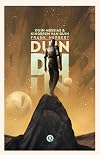
Dune messiah: "A holy war fought in space and on a thousand planets had made Paul Atreides the religious and political leader of the galaxy. The product of generations of controlled breeding, trained in the arcane disciplines by the Bene Gesserit sisterhood, he had more than human powers, including the ability to sense the shape of the future. Then the Bene Gesserit, unable to dominate the man they had made a god, set out to overthrow him. But Paul Atreides could foresee their plans and show more shape them to an unexpected and shocking goal ..."--Jacket Children of Dune: "When Paul Atreides mysteriously vanished, he left only his two young children as heirs to the coveted throne. Fortunately they had been endowed with superior intelligence and the memories of their ancestors, for each day brought them new dangers. When one was abducted, the other was forced to seek sanctuary in the scorching flatlands. There his mind began to swirl with thought-patterns from strange times and places, warning him of the terrifying perils awaiting Dune ... giving him an improbable plan to save it ... and predicting his destiny as ruler of the world. But were these messages real-- or the delusions of a mind deranged by heat, exhaustion and the addictive spice, Melange?"--Jacket show lessTags
Recommendations
















Member Reviews
Dune Messiah:
Paul Atreides' downfall. The Jihad has been conveniently all wrapped up and the bureaucracy is starting it's inevitable creep.
Paul has trapped himself by prescience and knowing the future destroys him.
He gives up, but I can't blame him.
Children of Dune:
Leto and Ghanima are the main characters. Alia takes the predetermined path of the preborn. Leto takes the path of vision instead of prescience and sets up humanity for the Golden Path, whatever that is.
Fantastic! Instead of a simple messianic action story like Dune, we get a full fledged galactic spanning empire intrigue underpinned by arguments of free will and what it means to be human.
There were lots of monologues and dialogues that Herbert threw in that bored me to show more tears, or went completely over my head, or appeared to delve into completely pointless ethereal world views,
BUT, it was great nonetheless! I feel like I can learn a lot of what is going on inside Herberts head, and I always like a psychological twist to my reads. show less
Paul Atreides' downfall. The Jihad has been conveniently all wrapped up and the bureaucracy is starting it's inevitable creep.
Paul has trapped himself by prescience and knowing the future destroys him.
He gives up, but I can't blame him.
Children of Dune:
Leto and Ghanima are the main characters. Alia takes the predetermined path of the preborn. Leto takes the path of vision instead of prescience and sets up humanity for the Golden Path, whatever that is.
Fantastic! Instead of a simple messianic action story like Dune, we get a full fledged galactic spanning empire intrigue underpinned by arguments of free will and what it means to be human.
There were lots of monologues and dialogues that Herbert threw in that bored me to show more tears, or went completely over my head, or appeared to delve into completely pointless ethereal world views,
BUT, it was great nonetheless! I feel like I can learn a lot of what is going on inside Herberts head, and I always like a psychological twist to my reads. show less
Overall a pretty solid arc, with the events in the two books, they can be read as two parts of one story. The movie that combined these two also did a pretty great job in telling the story, I recommend it.
Ratings
Members
- Recently Added By
Author Information

255+ Works 148,065 Members
Frank Herbert was born Franklin Patrick Herbert, Jr. in Tacoma, Washington on October 8, 1920. He worked originally as a journalist, but then turned to science fiction. His Dune series has had a major impact on that genre. Some critics assert that Herbert is responsible for bringing in a new branch of ecological science fiction. He had a personal show more interest in world ecology, and consulted with the governments of Vietnam and Pakistan about ecological issues. The length of some of Herbert's novels also helped make it acceptable for science fiction authors to write longer books. It is clear that, if the reader is engaged by the story---and Herbert certainly has the ability to engage his readers---length is not important. As is usually the case with popular fiction, it comes down to whether or not the reader is entertained, and Herbert is, above all, an entertaining and often compelling writer. His greatest talent is his ability to create new worlds that are plausible to readers, in spite of their alien nature, such as the planet Arrakis in the Dune series. Frank Herbert died of complications from pancreatic cancer on February, 11, 1986, in Madison, Wisconsin. He was 65. (Bowker Author Biography) show less
Series

Belongs to Publisher Series
Work Relationships
Contains
Common Knowledge
- Canonical title
- Dune Messiah / Children of Dune
- Original title
- Dune Messiah & Children of Dune
- People/Characters
- Alia Atreides; Leto Atreides II; Ghanima Atreides
- Important places
- Arrakis; Arrakeen, Arrakis
- First words
- DUNE MESSIAH PROLOGUE:
Dune is the planet Arrakis, an arid world of great deserts where life survives against terrifying odds.
CHILDREN OF DUNE:
A spot of light appeared on the deep red rug which covered the raw rock of the cave floor. - Last words
- (Click to show. Warning: May contain spoilers.)DUNE MESSIAH:
She led him back across the qanat in the darkness at the base of the massif and its Place of Safety.
(Click to show. Warning: May contain spoilers.)CHILDREN OF DUNE:
"One of us had to accept the agony," she said, "and he was always the stronger."
Classifications
Statistics
- Members
- 207
- Popularity
- 157,543
- Reviews
- 2
- Rating
- (4.27)
- Languages
- Bulgarian, Dutch, English, French
- Media
- Paper
- ISBNs
- 3