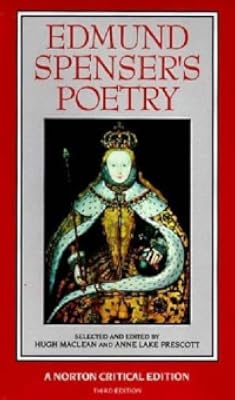
Edmund Spenser's Poetry [Norton Critical Edition]
by Edmund Spenser, Hugh Maclean (Editor)
On This Page
Description
This new edition addresses the shifts in scholarly and critical interests in Spenser studies since 1993 as well as access provided by new technology. Notes reflect the information that Spenser's best readers would have at their fingertips without spoiling the pleasure of reading Spenser for the first time. Mother Hubberds Tale from the 1591 Complaints is newly included. The Ruines of Rome, Spenser's translation of Joachim Du Bellay's Antiquitez, is also added to give readers the chance to show more see Spenser at work as a translator and to give the English perspective on Rome. Sixteen critical essays have been added to supplement fourteen earlier commentaries. Among the perspectives new to the Fourth Edition are those of C.S Lewis, Martha Craig, Gordon Teskey, Jeff Dolven, David Wilson-Okamura, and Jennifer Summit. In keeping with the last edition, critical pieces on the House of Busyrane, Spenser's pastoral, Muiopotmos, and Amoretti are grouped together to facilitate classroom discussion. New selections from Jane Grogan, Andrew D. Hadfield, Colin Burrow, Lynn Staley, Lauren Silberman, and A.E.B. Coldiron join the readings on House of Busyrane, and "Amoretti" grows with selections by A. Leigh DeNeef and Helena Mennie Shire."--Publisher website. show lessTags
Recommendations






















Member Reviews
This book includes The Faerie Queen and a selection of other poetry by Spenser. The brilliance of his verse is on display throughout.
Ratings
Members
- Recently Added By
Lists

Books in the Bibliography of The History of Hell by Alice K. Turner
155 works; 1 member
Author Information

240+ Works 7,134 Members
"The poet's poet"---as Charles Lamb was to call Spenser two centuries later---was born in London, where he attended school before going to Cambridge in 1569. About 1579 he came to know Sir Philip Sidney; his first significant work, The Shepheardes Calendar, published under a pseudonym in 1579 and consisting of 12 "ecologues" (one for each month of show more the year), was dedicated to Sidney. Spenser hoped for advancement at the court of Queen Elizabeth, but in August 1580 he took a minor position in Ireland, where he spent the rest of his life, save for two visits to England. In 1594 he married Elizabeth Boyle, in Cork; the sonnet sequence Amoretti (1595) bears on his courtship, and the great marriage hymn, Epithalamion (1595), celebrates the wedding. The first three books of Spenser's allegorical epic romance,The Faerie Queene, appeared in 1590; three more appeared in 1596. A fragment, the Cantos of Mutabilitie, which may or may not have been intended to form part of the great poem, appeared in 1609, after Spenser's death. Spenser appended a letter to his friend Sir Walter Raleigh to the edition of 1590, explaining that the "general end...of all the book is to fashion a gentleman or noble person in vertuous and gentle discipline." Although Spenser planned to write 12 books in all, only 6, and the two Cantos of Mutabilitie, survive. The rest may possibly have been destroyed by Irish rebels when, in 1598, they sacked Spenser's Irish residence at Kilcolman, but it is equally possible that the poet never managed to bring his massively planned work to completion. Spenser's Amoretti (1595) is one of the more idealized sonnet sequences, and Colin Clout's Come Home Again (1595) is an allegorical attack on the taste of the court. Like many Renaissance authors, his writings extend beyond the narrowly literary; his tract "A View of the Present State of Ireland" (1596) provides a series of brutal recommendations for the colonial suppression of England's Irish territories. Spenser's complex range of styles and genres served as both a model and a challenge for his contemporaries and for later authors. (Bowker Author Biography) show less
Series
Belongs to Publisher Series
Common Knowledge
- Canonical title
- Edmund Spenser's Poetry [Norton Critical Edition]
- Disambiguation notice
- Do Not Combine: This is a "Norton Critical Edition", it is a unique work with significant added material, including essays and background materials. Do not combine with other editions of the work. Please maintain the p... (show all)hrase "Norton Critical Edition" in the Canonical Title and Publisher Series fields.
Classifications
Statistics
- Members
- 640
- Popularity
- 45,569
- Reviews
- 1
- Rating
- (3.93)
- Languages
- English
- Media
- Paper
- ISBNs
- 5
- ASINs
- 4